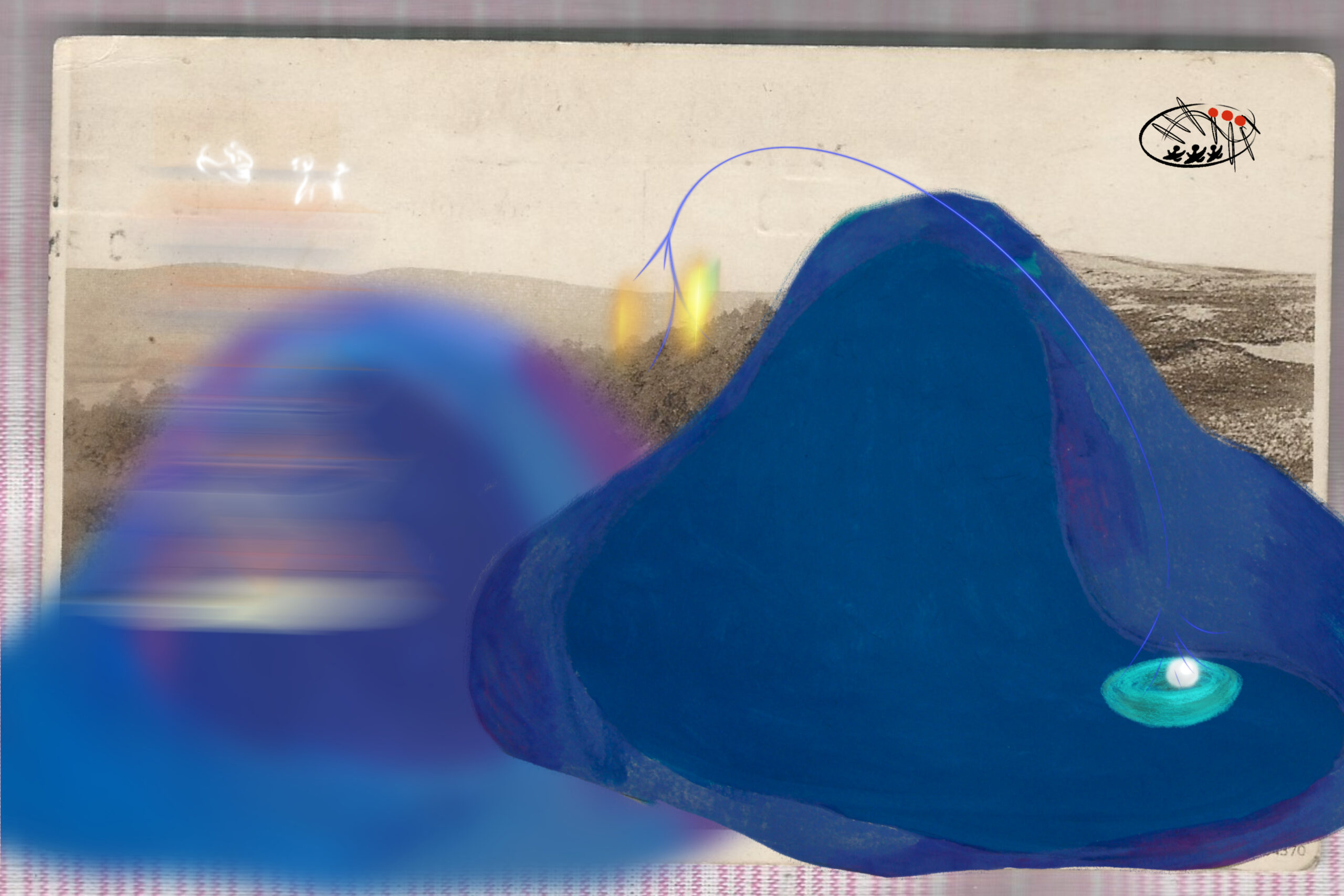
The Mountain That Hid
| November 11, 2025
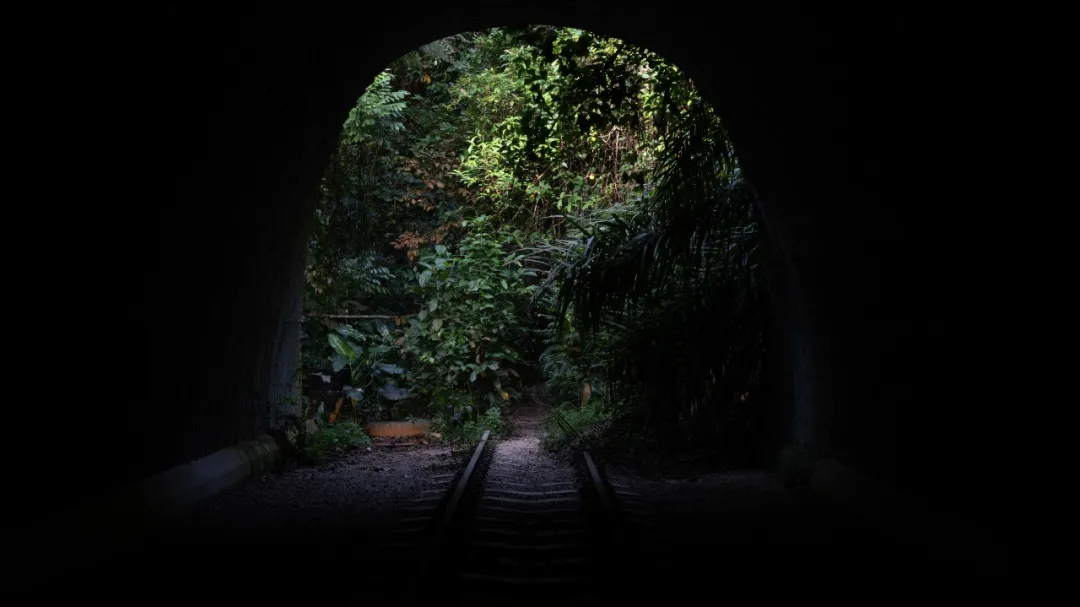
The Mountain That Hid (stills), 2022
Two-channel video, colour, sound, 5 min 56 sec
Colonial-era train tunnel, Singapore.
Courtesy the artist
There was never a photograph of him in our house. Or in those of his other children. There was no mention of him anywhere. I was well into my early 30s when I started to really think about him: my father’s father. And then, as I started to reconnect the dots, I found his grave and a monument built to him—in our ancestral village of Gaoshang in Meixian, Guangdong province, southern China. A three-meter high obelisk marking his martyrdom—for the Chinese Communist Party.
How did he, born in Hong Kong, taken as a baby to British Malaya (present-day Malaysia) where he grew up, lived and worked, end up buried at the foot of a monument in his father’s ancestral village?
In every family, perhaps, there are skeletons in the closet. In ours, there is certainly that, and Granddad’s presence was like a mountain hiding in plain sight. It was there, silently sitting in the family for decades. Like that palm-sized photograph of him that lay in a drawer in the Meixian village house, as if waiting for my eventual visit in January 2011. A relative ran into a room to retrieve it and thrust it into my hand. On scrutiny, I realized it was his prison mug shot from Malaya—the very last photograph of him.
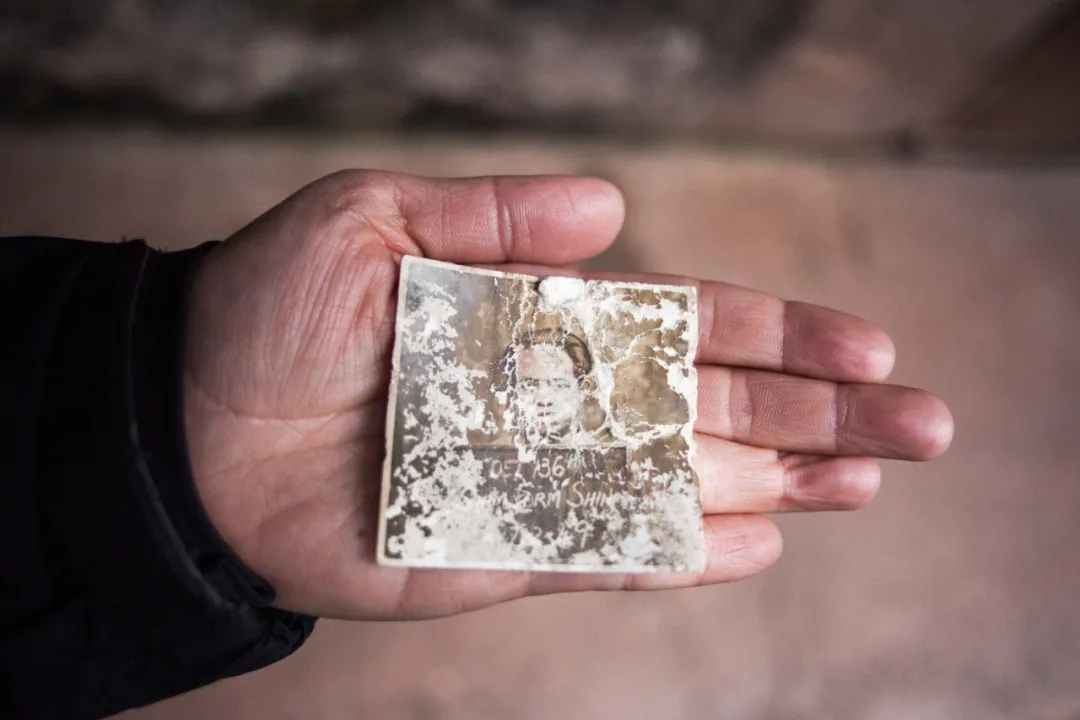
The artist holds and sees at her grandfather’s prison mugshot for the first time, 2 January 2011. She was given this sole item on her visit to her ancestral house.
Shen Huansheng, the artist’s grandfather, was arrested by the British during the crackdown on anti-colonial activism from mid 1948 in the colony of Malaya. This is the last known photograph of Shen, before he was executed in July 1949, shortly after being deported to China.
Photo by Sim Chi Yin
Courtesy the artist
Over the past decade, Granddad and the forgotten anti-colonial war in Malaya[1] has been the centre of my research and art-making, resulting in multiple works. My project, One Day We’ll Understand[2], which also resulted in an art practice-based PhD, uses artistic research and art-making as methods to re-remember and memorialize the Malayan war[3]. I seek to make visible and unmute characters and narratives hidden and silenced in the official archive, to intervene with official historiography and what public memory there is of this war, but also to contribute a different, more liminal, sort of knowledge to historical study. The artistic work, which spans photographic and filmic installation, book-making[4] and performance, can be thought of as multiple modes of archiving and counter-archiving the Malayan war. Then, using methods more speculative and akin to “critical fabulation,” I seek to transcend the archive and conjure memory in a space of imagination and futurity. Reading the colonial archive along and against its grain, I work between and beyond it.
Working through my family history to get to larger questions of memory and historiography, I map the personal onto the geopolitical. During the “Malayan Emergency” (1948–1960), Granddad, an educator and newspaper editor active in the anti-colonial movement, was deported to China by the British alongside 30,000 to 40,000 other leftist Malayans. This mass deportation—very little researched even by academics—led to varying fates for its subjects/victims[5]. In the case of my grandfather, who was among the first batches of deportees, being shipped to China in mid 1949 as that country was in the final months of its civil war, meant an almost certain death. He was executed by Nationalist Kuomintang soldiers in July 1949—as Chinese county archives show—just weeks shy of the Communist victory in China. Granddad, who went on to be memorialised as a Chinese Communist martyr with his own obelisk in our ancestral village, was never spoken about again by his wife, mother and five children left behind in Malaya. This silence—with its implicit trauma—sat for six decades within our family, like in so many others who experienced death or disappearance during the Cold War.
When I made my first visit back to Gaoshang village in early 2011, I learnt of the multiple myths that surround Granddad. I heard how villagers believed that Granddad, as an educated man returned from Nanyang (the Southern Seas—how Southeast Asia was referred to in the past), was the right-hand man of Chin Peng, the leader of the Malayan Communist Party—certainly not true. Another relative took me to a big tree on the hill near our ancestral house and described how the tree once blocked Granddad from being arrested. He also showed me the moss-covered drain behind the ancestral house which was where the family quickly and quietly disposed of all his belongings after the KMT arrested him—saving, apparently, only his Malaya prison mugshot. In the next village over, where Granddad was said to have been arrested by KMT soldiers, the story was that he had come down mountain that day to receive a letter appointing him to the new local CCP government being formed. Stopping there for some wine, he ran into KMT soldiers. Two villagers who claimed they witnessed his arrest as 9-year-old boys peering through a kitchen window said they saw him initially fight off seven soldiers with “kung fu” and then eventually a pistol fell out of his pocket. That proved he was with the communist guerrilla army and the KMT arrested him. After months in detention, Granddad was executed as an injured prisoner of war who could not march on during the KMT’s retreat towards Taiwan. Granddad, the only villager with a martyr’s monument in the area, was shrouded in these stories, orally transmitted. The fact was, he was a political activist in Malaya who had been arrested twice before: by the Japanese during their occupation in the early 1940s and by the British colonial government in mid 1948. But all the villagers and relatives in China knew for sure that his family in Nanyang never came back to visit for over 60 years after his execution.
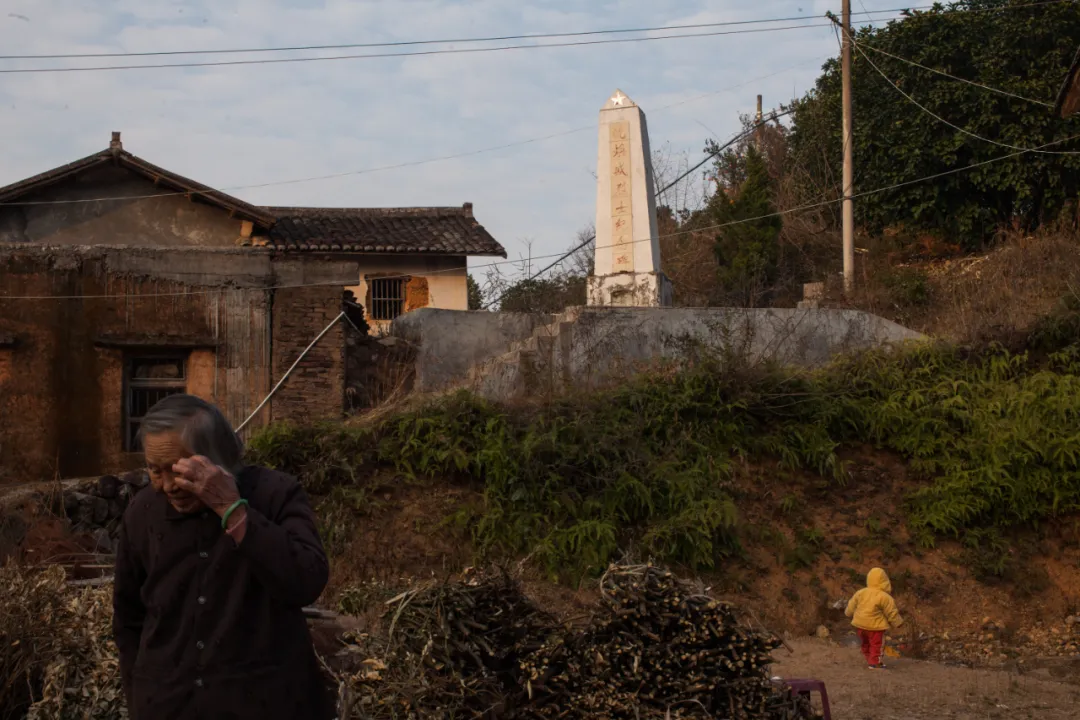
The obelisk of Shen Huansheng, paternal grandfather of the artist, was photographed by her in January 2011 — the first visit by anyone in her family in over 60 years.
Gaoshang village, Taoyao county, Meixian, Guangdong.
Photo by Sim Chi Yin
Courtesy the artist
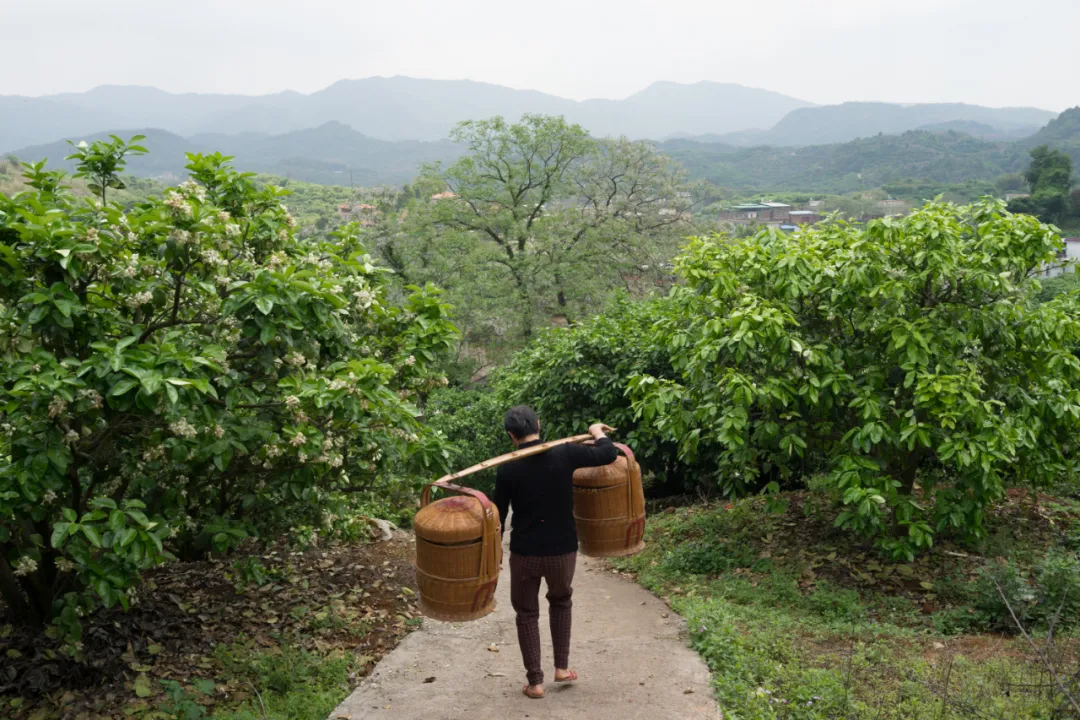
A relative carries a pair of traditional Hakka baskets filled with chicken and other food offerings at Qingming, walking over to the martyr’s monument at the mouth of Gaoshang Village to pay respects to Shen Huansheng, April 2014.
Photo by Sim Chi Yin
Courtesy the artist
I became the first in Granddad’s immediate family to return, also busting the belief within the Sim clan that the fengshui in the ancestral house was bad for us—causing every male descendent who had returned from Nanyang to die there. I convinced my father that I should visit the village, and that as a woman, the fengshui would not affect me. From that initial trip, I was able to convince my father and his four siblings to return to the village and Granddad’s grave with me. They made two emotional visits, in 2011 and 2013, before they themselves got too old to travel.
Between 2011 and 2017, when I was based in Beijing, I visited the village every year, making photographs and videos. The series of short videos of the interior of our ancestral house which I used in my two-channel film installation The Mountain That Hid (2022) is my somewhat romantic gaze at the dilapidated hundred-year-old traditional Hakka courtyard house that my great-grandfather had built and where Granddad returned in mid 1949, only to be executed nearby. Lung-like fibres of an expansive spider’s web undulating in the breeze; smoke rising from an open fire used for cooking in the courtyard; a pig hyperventilating in its pen. On the accompanying screen, a colonial-era train tunnel in Singapore appears like a wormhole, inviting us on a journey through multiple registers of time. It shows a serendipitous six-minute encounter I had there with a group of selfie-snapping mainland Chinese women hikers whose comments and conversation hit uncanny notes at the heart of my practice. The two channels exist in parallel and juxtaposition, as bookends of an unfinished history. Does time unfold in a line or does it loop?
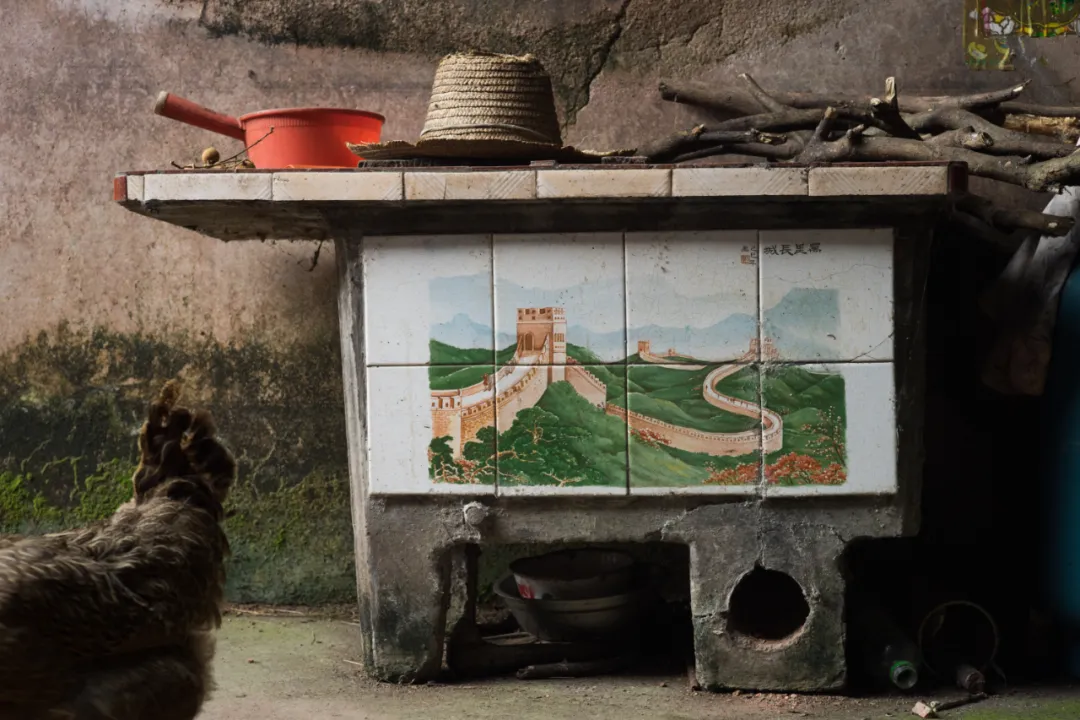
The Mountain That Hid (stills), 2022
Two-channel video, colour, sound, 5 min 56 sec
Interior of the artist’s ancestral house, where her grandfather returned to and was executed near in July 1949.
Courtesy the artist
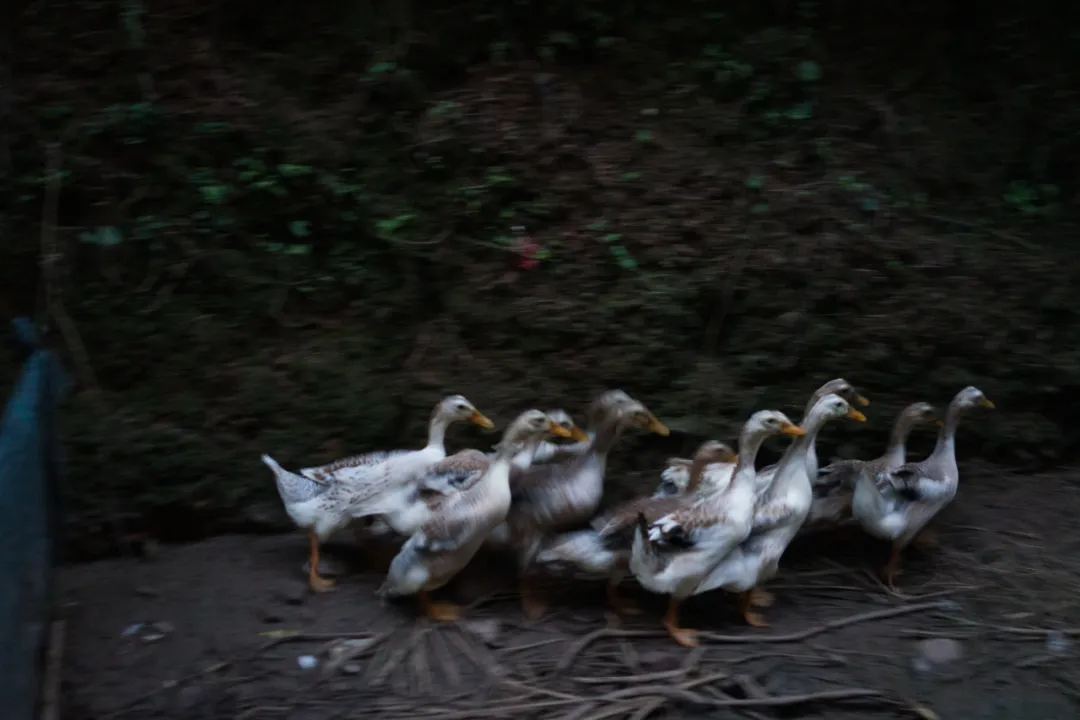
The Mountain That Hid (stills), 2022
Two-channel video, colour, sound, 5 min 56 sec
Courtesy the artist
Granddad floats, apparition-like, into an archive I’ve re-imagined, in The Suitcase Is A Little Bit Rotten[6], a series of glass plates which I have shown installed in a constellation of ten works on an oval-shaped plinth. He appears, hands on hip, camera slung around his neck, as if an observer at the back of a crowd of Malays; he sits on a log watching elephants at work in a timber yard; he stands on the deck of a ship over-looking Hong Kong harbour. After a decade of working with imagery from the colonial archive, I wanted to re-imagine through and out of its gaps and trauma. I attempt to cast a “disobedient gaze”[7] on the colonial archive, to interrupt its transmission of history using speculative methods of re-interpretation and “critical fabulation”[8]—engaging with imagination and its emancipatory potential as a way out of the entrapment of the past. In this series, I reappropriate 19th and 20th century Magic Lantern slides – once used for scientific, colonial or Christian missionary lectures and projections – to conjure an imaginary landscape melding the cosmos and historical Southeast Asia. I remake them as glass plates[9] in which time and space is suspended as I teleport Granddad into the same realm as my toddler son, who inherited his name. In a sort of time travel in the archives, these two characters inhabit a re-imagined Southeast Asia[10]. What, beyond a name, could a child inherit from our pasts? Can we remake the violence and trauma-filled colonial archive before passing it on to the next generation? Does history and time travel in a line or in circles?[11]
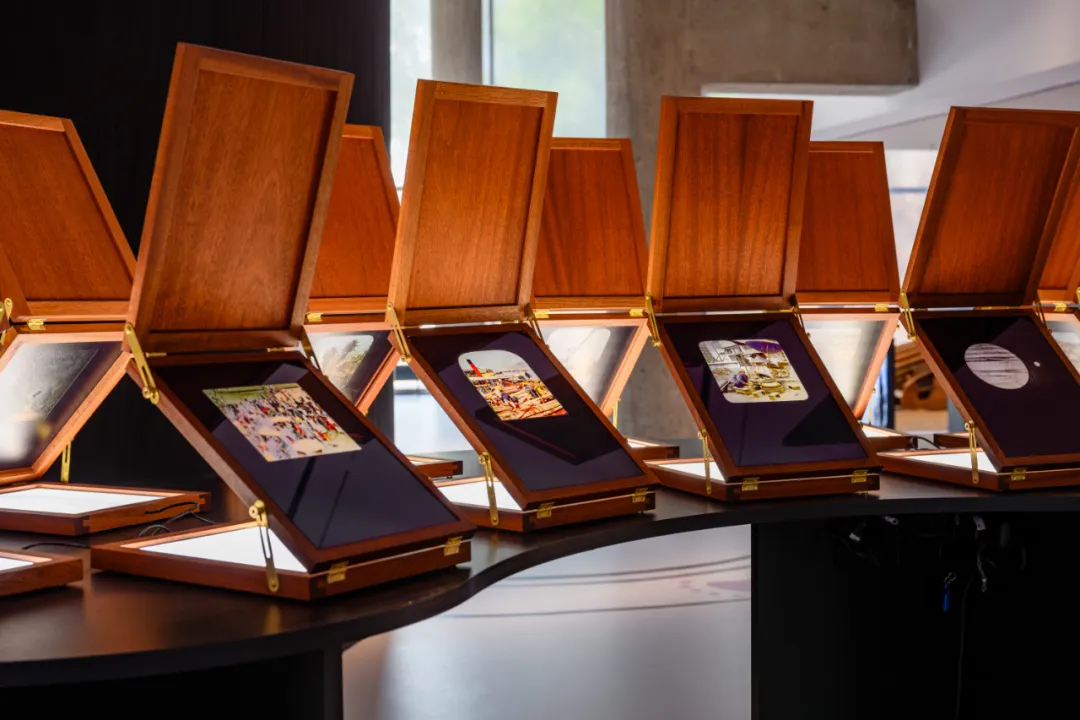
The Suitcase Is A Little Bit Rotten, 2023
Installation view of Forgive Us Our Trespasses, 2024, HKW, Berlin
Photo by Hanna Wiedemann
Courtesy HKW
These two works build on the earlier chapters of the project which leaned more on the evidential, the document. In Remnants (2015-2018) and Requiem (2017), I investigated the traces of the Malayan war in the land, objects and bodies that remained—or went into exile—through making evocative landscape photographs, and a counter-archive comprising still life pictures of left-behind artefacts as well as revolutionary songs the leftist veterans still remember or have forgotten. In Interventions(2018-2020) which followed, I looked at the entire collection of photographs on the Malayan war in the British Imperial War Museum. I then created a new work intervening with them, asking questions of what makes an archive, who is foregrounded or left out, and how all that governs the public memory of a war. Making in-camera collages merging verso and recto of the archival prints, I revealed the indexing within the colonial archive and made new compositions suggesting different—perhaps resistant—readings.[12]
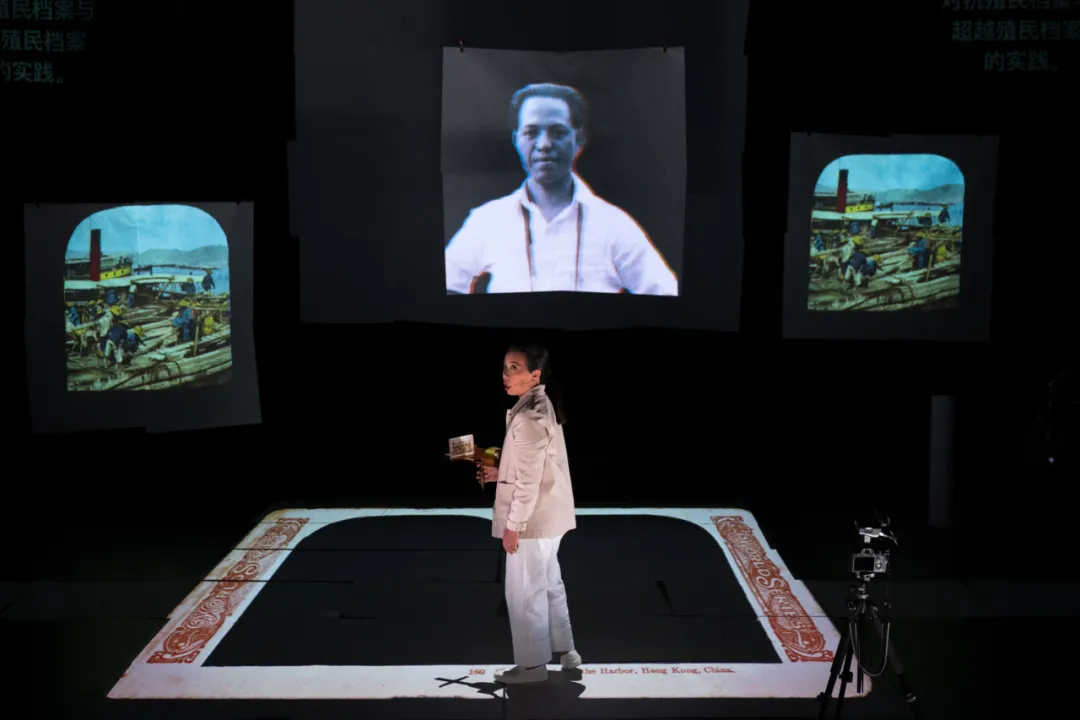
One Day We’ll Understand (Still image)
World premiere at Esplanade Waterfront Theatre Singapore, 30 August 2024
Trailer link: vimeo.com/simchiyin/odwutrailer2024
Photo by Joseph Nair
Courtesy the artist, Esplanade and CultureLink Singapore, ChamberMade.
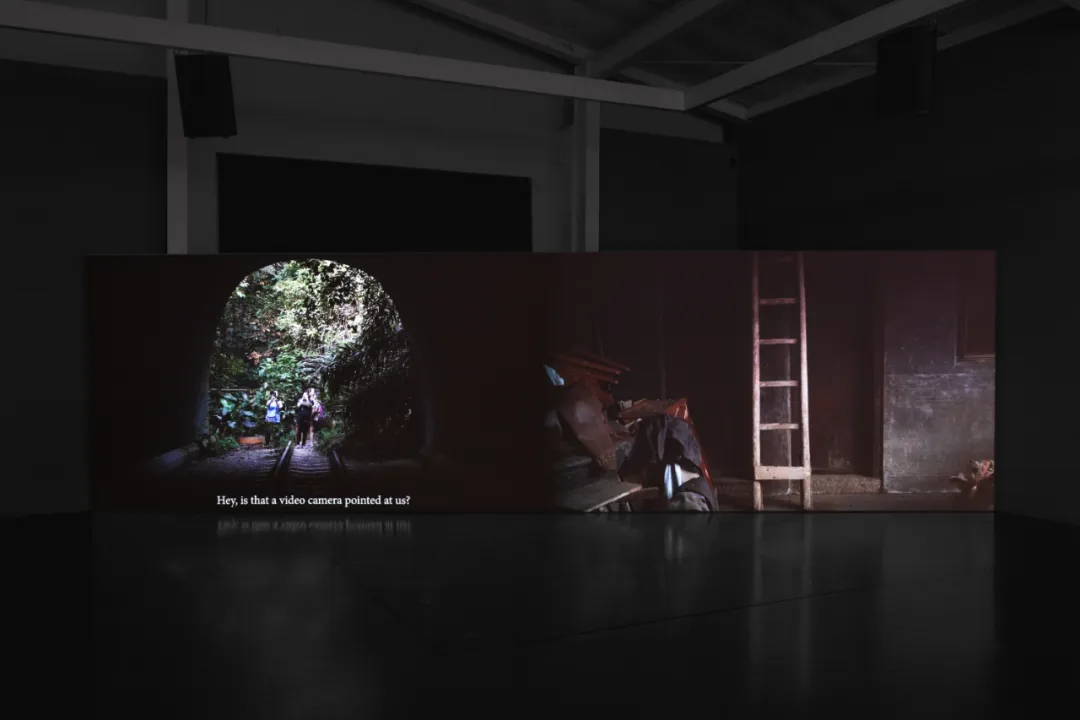
The Mountain That Hid, 2022
Two-channel video, colour, sound, 5 min 56 sec
Installation view of solo exhibition Chronotopia, 2025, Footscray Community Arts, Melbourne
Courtesy the artist
All these threads, documentary and speculative, culminate in a theatre performance I have since developed from the project. An hour-long monologue in which I perform as myself, the narrative shifts modes among my persona: as an artist, a researcher, a granddaughter/daughter/niece and a mother. It brings to the stage my contemplations around the imprints of time and history, and the workings of trans-generational memory and inheritance. The multimedia performance, developed from an earlier lecture performance[13], is anchored by projections of my visual work—there are multiple screens on pulleys and the whole floor is a projection surface too—as well as a sound world created by percussionist Cheryl Ong[14]. In a sort of duet between us, the story unfolds and remains unresolved. The frame of a lightbox is a motif through the piece, as are large sheets of paper—which become projection surfaces, alluding to my work in the archives and my unending search. In the closing scene, I am amid a sea of pieces of white paper laid across the stage. They are at first a projection surface where fragments of all the archives I have looked at as well as created flash across in rapid succession in an almost-algorithmic sequence. Then they go blank and become a pristine, bright canvas, a blank slate. With a marker in hand, I crawl all over the floor and write a seemingly-infinite series of clauses that could follow “one day we’ll understand…”:
“that traces remain in land and bodies
the harms of off-shoring unwanted peoples
that colonial practices continue
that some crimes will never be brought to justice
that memory is slippery and histories are governed
that our past shapes us in ways we acknowledge and not
that heartbreak mingled with anger and fear for the rest of her life
the personal costs of war
that some choose to remain silent
that there are pieces of the past we will never know
that things are not black or white
that there are presences we cannot see or speak about
that choices come with consequences
that things come around…”[15]
The lights go out.
Notes
[1] The 12-year “Malayan Emergency” (1948-1960) in which the British quashed a Communist-led insurgency in its colony of Malaya—present-day Malaysia and Singapore—has had an outsized importance in the history of warfare, its influences reverberating till today. Britain’s counter-insurgency strategies in Malaya, including defoliant use, forced relocation of rural populations, mass arrests and deportation, and the zoning of “Black” and “White” areas, have been written into western military manuals and gone on to influence the campaigns in Vietnam, Iraq, Afghanistan and even Gaza, scholars note. See, for instance, Laleh Khalili, Time In The Shadows: Confinement in Counter-insurgencies, Stanford: Stanford University Press, 2013. Also Caroline Elkins, Legacy of Violence: A History of the British Empire, New York: Alfred A. Knopf, 2022, especially p. 24-30, in which she charts how the “logics of violence”, “legal codes” and “time-honed [intelligence] techniques circulated across different parts of the empire through the movement of people, top colonial administrators as well as low-level police officers, from “South Africa to India, Palestine to Bengal, Ireland to Cyprus and so forth.” She writes: “…the movement of people, ideas, practices, and legal systems around Britain’s empire conjures the silks of a spider’s web whose final massive form can be discerned only by stepping back to take in its entirety.” Henry Gurney, high commissioner in Malaya from October 1948 to October 1951, had an instrumental role in Palestine before serving in Malaya where he was assassinated by Communist insurgents. Gerald Templer, who followed him in the role of British High Commissioner in Malaya in January 1952, had also served in Palestine as well as the two World Wars.
David A. Charters also writes of how counter-insurgency intelligence practices were passed on from one colonial war to the next by British officers, with lessons learnt from the campaign in Palestine shaping the “Malaya model,” which in turn garnered “articles of faith in army counter-insurgency doctrine” that informed the repression of the Mau Mau in Kenya and beyond. See Charters, “The Development of British Counter-Insurgency Intelligence”, Journal of Conflict Studies, Volume 29, Spring 2009, p 60, 61.
[2] The line comes from the epitaph on the gravestone of a Scottish plantation owner in Perak, northern Malaya, killed by the Communists in December 1950. It lies in a graveyard known as “God’s Little Acre”, in Batu Gajah, Perak. I use it as the title of my project for the multiple meanings it encompasses. Is it an affirmative statement? A tentative proposition? A probing question? Or an expectant aspiration or a wistful hope?
[3] Sim Chi Yin, Traces, spectres and speculation: Art and conjuring post-colonial memory, the “Malayan Emergency” (1948-1960) as case study, PhD thesis, War Studies, King’s College London, 1 Jan 2025.
[4] I am making four books from this project, the first of which was published in 2021. She Never Rode That Trishaw Again, focuses on the life of my grandmother after Granddad was deported and executed for his politics. The book uses her vacation snapshots and postcards to narrate through the life-long trauma she lived with, from his death and the silence she had to observe and impose around him hence. For more, see https://www.printedmatter.org/catalog/62922. The book is also the subject of an installation at Zilberman Gallery Berlin, Swaying The Current, https://www.zilbermangallery.com/swaying-the-current-en-e385.html , accessed 4 Feb 2025.
[5] Some went on to be persecuted during the Cultural Revolution in 1960s China; others led comfortable lives in the China and Hong Kong working in local government; and yet others suffered as labourers in “overseas Chinese villages” in southern China. As part of my research, between 2015 and 2019, I did oral history interviews with 40 former Malayan anti-colonial fighters and activists who were deported or exiled, now spread out over Guangdong and Fujian provinces in southern China, Hong Kong, southern Thailand, Malaysia and Singapore.
[6] The title came from a line that my toddler son uttered at age 2 1/2, conflating some ideas, but delivering a strangely poetic line which suggests the idea of travel but also hints that something is off about the journey.
[7] This is a term coined by art historian Gabrielle Moser, who describes it as a “resistant method of historiography”, “a mode of looking that refuses the readings imposed on photographs by the colonial state”. Gabrielle Moser, Projecting Citizenship: Photography and Belonging in the British Empire, Pennsylvania: Penn State University Press, 2019, p. 2.
[8] Coined by literary scholar Saidiya Hartman, this method is a critical and empathetic reading of the archive “against the grain” that amounts to what she describes as “a combination of foraging and disfiguration”, as “troubling the line between history and imagination”. Saidiya Hartman, Scenes of Subjection: Terror, Slavery, and Self-making in Nineteenth-Century America, Oxford University Press, 2017, W. W. Norton and Company, 2022. See also Hartman, “Venus In Two Acts”. The concept is not uncontroversial, particularly among historians—Nell Painter, eminent US historian who also practises as an artist has voiced questions about the method alongside what Black feminist scholar Christina Sharpe has termed “wake work”, as a “resurrection” of neglected histories. I have considered these and in my art-making thus far engage with speculative, fabulist methods only in relation to my own family history as well as towards the future, and not the past or with other people’s oral histories and historical material.
[9] These are displayed on replicas of vintage glass negative retouching stands, which date also to the earlier 1900s. In using these and Magic Lantern slides, I perform a sort of double re-appropriation of colonial photographic apparatus to re-narrate the anti-colonial war.
[10] I discuss the idea of time traveling in the archives on this panel at Art Basel Hong Kong, 23 March 2023, “Time Travelers: When Artists Remix the Past to Reframe the Present”, artists (from left) Mónica de Miranda, Sim Chi Yin, artist-moderator Ho Tzu Nyen and artist Kenneth Tam: https://www.artbasel.com/stories/time-travelers-when-artists-remix-the-past-to-reframe-the-present, accessed 3 Feb 2025.
[11] The writer Ocean Vuong writes: “Some people say history moves in a spiral, not the line we have come to expect. We travel through time in a circular trajectory, our distance increasing from an epicentre only to return again, one circle removed.” Vuong, On Earth We’re Briefly Gorgeous, New York: Penguin Press, 2019, p. 27.
[12] For more on these earlier chapters of the work, see the catalogue by Lotte Laub, et al, Sim Chi Yin, One Day We’ll Understand, Berlin: Zilberman Gallery, 2021, https://www.zilbermangallery.com/images/publications/2046550472808769422.pdf , accessed 3 Feb 2025.
[13] Methods of Memory: Time Travels in the Archives, at Asia Art Archive in America, New York, 2 December 2022 : https://www.aaa-a.org/programs/sim-chi-yin-methods-of-memory-time-travels-in-the-archives, accessed 4 Feb 2025.
[14] Shawn Hoo, “Theatre review: Artist Sim Chi Yin’s miraculous counter-archive is brought to life”, The Straits Times, 1 Sept 2024, https://www.straitstimes.com/life/arts/theatre-review-artist-sim-chi-yin-s-miraculous-counter-archive-is-brought-to-life , accessed 4 Feb 2025.
[15] Sim Chi Yin, One Day We’ll Understand, script for theatre performance, 2024.
Text by Sim Chi Yin
Sim Chi Yin is an artist from Singapore whose research-based practice uses artistic and archival interventions to contest and complicate historiographies and colonial narratives. She works across photography, film, installation, performance, and book-making. She was an artist fellow in the Whitney Museum’s Independent Study Program (2022–2023) and holds a PhD in War Studies from King’s College London. Sim is based in Berlin.