Navigating through Loss at Sea—Beyond the Screens of Isaac Julien, Steve McQueen, Séverine Sajous and Anna Surinyach
| March 12, 2026
Text by Sara Quattrocchi Febles

Steve McQueen, Ashes (still), 2002–2015, Super 8 and 16mm color film transferred to HD, sound, posters, 20 min 31 sec
© Steve McQueen.
Courtesy Thomas Dane Gallery, Marian Goodman Gallery, and the artist
In a photograph taken ten years ago, a child lies face down on the shore of a beach, his head turned towards the waves, his hands facing upwards. If it wasn’t for the damp red t-shirt and blue shorts that he wears, one could think that he was asleep. The child in the photograph is three-year-old Aylan Kurdi, a Syrian boy who embarked on the short but dangerous journey on a boat across the Aegean Sea from Turkey to Greece with 22 other refugees seeking asylum in Europe. When Turkish photojournalist Nilüfer Demir found Aylan lying on the Turkish beach near the resort town of Bodrum, he was already dead, having washed ashore after drowning—with eleven other people, including four other children—as a result of the boat capsizing during the precarious journey.
Aylan’s photograph flooded news outlets and social media platforms all over the world, becoming a symbol of the European migrant crisis in 2015. The image humanised the crisis, producing a visceral effect within anyone who came across it, breaking through the sterilized and detached statistics accounting those risking their lives to seek a better life in Europe. Yet, Aylan’s image is frozen within the rectangular frame of the photograph, only a glimpse of his story told through the symbolic power the photograph itself gained. The still doesn’t reveal how Aylan embarked on the journey to Greece with his mother Rehan, his father Abdullah, and his five-year-old brother Galip to flee from the war in Syria with the intention of ultimately reaching Canada, where they had relatives. The image doesn’t reveal the sea’s unruly and uncontrollable role in the tragedy, only captured through a blurred and tranquil wave in the background.
They say a picture speaks more than a thousand words, but sometimes it falls short in painting the full story, especially in relation to the ocean’s vast, volatile, untameable, and constantly moving presence. For four artists—Séverine Sajous, Anna Surinyach, Steve McQueen, and Isaac Julien, moving image becomes the tool to document loss in relation to the sea, capturing the complex narratives that exist beyond its uncontrollable nature. In three of their respective works—#boza (2020), Ashes (2002–2015), and Ten Thousand Waves (2010)—each artist takes and transforms the medium of the two-dimensional screen into multi-dimensional experiences to document fragile human experiences at sea, looking beyond the static symbolic power of an iconic photograph.
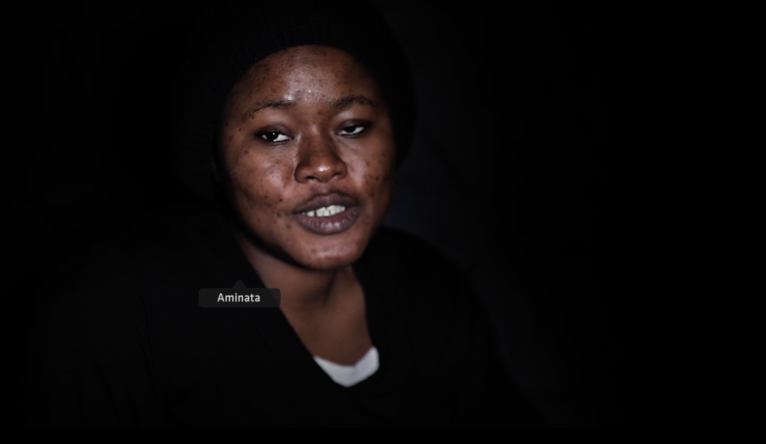
Anna Surinyach & Séverine Sajous, #boza (still), 2020, documentary film, 17 minutes
© Anna Surinyach & Séverine Sajous
Courtesy the artists
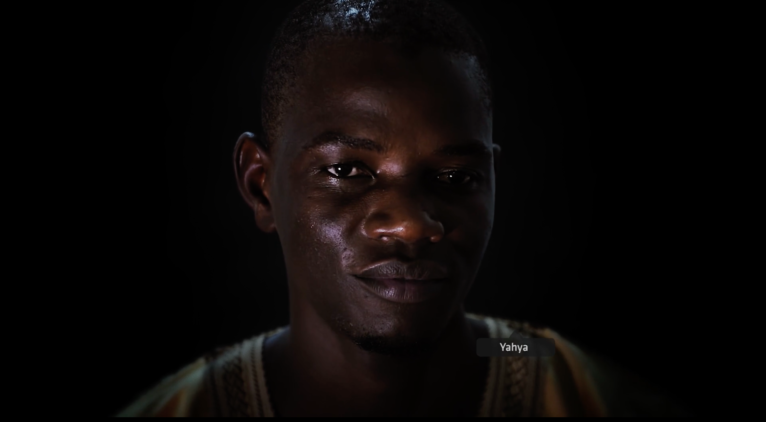
Anna Surinyach & Séverine Sajous, #boza (still), 2020, documentary film, 17 minutes
© Anna Surinyach & Séverine Sajous
Courtesy the artists
When creating #boza—a short film about people on the move from the African continent to Europe—French photographer Séverine Sajous and Spanish photographer Anna Surinyach had a different approach to contrast the narratives often portrayed of those arriving at sea, detaching from the sterilized news narratives and statistics by bringing in the first person narratives of five individuals—Alhassane, Aminata, Mamadou, Mariam and Yahya—to tell their individuals journeys of crossing the Mediterranean Sea.
“Of course I’m a migrant, but I don’t identify myself with the pictures in the press,” says Aminata, a young Guinean woman who crossed the border and traveled to Europe via sea, ultimately arriving in France. She says this directly to the camera in French, in a medium close-up shot against a black backdrop that absorbs her surroundings completely. The pictures she does identify with are the ones she takes of herself: selfies taken alone using filters posted on her Instagram, selfies smiling with friends using a selfie stick, vertical reels of her happily singing along to songs in the shotgun seat of a car. These selfies and reels are superimposed over her direct testimony to the camera about why she left Guinea. “I couldn’t see my friends and my husband raped me,” she says. “He’s old and I was a hundred percent sure he’d end up killing me because he told me so.” The slideshow of happy and serene images with her friends creates a rupturing disconnect from what she’s saying, bringing into question that there might be more than meets the eye in a photograph, and definitely more to someone’s life. In the essay “A Thing Like You and Me”(2010), artist, writer, and filmmaker Hito Steyerl argues that the image “doesn’t represent reality. It is a fragment of the real world. It is a thing just like any other—a thing like you and me.” Each of Aminata’s photographs are standalone objects that only represent a fragment of her life and reality, unable to reveal the full picture of her life experiences. By bringing in Aminata’s voice over the images, Sajous and Surinyach give her the agency to contextualize them within her life story that led her to choose to migrate to Europe by sea.
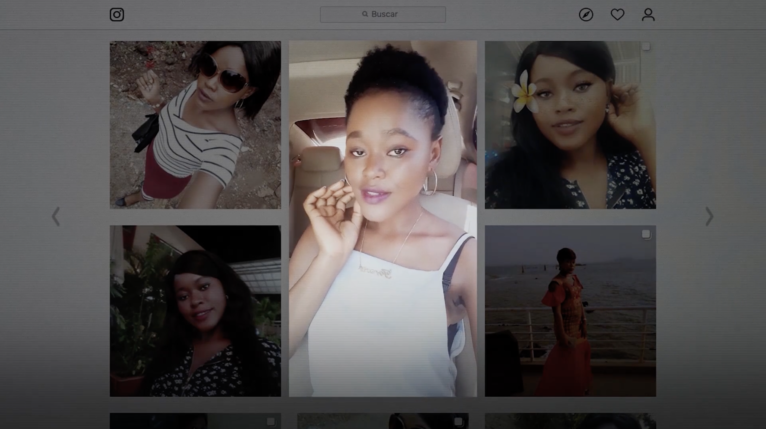
Anna Surinyach & Séverine Sajous, #boza (still), 2020, documentary film, 17 minutes
© Anna Surinyach & Séverine Sajous
Courtesy the artists
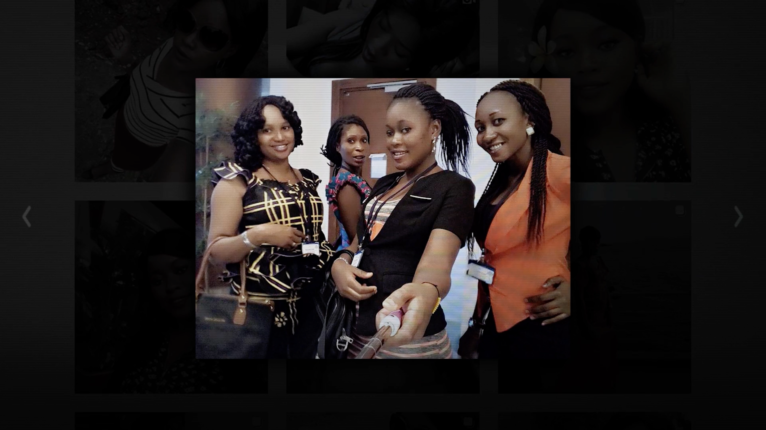
Anna Surinyach & Séverine Sajous, #boza (still), 2020, documentary film, 17 minutes
© Anna Surinyach & Séverine Sajous
Courtesy the artists
Alhassane, Mamadou, Mariam, and Yahya are also captured through their direct testimonies in #boza besides Aminata, each revealing different experiences and reasons as to why they decided to leave their home countries and emigrate to Europe. Sajous and Surinyach portray their complete journeys, from before, in the African continent, to after, when they arrive in Europe. Yet, the film ends with the during, capturing the tumultuous journey of crossing the sea to reach Europe. Some clips are pixelated, blurry, and shaky, taken on a crowded boat with the sound of cackling wind and with voices shouting “boza”—a word of hope that signifies the act of successfully crossing the particular border between Africa and Europe across the Mediterranean Sea. In other clips, the camera seems to be submerged underwater, the screen dominated by violent waves and bubbling water. The blurry water is murky and green, nothing like the turquoise and crystalline water one might envision the Mediterranean Sea to be.
“Everyone talks about the people that arrive, but not about the lives that remain in the sea,” a voice says over the unruly, murky liquid. “Are there investigations to recover the bodies missing in the Mediterranean?” A vertical video of a mother laughing with a baby with a filter of flower crowns on top of their heads, a photograph of a young boy posing with his arms crossed to the camera, and a selfie of a smiling couple—Meite Metioule and his fiance—are alternated between clips of the unruly sea, with the voices of their loved ones placed over them. “I am looking for my wife and daughter,” a man’s voice says over the video of the mother and baby. In a New Yorker article published in January 2023 “The Crisis of Missing Migrants,” journalist Alexis Okeowo writes, “The relatives of those who go missing are often left with only social-media posts from their loved ones and unfinished text conversations.” #boza ends with the last WhatsApp audio Meite sent to his partner, over a stuttering video of the ocean’s horizon line, with waves splashing and with large ships in the distance. “We will get over this. Stay strong, don’t lose faith. It will all be ok, Inshallah!” By piecing together first-hand videos, photographs, audios, and testimonies of the people who have risked their lives to cross the Mediterranean Sea, #boza becomes a collective and collaborative video collage where each individual is an agent over their own story. Rather than take control over and direct each person’s narrative, Sajous and Surinyach act as facilitators in giving each individual control over the story they want to present, beyond the narrative that might be projected onto them in the news.
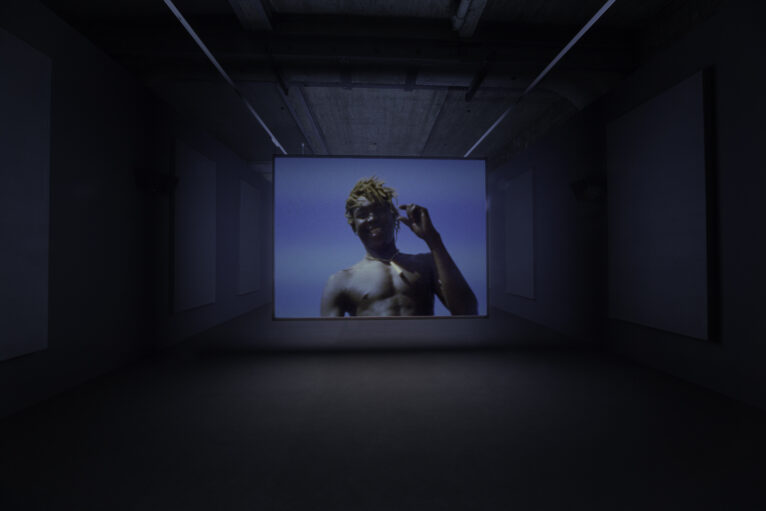
Steve McQueen, Ashes, 2002–2015, Super 8 and 16mm color film transferred to HD, sound, posters, 20 min 31 sec
View of “Steve McQueen: Ashes,” Thomas Dane Gallery, London, 2014
Photo: Richard Ivey
© Steve McQueen. Courtesy Thomas Dane Gallery, Marian Goodman Gallery, and the artist
In British film director and video artist Steve McQueen’s video installation Ashes, the experience of watching the story of a young Caribbean fisherman called Ashes emerges beyond the two-dimensional screen and into the three-dimensional world through a two-sided freestanding screen. On one side, the young man balances himself playfully on a pitching boat against a vibrant blue sky and the glistening Caribbean Sea. Shot by Dutch cinematographer Robby Müller through a grainy Super 8 film camera, Ashes is seen interacting with the boat and the sea. McQueen had organised for Müller to film the footage, initially planned for his film Carib’s Leap (2002). Müller transforms Ashes in his muse as he sits on the prow of the boat with his legs dangling while facing the open water, or standing and facing back. At certain points, Ashes looks directly at the camera, mouthing words and laughing. Müller captures him intimately, closing in on his face and showing him at ease with the sea and its waves against the rocking of the boat. As the pitching boat gently rocks against the waves of the ocean, so does Müller’s handheld camera. Even when he loses balance and falls from the boat, Ashes is filmed at peace in his natural element, enjoying the sun and the idyllic sea. We can almost picture ourselves sitting in the pitching boat in the middle of the Caribbean, calmly swaying with him and the soothing sound of the waves, if it wasn’t for the mix of other noises engulfing the dark room, clanging metal and scraping, and at a certain point, a voice with a heavy Caribbean accent starting to speak.

Steve McQueen, Ashes (still), 2002–2015, Super 8 and 16mm color film transferred to HD, sound, posters, 20 min 31 sec
© Steve McQueen. Courtesy Thomas Dane Gallery, Marian Goodman Gallery, and the artist
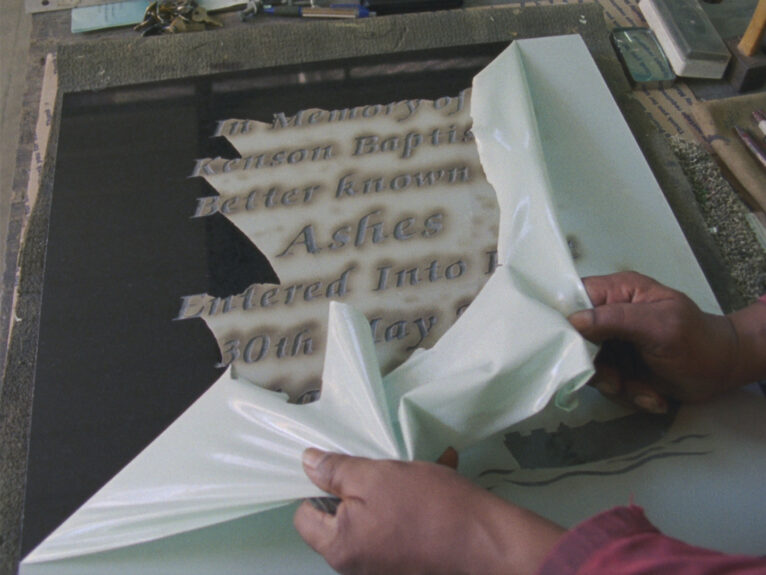
Steve McQueen, Ashes (still), 2002–2015, Super 8 and 16mm color film transferred to HD, sound, posters, 20 min 31 sec
© Steve McQueen. Courtesy Thomas Dane Gallery, Marian Goodman Gallery, and the artist
“I know Ashes as a friend. All of us were young, man. We grew up in one neighborhood,” says the voice. “All of us dive together. Going fishing, diving, you know, everything.” We don’t see the friend giving the testimony, a voice engulfing the space. The voice describes his own relationship with Ashes, giving his own testimony of Ashes’s life. “But with this thing with the drugs thing there, I don’t know where he found the drugs. I don’t know.” The voice recounts how Ashes died, killed by drug dealers, only two months after McQueen had met him on the island of Grenada—the birthplace of McQueen’s parents—in 2002 while filming Caribs’ Leap.
The other side of the screen was filmed more than ten years later, when McQueen revisited Grenada and asked about Ashes. When McQueen found out that he had been buried in an unmarked grave, he arranged for a new tombstone to be made and filmed the process on 16mm film. McQueen films the complete process of building the tombstone, from close-ups of hands carving out Ashes’s name on the tombstone and feet patting down the soil on the grave to the pouring and sanding of cement to give shape to the tomb in the graveyard. With the sound of materials mixing and metal tools banging against cement, step by step, McQueen highlights the manual and arduous task that is building the grave in a detached documentary style, similar to programs about processes that one might watch on the Discovery Channel.
While the tombstone is being engraved and completed, Ashes continues smiling and swaying along the turquoise Caribbean Sea on the other side; it becomes apparent that the video is on loop. Ashes’s video takes on a new role and is transformed, no longer just a video of a young man basking in the idyllic sea and sun, but rather a memorial in constant motion.
Yet, it is in the brief seconds when one oscillates between one side of the screen to the other in the dark room of the installation that one not only grieves Ashes’s life but is in the liminal space between life and death. The division of the screen means that they can never be experienced simultaneously, only shared by the same soundtrack. In the 2023 essay “Split Screens and Partitioned Publics,” theorist David Joselit writes how both the internal divisions within video content and external divisions between monitors are “generative rather than restrictive” and how the split or the division “is a navigable space of interchange rather than a void or vacuum into which dialogue disappears.” The story of Ashes emerges in the space surrounding the double-sided screen, where the past and present are placed in dialogue in the few seconds in between.
If one crosses the Atlantic Ocean from Ashes’s Caribbean island of Grenada all the way to Ireland and the United Kingdom into the Irish Sea, one might arrive at Morecambe Bay on the coast of northwest England. In 2004, Morecambe Bay became the site of a tragedy where 23 Chinese cockle-pickers drowned due to the incoming tide. The pickers, mainly from Fujian, had been trafficked and exploited to work for cheap labor, inexperienced and unfamiliar with the North England waters. “I felt very moved by the tragedy because they had come from such a far distance to meet this kind of horrid end,” says British installation artist and filmmaker Isaac Julien in a 2013 interview with MoMA in New York. “I thought it’d be very interesting to try to view this tragedy not from the current European point of view but from a Chinese point of view.” In the nine-screen video installation Ten Thousand Waves, Julien interweaves China’s contemporary culture with its ancient myths, embarking on a journey across 400 years of history—from the Ming Dynasty to 1930s Shanghai up until modern day China—to reflect on the tragedy beyond the confines of time and borders.
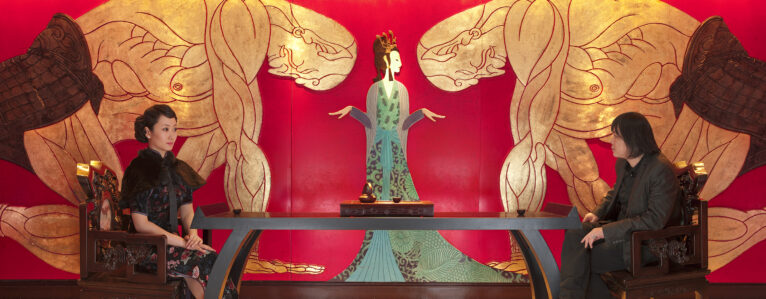
Isaac Julien, Red Chamber Dream (Ten Thousand Waves), 2010, Endura Ultra photograph, diptych, 180 × 230 × 7.5 cm each
© Isaac Julien.
Courtesy Galerie Ron Mandos and the artist
In one scene, Julien includes a reenactment of Wu Yonggang’s 1934 Chinese silent film The Goddess (神女), where contemporary Chinese actress Zhao Tao takes on the role of the protagonist—a mother who turns to prostitution to raise her child—sat at the end of a long table watching as a man (potentially, the Boss) drinks on the other side with a bright red background where two large golden men bow to a woman with a crown, potentially the goddess Mazu, shot in different angles and close-ups. At the same time, other screens play archival footage of street scenes from Republican-era Shanghai and mass rallies during the Great Leap Forward. Julien places archive and reenactment side by side across the nine hanging screens, blurring the lines between fact and fiction. The archival footage and reenactment almost overlap not only through their dominating bright red colors, but also as they both capture individuals seeking change, either through the revolutionary collective or through individual action. At first glance, they might seem distant from the story of the cockle-pickers, but just like the Chinese communists and “the goddess,” they were also seeking radical change.
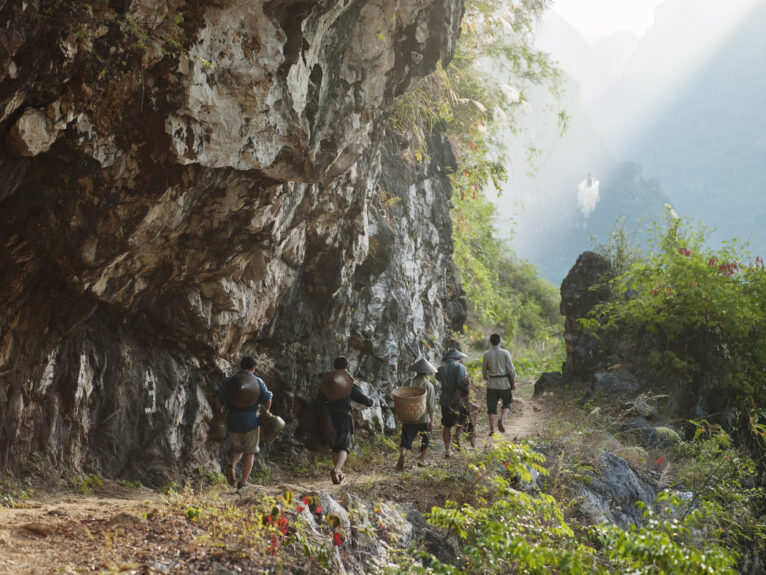
Isaac Julien, Yishan Island, Long March (Ten Thousand Waves), 2010, Endura Ultra photograph, 180 × 240 cm
© Isaac Julien.
Courtesy Galerie Ron Mandos and the artist

Isaac Julien, Maiden of Silence (Ten Thousand Waves), 2010, Endura Ultra photograph, 180 × 240 × 7.5 cm
© Isaac Julien.
Courtesy Galerie Ron Mandos and the artist
In another scene, Julien recreates the “Tale of Yishan Island”: a 16th century myth originating from Fujian—the same province as the cockle-pickers—about fishermen lost at sea protected and guided to safety by the sea goddess Mazu. Julien captures the fishermen through a dreamlike past, walking along the vast natural landscapes of Guangxi province with its unique limestone karst mountains, led by Mazu (played by Maggie Cheung), who floats above in long white ethereal-looking robes. Throughout the film, she’s the underlying presence, appearing and disappearing not only throughout the journey of the fishermen, but also in videos of present-day China, among Shanghai’s skyscrapers and highly trafficked roads. From the present day to the past and across borders and confines, the multi-screen film becomes a journey across time and space where Mazu is the connecting thread, the guide who brings the lost souls of the cockle-pickers back to China from the United Kingdom, linked back through culture, history, and myth.
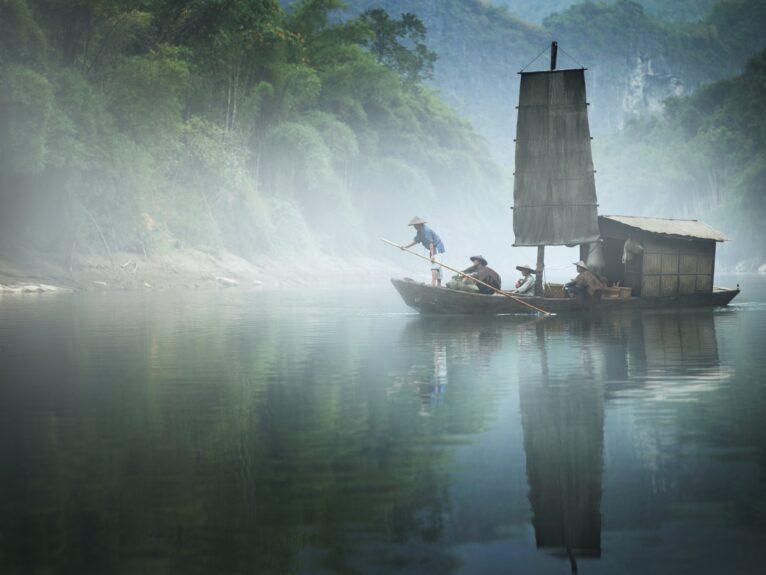
Isaac Julien, Yishan Island, Voyage (Ten Thousand Waves), 2010, Endura Ultra photograph, 120 × 160 cm
© Isaac Julien.
Courtesy Galerie Ron Mandos and the artist
The cockle-pickers are directly referenced in Ten Thousand Waves through scenes of surveillance footage shot from a helicopter on Morecambe Bay in a mission to search for survivors, supported by an audio extract of a desperate communication between the coast guard and a witness of the tragedy. Shot at night from a bird’s-eye view of the bay, it becomes difficult to discern or find any survivors, the viewer becoming participant in the distressing and futile search action. The inclusion of this surveillance footage becomes a rupturing scene in the structure of Ten Thousand Waves, breaking from the linear narrative through China’s history from past to present where the cockle-pickers only appear figuratively through historical or cultural allusions. By including this rupture, Julien brings the viewer back to the present reality beyond the fictional reenactments and mythical representations experienced through the all-encompassing and multi-dimensional nine screens.
In Samuel R. Delany’s introduction text for MoMA’s 1995 exhibition “Video Spaces,” he discusses how with video, the picture frame no longer acts “as a view through a window to the outdoors” like with a painting, but rather with video art specifically, “that window comes away from the wall, to stand free within an architectural space,” and “when the image leaves the screen to become dispersed in the air, the framing question is again reconfigured.” In Julien’s Ten Thousand Waves, the way the nine screens overlap and are layered—which changes every time they are installed in a new space—allows each viewer to have a completely different viewing experience, framing new narratives surrounding the Morecambe Bay cockle-pickers. The arrangement of the screens reflect the complex network of meanings and narratives in their story, revealing how their life story is not made up solely by the tragic account of how their life ended but rather by the multiplicity of stories and narratives that span across centuries through collective memories and myths.
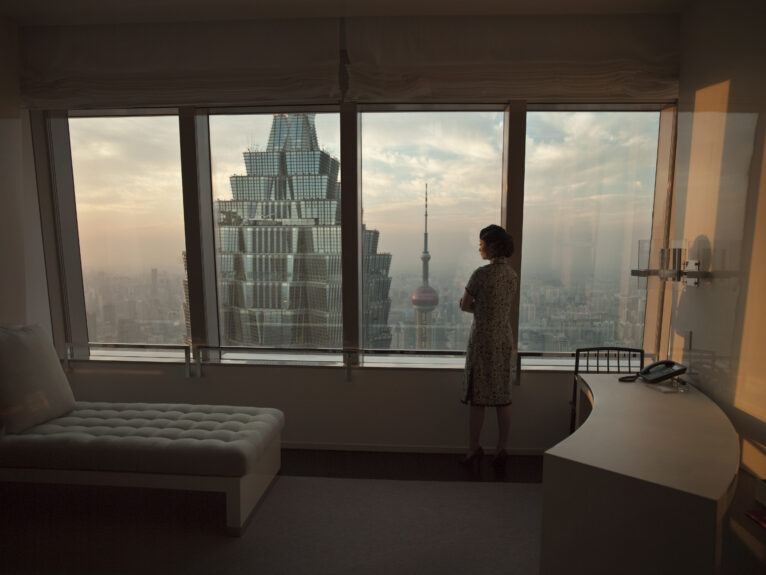
Isaac Julien, Hotel (Ten Thousand Waves), 2010, Endura Ultra photograph, diptych, 180 × 239.8 × 7.5 cm
© Isaac Julien. Courtesy Galerie Ron Mandos and the artist
All four artists—Severine Sajous, Anna Surinyach, Steve McQueen, and Isaac Julien—explore real-life stories relating to the unknown and unruly sea, yet they do not remain within the confines of portraying each story through a singular tragic narrative. The sea becomes the starting point from which to tell the stories of each individual they meet and portray in a multi-faceted and complex way, be it in the Mediterranean, the Caribbean, or the Irish Sea. Through #boza, Ashes, and Ten Thousand Waves, each artist reveals that far from being reducible to a singular, fixed image—like a photograph capturing a mere instant, our life experiences often emerge beyond life itself, layered, uncertain, and shaped by factors beyond our control. The ocean, with its unruly currents, uncontrollable power, and vast, unknown depths, serves as a poignant metaphor for the forces—social, historical, environmental, or psychological—that constantly mold and redefine who we are and what our lives become. Just as the deep sea conceals more than it reveals on the surface, the artists’ works suggest that the true substance of life is found in its complexities, its unknowns, and its constant, restless motion.
Sara Quattrocchi Febles is a Spanish-Italian journalist and a history of art graduate from the Courtauld in London. In 2021, she was awarded the Michael O’Pray Prize for new writing on innovation and experimentation in the moving image. She has lived in Tokyo, Rome, Guangzhou, Shanghai, and London, and is currently in Madrid doing a master’s in journalism at El País.