Endless Return under the Monsoon
| June 11, 2026
Text by Tan Sin Thiau
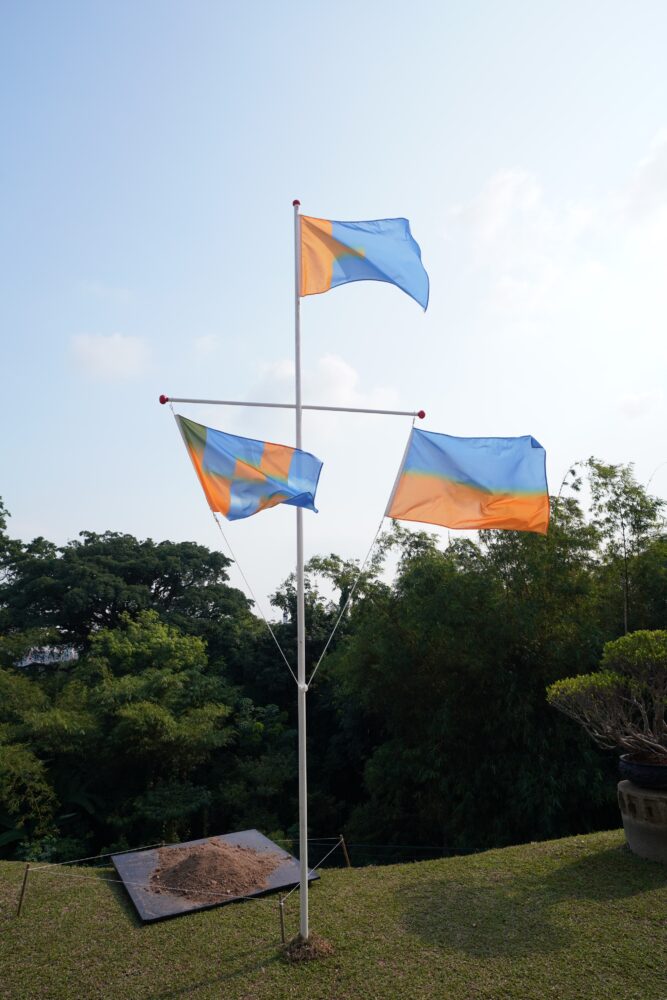
Boedi Widjaja, Path. 10, A Tree Talks, A Tree Walks, 2019
Commissioned by the Temenggong Artists-in-Residence, Singapore for “Longings, 寄望, jiwa” curated by Yueh-Siang Chang; supported by the National Museum of Singapore; and in consultation with geneticist Assoc. Prof Dr. Eric Yap, Lee Kong Chian School of Medicine
Courtesy the artist
Flying south for three thousand kilometers, the aircraft begins its descent in the final moments of a seven-hour journey. As it pierces through the cloud cover, the vast Pacific Ocean unfolds beneath the window. Peninsulas and islands slowly approach; the macro scale contracts, and the landscape becomes specific. Tropical rainforests cling to undulating mountain ranges, punctuated by scattered kampungs. Rural paths extend outward, merging into broader roads. Against the flow of the Klang River, they lead to valleys covered by artificial forests—a land caressed by monsoon.
Earlier, sailing vessels would depart from Zayton, following the northeast monsoon in October. Under favorable conditions, the voyage would take two months. Later, taking a steam ferry from Amoy, one could arrive in half a month. This space has been repeatedly shaped by transoceanic trade, colonial expansion, wars, and geopolitical confrontations, and has thus borne many names: Nusantara, Nanyang (南洋), Southeast Asia. Each designation reflects a different geopolitical relation and a different gaze.
Within this space, islands are continuously drawn into relation by ocean currents, monsoon, and shipping routes. They connect not through land but across water, refusing the logic of contiguous territory. From this emerges a sense of the world that rejects continents, centers, or singular origins as points of departure. History here does not unfold as a linear expansion from a fixed source; rather, it is assembled through encounters, displacements, and returns—at times through trade, at times through colonialism, and at others briefly surfacing in the fissures of Cold War antagonism, nation-state formation, or geopolitical conflicts, only to retreat again into zones resistant to language.
It is within this dynamic structure that populations migrating southward from China encountered, witnessed, and remembered interactions and frictions with other peoples and civilizations. Accordingly, they have been named differently across historical contexts: Teng Lang, Sengkek (新客), Overseas Chinese, Chinese. Through processes of settlement and creolization, they became Baba Nyonya Peranakan, or mestizo. Here, “Chinese” is not a stable identity but a dispersed, fluid, and difficult-to-anchor condition across oceans and archipelagos. The meaning structure of “homeland-return” has been repeatedly destabilized through this ongoing turbulence, its aftershocks lingering to this day. Any narrative that proceeds from a single vantage point—whether it be “overseas Chinese” or “diasporic aesthetics”—inevitably appears partial and skewed, fractured by irreconcilable structural gaps.
In Against Diaspora: The Sinophone as Places of Cultural Production (2017), Shu-mei Shih proposed that overseas Chinese should “become rooted in place.” From her radical de-centrist position, “diaspora” itself remains a structure tethered to an attachment to the center. The emotional imagination of a cultural homeland may instead place Chinese subjects in a condition of double exclusion: disciplined by the interpellative discourse of China or Chineseness on the one hand, and regarded as perpetually unassimilable others within colonial and postcolonial nation-states on the other. Chinese subjects thus become simultaneously “called back” and “refused recognition.”
Under this logic, “anti-diaspora” demands the abandonment of homeland attachment at particular historical moments, urging Chinese communities to transform emotionally and politically into modern citizens of their resident states in exchange for local recognition. Yet this proposition overlooks the concrete and brutal historical realities experienced by Southeast Asian Chinese, lacking both historical and material sensitivity. Examples abound: the British-led Malayan Emergency, which forcibly relocated Chinese communities into “New Villages”; Indonesia’s Peraturan Presiden Nomor 10 Tahun 1959, which restricted Chinese commercial activity and rendered hundreds of thousands economic refugees; following Suharto’s ascent to power in 1965, the purge against the Indonesian Communist Party unfolded into a wave of systematic ethnic violence directed at Chinese communities.
The residues of these histories still drift within the everyday lives of Southeast Asian Chinese, rendering “localization” anything but a clear or uncontested option. Their position resembles one buried beneath thick, opaque historical sediment—ash and dust layered upon one another. Under such conditions, becoming Chinese, or not becoming Chinese, is never an unconditional choice; each bears an unbearable historical weight.
Recognition and denial, belonging and exclusion, visibility and opacity intersect structurally within the historical condition of Southeast Asian Chinese. Long subjected to both excessive identification and systematic erasure, the question for Southeast Asian Chinese artists is no longer simply “how to express identity,” but rather: how can art take place within an unstable historical structure? And how might it reflexively respond to this condition without resorting to total narratives or fixed subjects?
A Lost Position
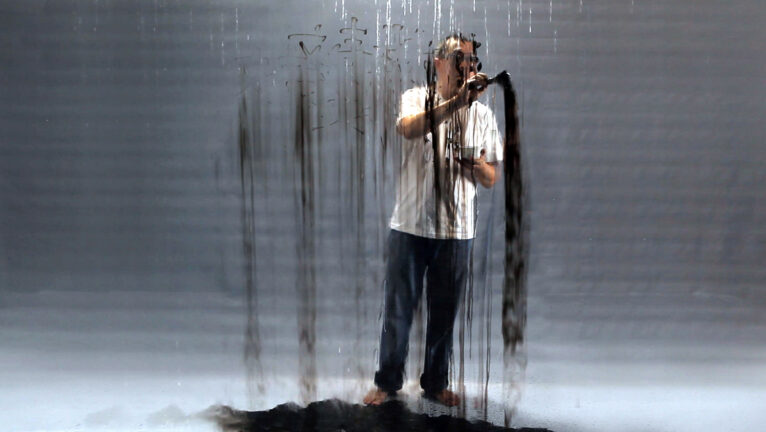
FX Harsono, Writing in The Rain, 2011
Single channel video, 6 min 2 sec
Courtesy the artist
The practice of Indonesian Chinese artist FX Harsono does not answer the question of “what it means to be Chinese.” Instead, it shifts the inquiry toward a more fundamental concern: when history itself acts upon the subject through rupture, silencing, and institutional violence, how can history be made visible without assuming the role of spokesperson?
In Writing in the Rain (2011), a sheet of glass stands upright in the frame, nearly transparent. Writing unfolds in a space without background, as if suspended alongside time itself. Holding a brush, Harsono slowly and carefully writes his Chinese name—“胡丰文”—one of the few Chinese characters he can write fluently. Before the inscription is completed, water begins to fall from above. This homogeneous, steady yet irresistible force slides down the glass, dispersing and elongating the fresh strokes until they blur. Lines lose their boundaries; characters dissolve into illegible traces. Only watermarks and blankness remain—again and again.
Born in 1949 in Blitar, East Java, Harsono was a founding member of Indonesia’s New Art Movement (Gerakan Seni Rupa Baru) in 1975. His father hailed from Zhangzhou, Fujian, China; his mother was Indonesian. “FX” abbreviates St. Francis Xavier, while “Harsono” is an Indonesianized transliteration of the Chinese surname Hu (胡). In 1966, Indonesia enforced regulations requiring Chinese citizens to adopt Indonesian names as part of assimilation policies, only repealed in 2000. In Writing in the Rain (2011), the repeated acts of inscription and erasure point toward antagonistic forces of affirmation and obliteration. Proof of individual existence becomes a Sisyphean gesture, while the procedural washing enacted by falling water evokes a continuous, invisible regime of identity confiscation. Meaning resides not in what remains, but in the reality that nothing can remain. Writing ceases to be inscription; it becomes a gesture that persists alongside disappearance, enacted at the edge of blankness. Yet repetition also betrays the impossibility of healing the pain of lost names—an erasure that, precisely because it cannot be completed, continues to haunt.
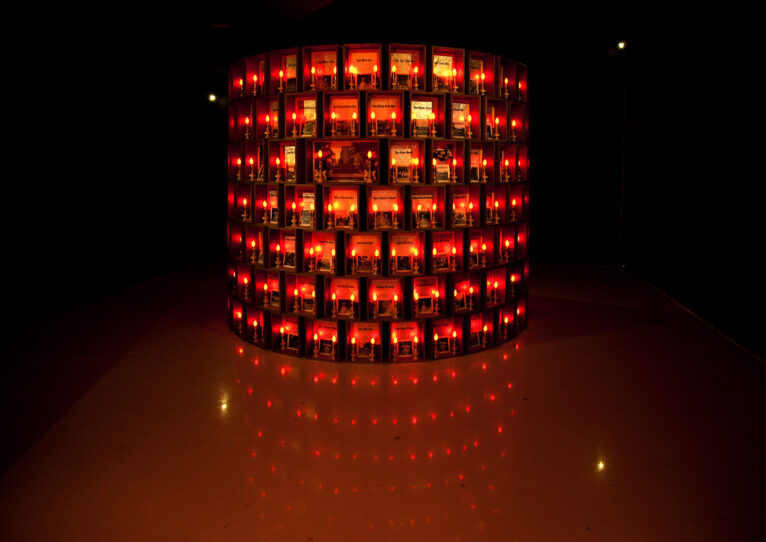
FX Harsono, Bone Cemetery Monument, 2009–2011
Installation with multiplex wood box, electric light, paper, and photograph, 270 × 270 × 210 cm
Courtesy the artist
This logic of inscription recurs in Bone Cemetery Monument (2009–2011), a memorial composed of shrine-like structures containing photographs of human remains. The skeletons in the photographs lay scattered in abandoned mine shafts, wildernesses, and along riverbanks, silently weathering away. Today, this massive monument is housed in Harsono’s studio on the outskirts of Yogyakarta. The deceased seem to murmur in silence amidst the red glow of electronic candles; as I approached them, I felt compelled to listen to those “disappearing voices.” Within sight, at the center of the shrines, were the names of the victims written by Harsono in calligraphy—Njoo Djioe Poo, Tan Hong Kwan, Tan Kauw Kwan, Ang Bok Beng, Djie Kim Poo, Go Twan Ling… (all Hokkien transliterations). These photographs were taken by Harsono’s father, Oh Hok Djoe. Between 1948 and 1949, commissioned by the local Tiong Hoa Hwee Koan (Chinese Association), he documented the mass graves of ethnic Chinese being exhumed in East Java, Indonesia, particularly in the Blitar region. These images expose truths excised from dominant histories: In the chaotic aftermath of World War II and during the Indonesian National Revolution, the local ethnic Chinese community became profoundly isolated victims trapped within complex ethnic conflicts and political maneuvering; they were not only mistrusted by the Dutch colonizers but were also liquidated by Indonesian nationalist forces, who viewed them as colonial collaborators. Consequently, tens of thousands of civilians were massacred in the ensuing riot. In the process of making these works, Harsono traveled across Indonesia with photos, searching for the descendants of survivors through the limited clues provided by Chinese temples and funeral parlors. During this journey, he discovered that even today, after the political thaw, many people remain deeply reluctant to speak about these past events
The work of Harsono is not a mere presentation of the “trauma motifs” belonging to the Indonesian Chinese community; rather, it leans toward a methodology of “visual archaeology.” Throughout these processes of visiting and returning, he does not attempt to reconstruct a complete historical narrative. What he confronts instead are the remnants that have neither been written down nor easily told: fragmented memories, hesitant silences, and the recurring blanks in conversation that remain impossible to name. It is precisely within these blanks that a state of aphasia—prevalent across the Indonesian Chinese community—gradually becomes visible. This rupture is the result of an “engineering” driven by power, operating at both macro and micro levels; such engineering exerts a more complex and profound influence upon the history, memory, body, and even the genes of the ethnic group.
An Unsettled Position
Singaporean artist Boedi Widjaja, born in 1975 in Solo, Indonesia, left his parents at nine to study in Singapore, later pursuing education in Australia and acquiring Singaporean citizenship in 2011. His long-term project “DNA and Ancestral Memories” (initiated in 2019) shifts from geographical and national scales toward molecular encoding.
In his installation Path 10: A Tree Talks, A Tree Walks (2019), the Chinese diary written by his grandfather when migrating from Zhangzhou, Fujian to Indonesia was dismantled, translated, and re-encoded—the 20 phonemes of the Javanese language were mapped onto the 20 amino acids that constitute proteins, and ultimately transformed into a DNA sequence. This sequence was then mixed with the DNA of a parasol tree (the source of his grandfather’s name, “Huang Wutong”), a bodhi tree (the source of his Indonesian name, “Boedi”), and a sample of his own saliva. Together with a handful of sand, these elements were sealed as a loose, hybridized, and unstable material composition. In this process, “returning to where” no longer constitutes a valid question. Position is not confirmed but diluted; history no longer appears in the form of memory but is compressed, in a biological manner, into a layer that cannot be directly read.
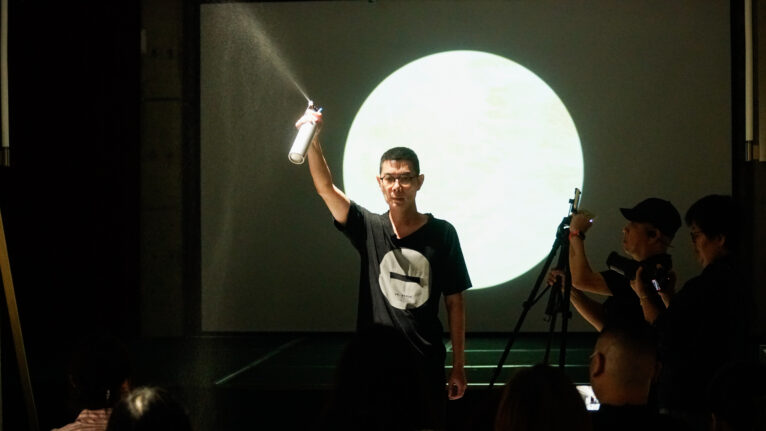
Boedi Widjaja, Performance-lecture “I Want to Infect You with History”, MACA Vortex, 2025
Courtesy MACA Art Center
In August 2025, during the performance lecture I Want to Infect You with History held at Fotografiska in Shanghai as part of MACA Art Center’s “Vortex” project, Widjaja connected Indonesian Chinese trauma to epigenetic changes in the FKBP5 gene, associated with stress response. He mentioned that the FKBP5 gene is closely associated with stress and trauma responses: individuals who have experienced extreme stress may exhibit altered patterns of gene expression, and these changes can potentially be inherited by the next generation, even if they have not directly experienced the violence themselves. At the pauses in his lecture, text flickered across the screen while the audio played the Indonesian dialogue of his parents, who do not speak Chinese—they were reminiscing about the period surrounding the Bandung Conference, when ethnic Chinese were forced to choose between nationalities… “Memory sits below the sharp edges/Invisible as a virus/Wandering through the rifts of time and space.” At the conclusion of the performance, Widjaja circled the audience, spraying a solvent into the air of the gallery that he claimed was infused with a genetic virus. The audience members reacted with avoidance, hesitation, or passive acceptance. No one could confirm when, or in what manner, this invisible transformation might take place. As the audience entered this “ominous” state, they seemed to experience a sense of persistent, unpredictable threat—an echo of the pervasive unease experienced by the Chinese in Indonesia throughout history—where no subject is ever absolutely pure or secure.
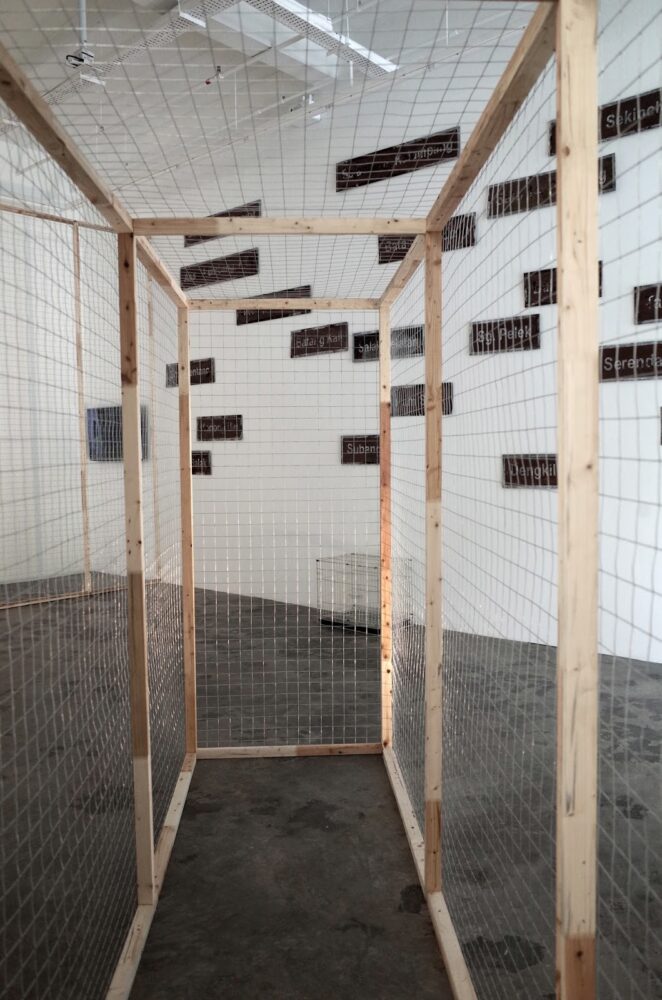
Chong Kim Chiew, Isolation House, 2005/2017
44 pieces sheet, 2 cage, fence, wood stick, light and single channel video, dimensions variable
Courtesy the artist
If the violence in Indonesia lay in the attempt to expunge the Chinese cultural matrix, the history of Malaysia reveals a different mechanism: the Chinese, maintaining their heterogeneity, were clearly categorized, defined, and sequestered into specific social positions by the state apparatus. Here, the physical body was thrust into a “state of exception” orchestrated by the confrontational structures of the Cold War. Malaysian artist Chong Kim Chiew’s installation, Isolation House (2005/2017), is constructed from crude wooden frames, translucent plastic sheeting, and cheap industrial waterproof tarpaulin. This ephemeral, defensive structure directly echoes the most profound collective memory in the history of Malaysian Chinese: the New Village. During the Malayan Emergency (1948–1960), the British colonial government forcibly relocated large numbers of Chinese into settlements encircled by barbed wire to sever ties between the community and the Malayan Communist Party. Chong’s “house” is no warm sanctuary; it is a visual remnant of the Emergency. Beyond the boundaries demarcated by the installation, viewers see signs bearing the names of various New Villages—collected by the artist across Malaysia—hanging on the gallery walls. The work evokes memories of Cold War-era mass internment while creating an eerie overlap with contemporary spaces of global governance, such as POW camps, refugee centers, and immigration detention facilities.
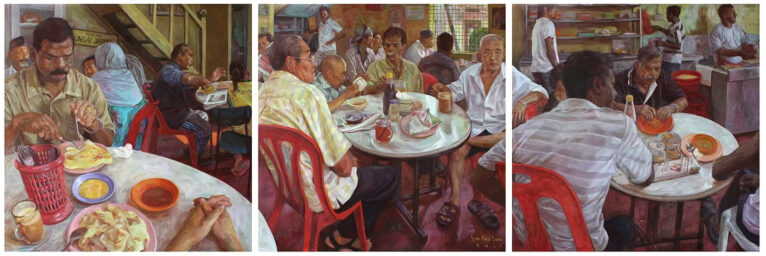
Gan Chin Lee, Kedai Kopi Sungai Jarom, 2011
Oil on linen, 122 × 122 cm each panel
Permanent collection of Balai Seni Negara
Courtesy the artist
The outbreak of the “May 13 Incident” in Kuala Lumpur in 1969—a racial riot between Malays and Chinese—resulted in heavy casualties and led the government to introduce the New Economic Policy (NEP). This policy, along with subsequent measures that persist today, granted institutional preferences to Malays and indigenous peoples (Bumiputera) in education, public sector employment, and equity distribution. For Gan Chin Lee, an artist who grew up in the Jenjarom New Village in Selangor and graduated from the Central Academy of Fine Arts in Beijing, China, the New Village represents an ambiguous local experience. At the edge of Jenjarom, a single street divides the Malay and Chinese residential quarters. Exactly on this demarcation line sits a 70-year-old Indian restaurant: Kedai Kopi Sungai Jarom. Gan’s triptych, Kedai Kopi Sungai Jarom (2011), captures a scene within the restaurant: Malays, Chinese, and Indians sharing a meal in an atmosphere of apparent harmony. However, the deliberate gaps between the three panels sequester the ethnic groups into separate frames, manifesting the psychological boundaries that persist between them. This is a form of highly “policed” multiculturalism: while ethnic groups in Malaysia are neighbors in physical space, they remain entrenched within their respective “islands” in the depths of their emotional structures.
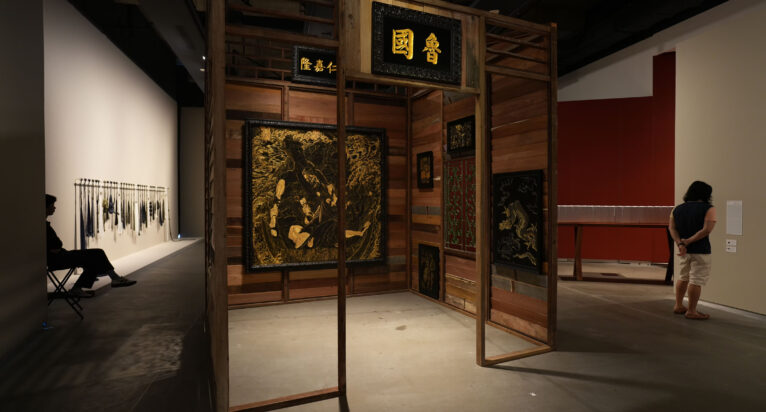
Gan Chin Lee, Invasion and Resistance, 2025
Installation view at Ilham Gallery, Kuala Lumpur, 2025
Courtesy Ilham Gallery and the artist
Gan’s installation Invasion and Resistance (2025), exhibited at the Ilham Gallery in Kuala Lumpur in November 2025, further articulates the inherent tensions within this “multiculturalism” and his complex understanding of “rootedness” and globalization from the perspective of a Malaysian citizen. The work comprises nine woodcarving panels coated in gold paint, centered around a large-scale print depicting a small boat tossing in a tempestuous sea, its figures blurred and struggling. These panels are supported by a wooden structure modeled after an old house in the Jenjarom New Village. Two plaques within the installation are particularly striking: “仁嘉隆” (Jenjarom) here no longer merely marks a collective memory of Cold War segregation but is transformed from a space of exception into a “home” imbued with belonging; meanwhile, “魯國” (the ancestral hall name of the Gan clan from Longhai, Fujian, China) bypasses modern national borders to point toward the family’s Chinese lineage. Simultaneously, works by Velázquez, Courbet, and Liu Xiaodong are re-rendered as woodcuts—a form resonant with Asian leftist aesthetics—hanging on the flanking walls. The artist “occupies” and “transforms” these Western and Chinese cultural narratives, integrating them into his own visual system. This suggests that in the multicultural tapestry of Malaysia, the local Chinese artist is no longer a passive vessel for external cultural influx, but a creative subject endowed with the agency to filter, dismantle, and reintegrate.
An Uncomfortable Position
If Gan Chin Lee senses the emergence of the subject through a retrospective on individual life history—using local Malaysian experience to trigger reflections on global multiculturalism—then fellow Malaysian artist Tan Zi Hao begins with the individual to probe the self: to what extent is one truly compatible with diverse cultures, laws, and institutions within an international context? When a mainland Chinese viewer encounters his Latinized name according to the phonetic rules of Mandarin Pinyin, “Tan Zi Hao” is almost inevitably misread as “Tan” (谭). In reality, his name is a hybridized product, combining the Hokkien romanization of his surname “Chen” (陈) with the Mandarin Pinyin of his given name “Zi Hao (子豪)”. This linguistic collision stems from his parents who, like many Malaysian Chinese, fervently responded to the “Speak Mandarin Campaign” launched by Singapore’s first Prime Minister, Lee Kuan Yew, in 1979.
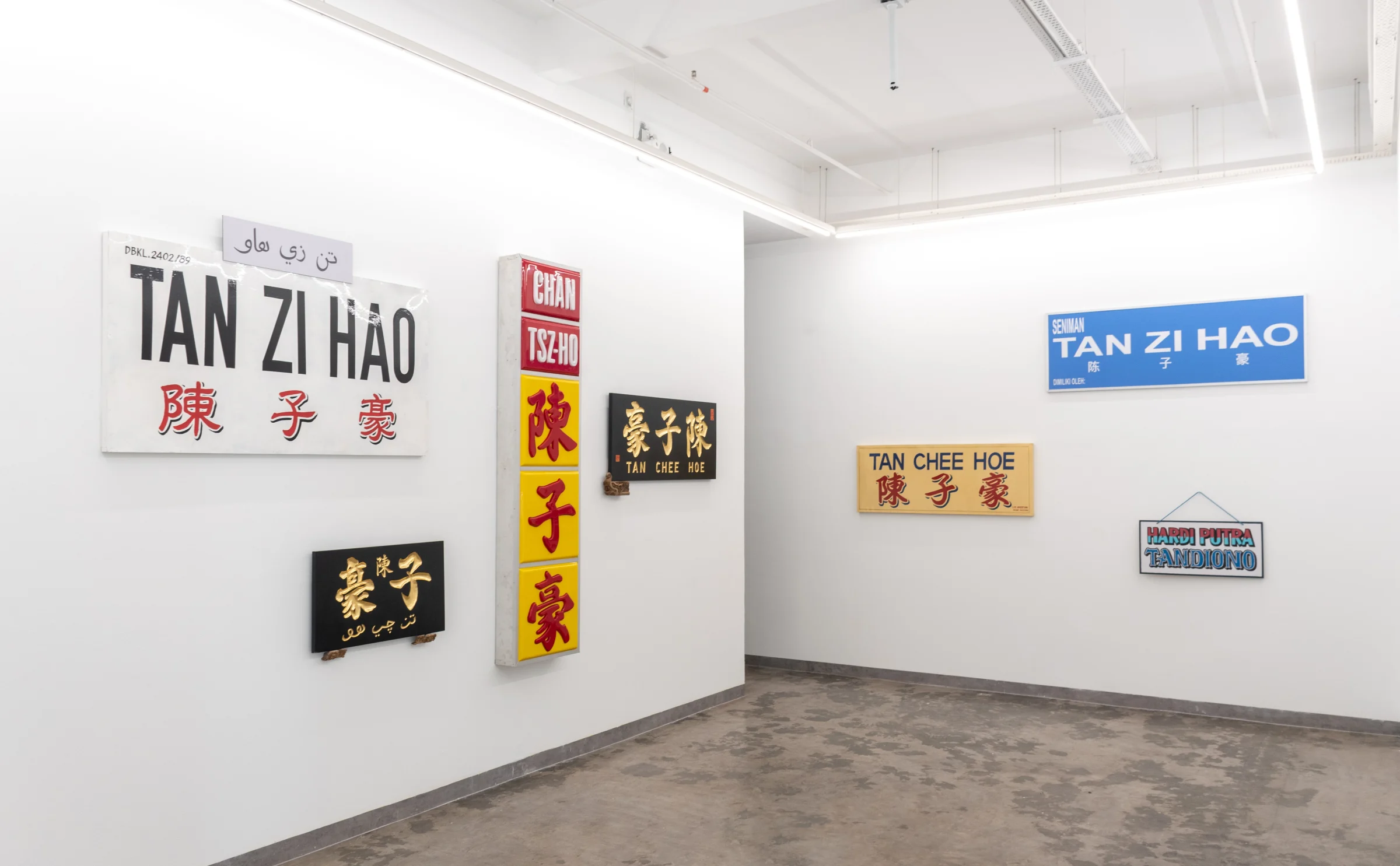
Tan Zi Hao, The Impossible Self-Portrait, 2024
Wooden plaques, aluminium sheets, neon signboard, thermoformed signboard, aluminium composite panel, plywood, nylon rope, plaque holders, wooden and metal framework, gold leaves, enamel paint, and emulsion paint, dimensions variable
Installation view of “The Tongue Has No Bones”, A+ Works of Art, Kuala Lumpur, 2024
Photo: Hariz Raof
Courtesy the artist
In his work The Impossible Self-Portrait (2024), Tan Zi Hao selected various materials and fonts to produce a series of signboards, presenting his own name through the phonetic and orthographic rules of diverse languages: “陈子豪,” “Tan Chee Hoe,” “Tan Zi Hao,” and so on. These names do not serve as interchangeable identity labels; rather, they are the varying outcomes of the same subject entering different systems of legibility across historical and institutional contexts.
As a potential Hokkien name, “Tan Chee Hoe” does not point back to a more primordial identity. On the contrary, it reveals a pre-existing hierarchy within the Chinese language: dialects were socially demoted during the processes of regional modernization and national linguistic engineering, gradually losing their legitimacy as formal naming resources. The subsequent appearance of “Tan Zi Hao” preserves the Hokkien spelling of the surname while transliterating the given name into Mandarin Pinyin, manifesting a hybrid form that appears natural yet is highly institutionalized. This hybridity simultaneously responds to the Southeast Asian Chinese community’s aspirations for linguistic modernity—whether driven by cultural identity or pragmatic economic demands—while submitting to the hegemonic authority of the Latin alphabet in administration and global circulation. In this process, tones are erased, linked syllables are split, and the name ceases to be an entity to be called upon; instead, it becomes a string of characters to be registered, compared, and frozen
In his critique, Tan Zi Hao refrains from making value judgments between these names, nor does he attempt to reclaim a “final version” for the sake of identity. Between these legitimate yet mutually autonomous versions of naming, the subject does not gain a clearer self-image; rather, what is exposed is an “opacity” that refuses to be fully represented by any single linguistic or political framework. It is precisely in the tension between this hyper-legibility and the failure of representation that the name becomes a structural remnant, rather than the ultimate signifier of identity.
As the historian Wang Gungwu observes, the “identity” of the ethnic Chinese is characterized by its plurality: it is simultaneously a product of history, institutions, and the state’s interpellation, as well as a lived practice of adaptation and transformation by individuals within specific environments.
In this world known as “Nanyang,” the forces of politics, economy, history, memory, ethnicity, and the individual intertwine into countless threads—shaping the scattered islands where the Chinese stand and labor like shifting winds and ocean currents. Upon the complex terrains of these islands, traces are left in varying depths: familial memories, yearnings for the ancestral home, linguistic habits, transoceanic migrations, institutional oppression, exclusion, and violence.
It is within these floating and inherently unintegrable experiences that Chinese identity ceases to be a singular belonging. Instead, it becomes a complex map woven from historical tensions, institutional powers, and individual survival strategies. Every migration, every change of name, and every fragment of memory acts like ripples on the sea under the monsoon—extending back and forth between islands, yet never fully confined by any single thread. The maneuvers of identity have no end, nor do the powerful winds of history.
Tan Sin Thiau is a curator, writer, and translator. Born in Zhangzhou, Fujian, he now lives and works in Hangzhou. He is the initiator of the Overseas Chinese Farm Project and managing editor of Suspended Needle: Writing around Hangzhou. His research focuses on transnational exchange, Chinese studies, Southeast Asian history, and geopolitics.