A Book of Actions: Islands, Coastlines, and the Sea
| June 22, 2026
Text by Long Yitang
,《贝壳里的一季》,2014-Zheng-Mahler-Collective-A-Season-in-Shell-2014-766x507.jpg)
Zheng Mahler (Collective), A Season in Shell, 2014, dual-channel video installation, abalone shells, porcelain tableware, tables and chairs, text
Courtesy Power Station of Art and the artist
In recent years, the field of contemporary Chinese art has seen a growing number of practice-based projects initiated by curators, artists, and institutions. Whether working alone during brief island or port residencies, or traveling collectively along expansive coastlines, these practitioners engage with long-standing maritime rituals—such as boat-sending ceremonies—and observe newly developed marine infrastructure. By employing “walking” as a methodology, they venture deep into the interiors of islands and harbors to forge connections with local communities and rethink the relationship between the sea and its surroundings. These curatorial and public projects are rarely confined to the conventional paradigms of collecting and displaying; instead, they emphasize diverse forms of situated practice. The interweaving of individual perceptions and lived experiences generates numerous “charged moments”—sharp, piercing points of intensity.
Islands: Points of Departure for Possibility
In the chapter on “Islands” in Topophilia (1974), human geographer Yi-Fu Tuan writes: “It would seem that islands are always associated with the human imagination. They lack the ecological diversity of tropical rain forests and coastal regions and have played little role in human evolution. Their importance lies chiefly in the human imagination.” In the cultural imaginary, islands are often perceived as isolated, self-contained micro-spaces—remote from the mainland and strictly bounded. Geographically, however, islands are more frequently embedded within vast archipelagic networks, as evidenced by the myriad islands scattered across China’s southeastern seas.
【1】
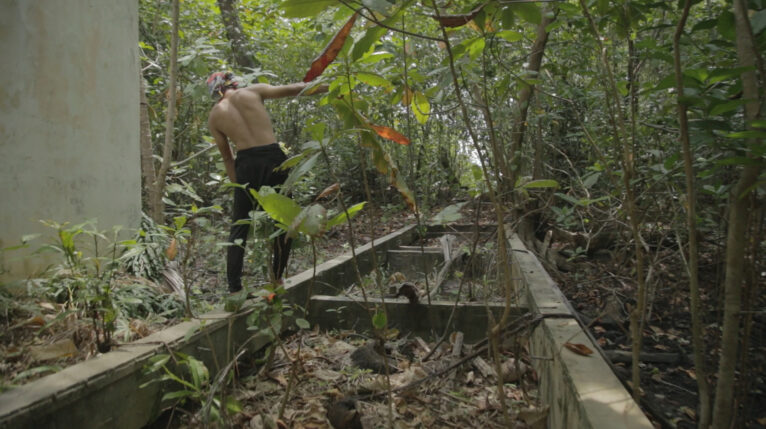
Hu Wei, Long Time Between Sunsets and Underground Waves (still), 2020–2021, single-channel video, color, sound, 53 min 16 sec
Courtesy the artist
Islands have inspired many artists to produce works that became definitive in their practice. Chang Yuchen’s Coral Dictionary (2019–), Tong Wenmin’s Wave (2019), Hu Wei’s Long Time Between Sunsets and Underground Waves (2021), and Fan Xi’s L (2020) and 17’17’’ (2020) all emerged from the “Offshore” residency program (2019), jointly initiated and organized by curators Yuan Fuca and Han Xinyi. During the program, artists traveled to Dinawan Island in Sabah, East Malaysia, engaging in what could be described as “purposeless” stays. Through interactions with the local Sama-Bajau maritime community and dialogues with the island’s geopolitical history and ecological conditions, they developed their own distinct modes of documentation.
Hu Wei’s video work, Long Time Between Sunsets and Underground Waves, unfolds through a first-person narrative. Fragments—a local boy’s letter home, the scattered memories of migrant laborers, and forgotten revolutionary footage—are woven together to reveal the island’s multiple entanglements: economic, political, and geographical. From the colonial period to the present, three historical processes have structurally shaped the trajectory of the Sama-Bajau people from maritime nomads to stateless subjects. First, colonial wars and boundary-making in the late nineteenth and early twentieth centuries—such as the Dutch–Aceh War—fractured their traditional sea territories. Later, in the mid-to-late twentieth century, newly independent Southeast Asian nation-states pushed them outside sovereign frameworks through hardened borders and intensified governance. Finally, contemporary maritime territorial disputes, including the question of Sabah’s sovereignty, coupled with the encroachment of tourism capital, have further entrenched their marginalization. This predicament is the cumulative outcome of overlapping colonial legacies, the exclusionary mechanisms of the nation-state, and the logic of global capital.
【2】
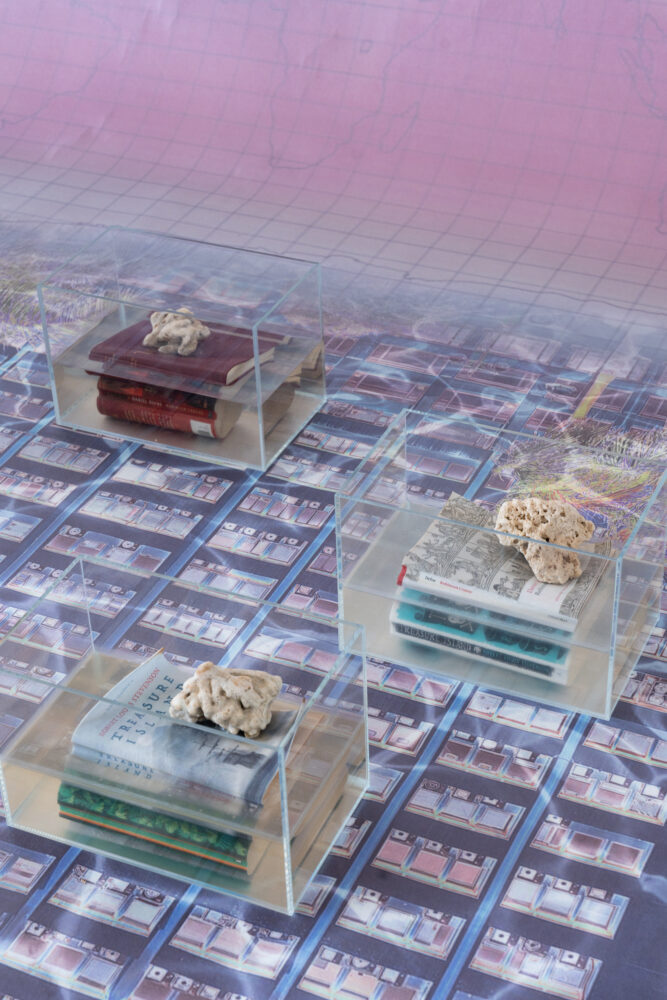
Hu Rui, Star House above the Breaking Waves (detail), 2024–2025
Installation view of “One Way Ashore, A Thousand Channels,” Guangdong Times Museum, Guangzhou, 2024–2025
© Homer
Another curatorial project that turns its gaze toward Southeast Asian islands is Tan Yue’s exhibition “One Way Ashore, A Thousand Channels” (2024–2025). The project extends research initiated in 2021 by the Guangdong Times Museum, which launched the “Pan-Curatorial in the Move” series with a field study on Hainan Island titled Islands in the Re-Making. At the time, Hainan was being developed as China’s largest free trade port, transforming the island into a speculative model for a future mega-port city. Artist Weng Fen participated in the Islands in the Re-Making research tour and later contributed to the final exhibition with Anthropocene Landscapes (2023–). His work documents storm-damaged houses in Hainan following typhoons, rubber plantations as economic landscapes, and the visual traces of new energy infrastructure. Notably, since 2010, Weng Fen has been engaged in an ongoing, collective, walking-based practice in Hainan titled Dismantling the Travel Agency. By inviting researchers and artists to conduct on-site visits, he facilitates dialogue with island villagers through nomadic movement, fostering a long-term situated practice that reflects on modernity and the concept of the “island countryside.”
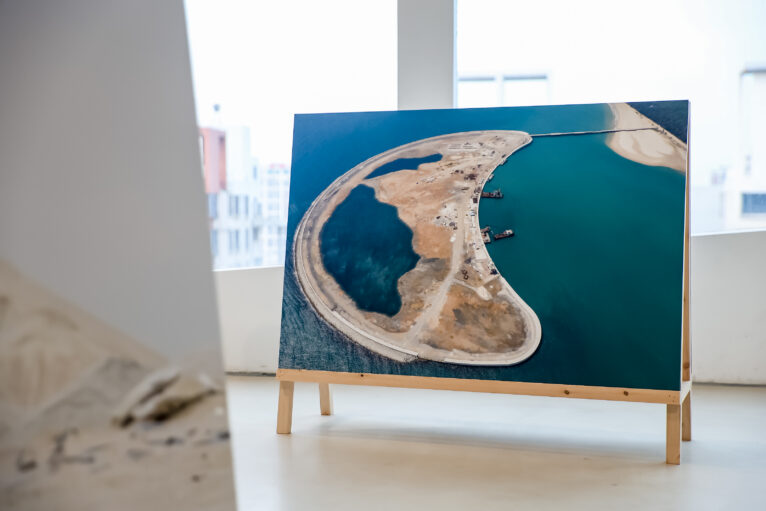
Sim Chi Yin, Shifting Sands (detail), 2017–
Installation view of “One Way Ashore, A Thousand Channels,” Guangdong Times Museum, Guangzhou, 2024–2025
© Guangdong Times Museum
Tan Yue’s curatorial vision does not end in Hainan; departing from Lingdingyang at the mouth of the Pearl River, it extends further southward. Here, archipelagos serve as metaphors for plural, multidirectional worldviews. One Way Ashore, A Thousand Channels also addresses themes of island-making, land reclamation, and maritime boundaries; it notably features Singaporean artist Sim Chi Yin’s photographic series “Shifting Sands” (2017–). Sim documents sand-mining sites and the reshaping of islands across China, Malaysia, Singapore, and Vietnam, exposing the ecological and social costs behind the growth of Singapore—a city-state that has expanded its landmass by nearly a quarter through reclamation. Meanwhile, Hu Rui’s commissioned video installation, Star House above the Breaking Waves (2024), imagines a future floating city called Namkong. In this vision, citizens of pirate descent choose to construct their dwellings from modular floating islands, as if rediscovering ancestral techniques of maritime living for a technological age. These techniques, the work suggests, may offer new possibilities for negotiating the boundary between land and sea in an era of rising sea levels.
【3】
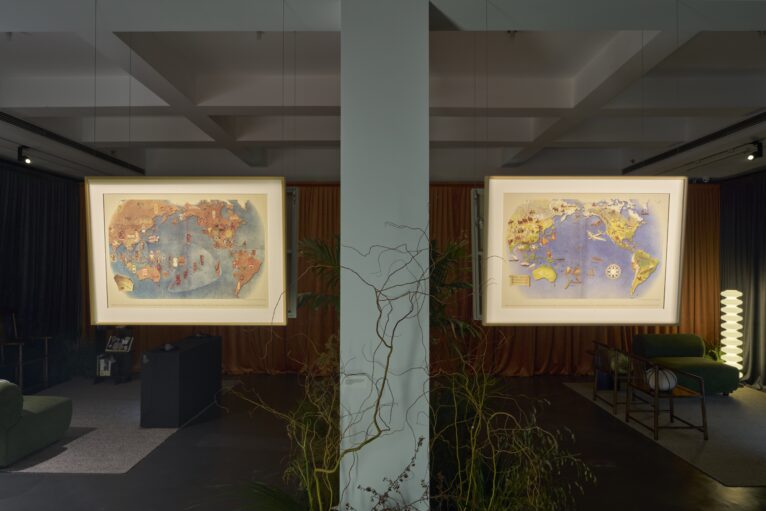
Installation view of “Wan Hai Hotel,” Rockbund Art Museum, Shanghai, 2024–2025
Photo: Cra
© Rockbund Art Museum
If the previous two projects focus primarily on the waters and archipelagos of Southeast Asia, the Rockbund Art Museum in Shanghai has recently presented two marine-related public projects that extend their gaze across the entire Pacific Rim. From late 2024 to early 2025, inspired by a small Chinese-run hotel in Penang, Malaysia, the museum transformed its ground floor into the ephemeral Wan Hai Hotel. Through tabloids, talks, screenings, music, and dance, the project restaged archipelagic scenes along with the indigenous cultures and ideas emerging from this world. It pointed toward an alternative network concealed beneath the global maritime trade system—one epitomized by modern shipping logistics. This hidden network is grounded in indigenous knowledge, inter-island cultural circulation, and worldviews of coexistence with nature. The project resonates with the concept of “a sea of islands” proposed by Tongan and Fijian intellectual Epeli Hau‘ofa, whose work is cited in the museum’s curatorial text. Hau‘ofa challenged the colonial perspective of “islands in a far sea,” which frames islands as isolated fragments adrift in vast oceans, far from the centers of power. In contrast, “a sea of islands” emphasizes the sea as a connective medium through which islands form an interrelated whole. Within this framework, the ocean is no longer a space of separation but a site for the production of relationships. The “hotel,” with its connotations of transit and temporary stay, aptly captures the fluidity of circum-oceanic regions. Conceived as a structure akin to a port, it serves not as a functional endpoint but as a narrative point of departure—a place where people, objects, and stories converge, pause, and set out again.
【4】
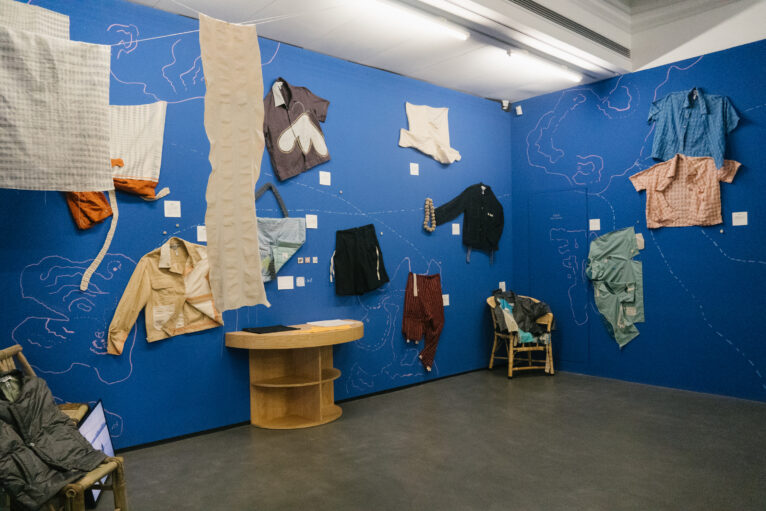
Installation view of “Making Substance 2022: Finding Maritime Asia,” Rockbund Art Museum, Shanghai, 2022
Photo: Sun Jiyuan
An earlier project at the Rockbund Art Museum, Making Substance 2022: Finding Maritime Asia, was co-curated by Sun Jiyuan and Chen Baiqi. Also adopting a scenographic approach, the curators transformed the museum’s third floor into a “Maritime Parlor.” While the Wan Hai Hotel looked toward the Pacific Rim, this project focused more specifically on the East Asian context, examining how seas and islands have shaped modern history, cultural memory, and identity formation within the region. Among the featured works was Taiwanese artist Hong-Kai Wang’s sound piece Borom (2020), produced on Jeju Island, South Korea. Named after the Jeju dialect word for “wind,” the work draws on the Jeju April 3 Incident of the mid-twentieth century. Using the monsoon as a sensory metaphor and the exile of Zainichi poet Kim Si-Jong as a narrative thread, Wang collects sounds associated with the “wind” to probe the forgotten historical traumas embedded in the geopolitics of the sea. Meanwhile, Hong Kong-born photographer Pok Chi Lau’s series on Chinatowns in Hong Kong, Malaysia, Myanmar, and Thailand—shot between 1968 and 2022—delves into overseas Chinese communities. His work portrays the diasporic condition of Chinese populations as an archipelagic mode of existence—scattered yet culturally interconnected.
Coastlines: Thresholds of Entanglement
When our gaze shifts from offshore archipelagos back to the shoreline, it becomes clear that seawater does more than erode the physical boundary between land and ocean. It also carries and interweaves maritime legends, belief systems, ritual practices, traditional crafts, local knowledge, and premodern architectural heritage. A close reading of the art research initiatives that have emerged along China’s extensive coastline in recent years—whether traversing its rugged contours from north to south, venturing into the estuaries where inland waters meet the sea, or engaging the wider world via peninsulas and port terminals—reveals, upon closer inspection, that many implicitly adopt the theoretical lens of the “contact zone.” As proposed by Mary Louise Pratt, the contact zone is a social space where disparate cultures meet, clash, and grapple with one another. It brings together groups previously separated by geography or history, binding them in sustained, tension-filled relationships. For curators, this perspective serves as a primary impetus for action—a way to seek answers within the intersections, mobilities, and contradictions embedded in the coastal landscape.
【5】

Zhu Lanqing, Shipyard, Hui’an County, from the “Excavations of a Shipwreck” series, 2017
Courtesy the artist
Initiated by curator He Yining, “The Port and The Image” project has unfolded in three editions to date (2017, 2019, 2022). Its first iteration, titled “Documenting China’s Harbor Cities” (2017)—which integrated commissioned works, exhibitions, and publications—took seven major port cities, including Ningbo, Quanzhou, Guangzhou, Shanghai, and Dalian, as points of entry. Artists were invited to explore how these cities articulate their regional identities at the juncture of modernization and historical tradition. Among these projects, photographer Zhu Lanqing developed Excavations of a Shipwreck (2017). Drawing on the 1973 discovery of a Song-dynasty shipwreck in Quanzhou Bay’s Houzhu Port, Zhu imagined herself as a member of an excavation team. In revisiting historical sites associated with the ancient port, she deliberately sidestepped the dominant narrative of Quanzhou as the starting point of the Maritime Silk Road, focusing instead on the remnants of local manufacturing. The result is a portrait of Quanzhou Port marked by heterogeneity and difference. In the second edition, “The Disappearing Harbor” (2019), He Yining continued this inquiry by inviting artists to visit ports that were either gradually vanishing or undergoing revival. Curator and writer Chen Min traced the modern transformation of Fuzhou’s Mawei Port in The Ebb and Flow of Mawei (2019). As the site of numerous pivotal events—from the Ryukyu missions and the Sino-French War to the opening of the treaty ports and the Self-Strengthening Movement—Mawei has shifted from a protected historical zone into a development area and cultural park. These shifts in spatial function continue to reshape the lived reality of this coastal harbor.
【6&7】
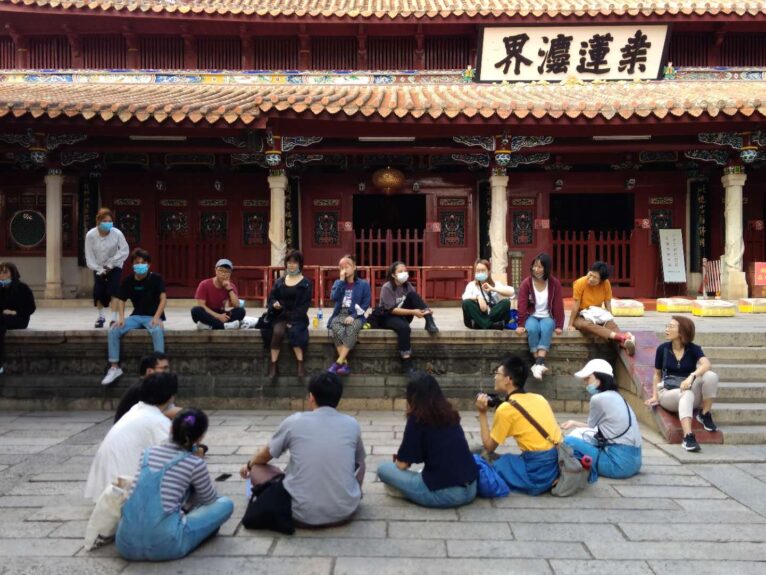
Field research “The Fleeting Union of Portals,” 2020
©️Guangdong Times Museum
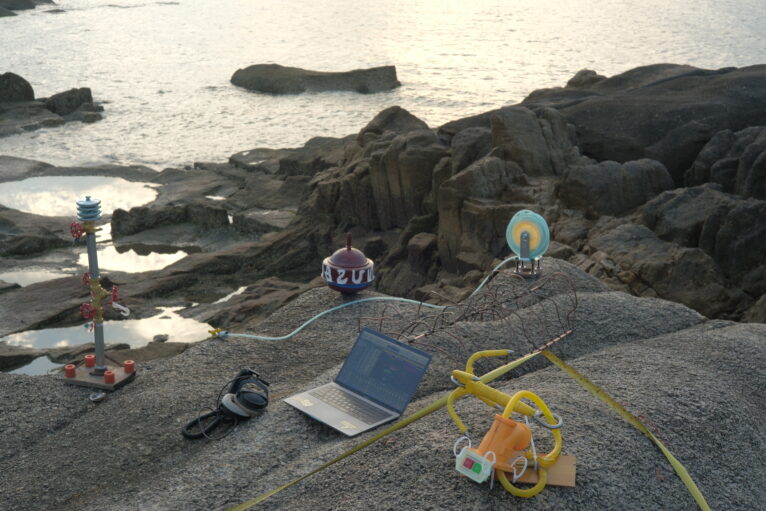
Installation view of “Pilgrimage to Mazu” coastal parallel exhibition, “Re-Asia Project, ” 2025
Courtesy Longlati Foundation
Dock communities, which remained marginal prior to the 17th century, were blasted open by gunfire over the past two hundred years and transformed into treaty ports. This process not only reconfigured the spatial and social structures of coastal cities but also catalyzed a fundamental shift in China’s conception of the sea: moving from a traditional worldview—where “the Four Seas” marked the bounds of a self-sufficient Tianxia order—to a modern maritime consciousness forged under the pressures of warfare. This new consciousness, exemplified by the vision in the Illustrated Treatise on the Maritime Kingdoms, positioned other nations as points of reference and focused on disparities in technology and institutions. Against this historical backdrop, the Guangdong Times Museum launched “The Fleeting Union of Portals” in 2020 as part of its “Pan-Curatorial in the Move” program. This was followed in 2025 by the Longlati Foundation’s “Re-Asia Project,” which initiated the field investigation “Pilgrimage to Mazu.” Both projects treat the port as a central question. As some of the earliest sites in China to engage intensively with foreign cultures, what has become of the hybrid forms—where the premodern and modern intertwine—that these ports once nurtured? Organized by art institutions, these collective research groups moved through various port cities, seeking to trace two forces that continue to shape the southeastern coast. On the one hand is Mazu, the sea goddess originating in Fujian’s Meizhou Bay, whose worship has been continuously adopted and reshaped by diverse communities through centuries of seafaring and migration. On the other are the five treaty ports forcibly opened in the modern era—Guangzhou, Xiamen, Fuzhou, Ningbo, and Shanghai—whose flows of people, goods, and ideas are not merely historical relics, but remain deeply entangled with the contemporary logistics hubs of global trade and the maritime economy.
【8】
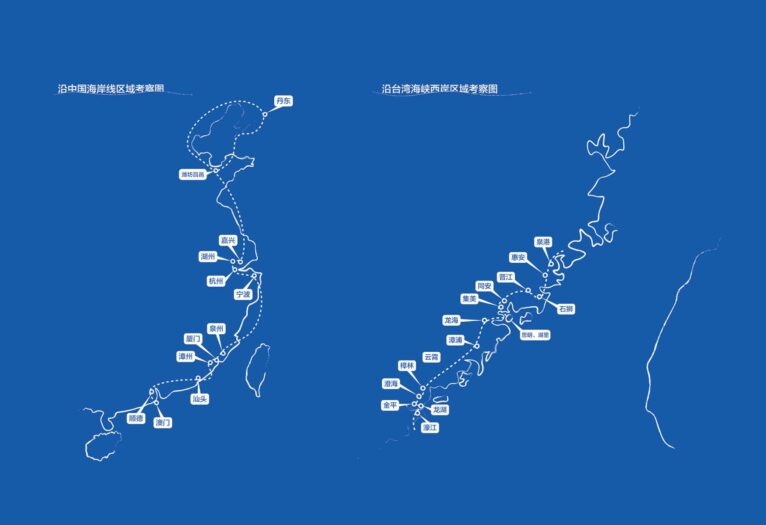
A map of “Thinking Through Ocean: Sea Route” traced by walking along the coastline
Courtesy the author
If the projects discussed above unfold primarily from a macroscopic historical perspective, “Thinking Through Ocean: Sea Route” (2022–)—curated by Long Yitang and Ma Sai—deliberately moves beyond narratives centered on the nation-state or regional hubs. The project conducts on-site investigations in a series of minor locales along the coastline—Quangang, Jinjiang, Anhai, Haicheng, Longhai, Zhangpu, and Yunxiao—seeking out records and memories buried beneath dominant accounts. Beyond everyday residents, these counties, towns, and villages—communities shaped by fishing, agriculture, salt production, and migration—are home to many local historians and cultural researchers; nonetheless, these locales have rarely seen sustained engagement from the field of contemporary art. Over nearly a year, dozens of participants from various disciplines undertook extensive walking and fieldwork in these locales. Their inquiries ranged from the histories of inland-to-coastal migration—encompassing the intermingling of Han and non-Han peoples, the southward movement of elite lineages, the development of Fujian and Zhangzhou, and the urbanization of the Reform and Opening-up era—to national and individual experiences shaped by maritime encounters: the Maritime Silk Road, tributary trade, Mazu worship, pirate histories, the Nanyang (or Southeast Asia) diaspora, and the return of refugee overseas Chinese. These minor narratives, often submerged beneath the dominant histories of regional centers, seep like capillaries into local communities, quietly shaping and sustaining them.
Ebb and Flow: Toward a Distribution of the Sensible
While historical geography provides the coordinates for understanding the ocean’s past, critiques of environmental media and marine infrastructure—alongside the “liquid thinking” gleaned from the sea itself—open new pathways for artistic practice. These perspectives allow us to engage with present realities, reconstruct conceptual frameworks, and articulate novel aesthetic forms.
【9】
Zhang Beichen, The Sun Rises, the Great Northern Telegraphy Station Sinks into the Sea, 2022–
Installation view of “Postscript of Silence,” McaM, Shanghai, 2023
Photo: JLW Studio
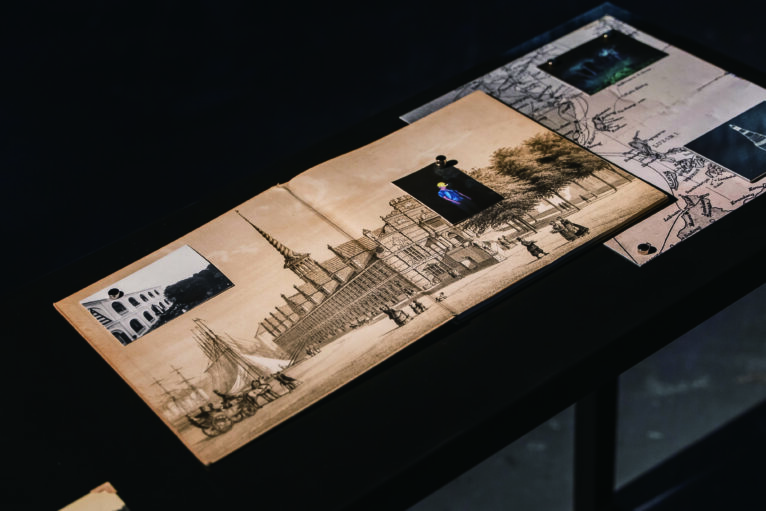
Over recent decades, the proliferation of industrial facilities along coastal regions—roads and bridges, power stations, distant-water fisheries, cross-sea megastructures, land-reclamation projects, and marine ranching—has produced a contemporary seascape in which old and new infrastructures intersect, forming a layered and perpetually shifting field. This transformation has prompted artists and curators to revisit infrastructural questions through research-based practice. In 2024, the Jiazazhi Library hosted the art symposium “Infrastructure, the Ocean, and the Field of Image Narratives,” inviting artists Ren Zeyuan, Zhang Beichen, Zhang Zixuan, and Zheng Andong to reflect on the relations between infrastructure, fieldwork, and image-making. Among these, Zhang Beichen’s The Sun Rises, the Great Northern Telegraphy Station Sinks into the Sea (2022–) employs media archaeology to transport viewers back to the 19th century, an era when modern marine technologies were first taking shape. As the Danish Great Northern Telegraph Company laid submarine cables along the southeastern coast of China, these lines—descending into the deep—were not only physical links connecting islands to the wider world but also extensions of colonial power reaching into the ocean. By collaging archival photographs, historical maps, and personal albums, Zhang salvages technological memories “submerged” beneath the sea, translating historical images into sonic signals through a multimedia installation. This act of translation serves as a metaphor for the inevitable erosion and reconstruction of historical memory over time.
【10】
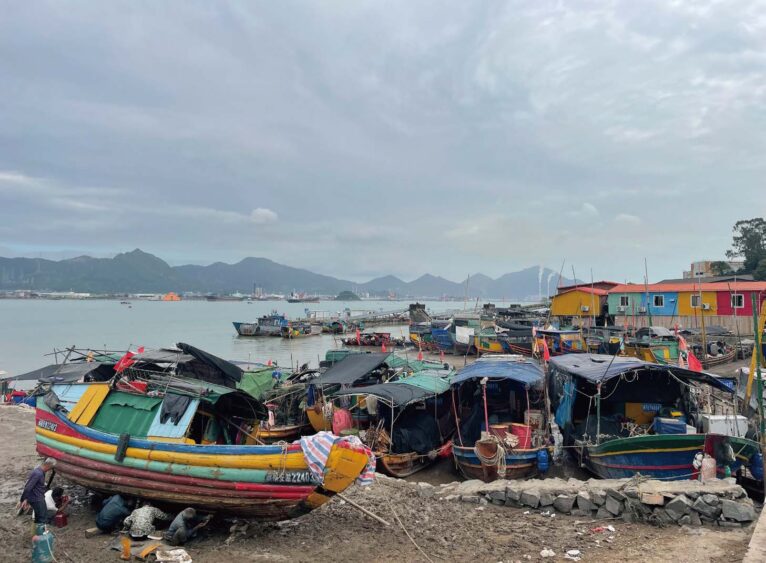
During Long Yitang’s walk for Umwelt-atlas (2024–2025), at the inner harbor of Sandu’ao, Ningde, within an indigenous Tanka (Dan) fishing community
Courtesy the author
Such practices demand not only a proficiency in textual and archival research but also a physical immersion in the field—and, crucially, a critical awareness of the interplay between the two. Supported by the One Way Street Foundation’s Sailors Program, Long Yitang’s work Umwelt-atlas (2024–2025) adopts such an approach. By following the 17th-century writings and itineraries of the Qing-dynasty literati Yu Yonghe, the project revisits the southeastern coast of China, traversing the newly completed G228 National Highway. In doing so, it directly confronts how modernity overlays and reshapes the shoreline. Heritage-listed stone fortresses, navigational beacons, and ancient stone bridges now sit in jarring proximity to oil terminals, nuclear power plants, cross-sea bridges, and submarine cable landings—diverse eras of infrastructure coexisting along a single, continuous coast.
【11】
Zheng Mahler (Collective), A Season in Shell, 2014
Exhibition view of the 13th Shanghai Biennale City Projects, Sun Ke Villa, Shanghai, 2020–2021
Courtesy Power Station of Art
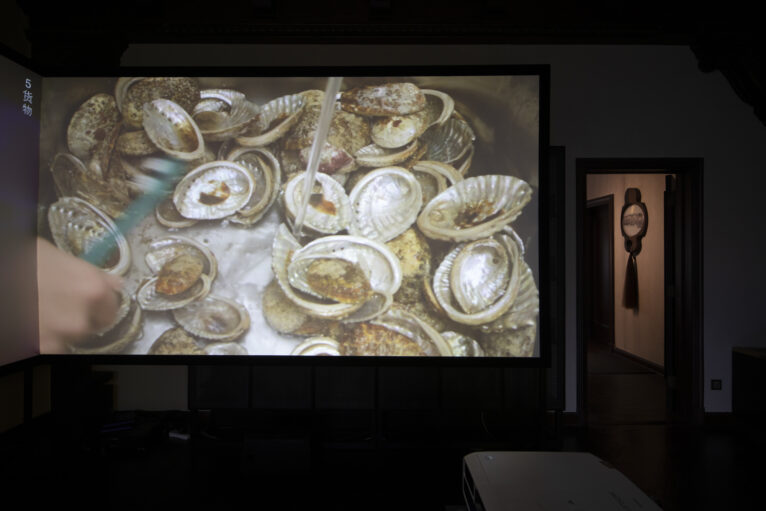
If marine infrastructure is understood as a medium that extends land-based perspectives into the sea, perhaps it is time to invert the position of the knowing subject. Melody Jue advocates for “thinking through seawater,” a shift toward a more “liquid” mode of cognition. The ocean possesses qualities fundamentally distinct from those of the land: it is immeasurable, mutable, and resistant to being exhausted by existing human epistemologies. The 2021 Shanghai Biennale, “Bodies of Water,” responded directly to this cognitive shift. Inspired by Bodies of Water: Posthuman Feminist Phenomenology (2017) by philosopher Astrida Neimanis, chief curator Andrés Jaque sought an ontology distinct from terrestrial logic. Within this framework, water is no longer a resource to be exploited, but a body charged with political potential—one that, through its inherent connectivity and permeability, redefines the relations between bodies, technologies, and environments.
【12】
Tong Wenmin, Wave (still), 2019
Performance, single-channel video, color, silent, 19 min 46 sec
Courtesy the artist
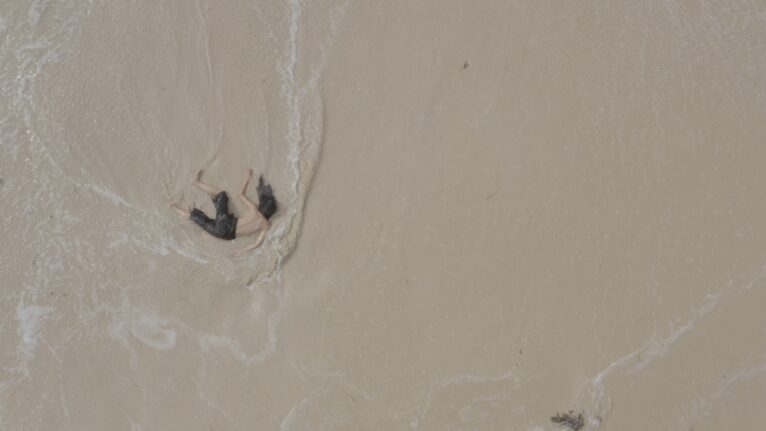
This line of thought recalls Wave (2019), a video work created by artist Tong Wenmin during her residency on Dinawan Island. In the lower-right corner of the frame, a strand of seagrass sways with the surge; nearby, the artist’s body—much like the seagrass—relinquishes all control to the tide, allowing itself to be washed, buffeted, and pulled by the sea to the point of exhaustion. To realize this performance, Tong learned to swim, dive, and row, mobilizing her body to internalize the ocean’s forces and to feel how nature shapes corporeal experience. When Wave appeared in the exhibition “The Reflection of the Moon Is the Spine of the Sea” (2022–2023), curated by Qiu Ding, it was situated within a more literary context. Here, the tide evokes a dual resonance: on one hand, the complex lunar imaginaries of Chinese mythology, and on the other, the periodic traces of the Earth–Moon gravitational relationship inscribed upon the terrestrial and aquatic surface. By presenting these diverse maritime imaginings, the exhibition suggested that the sensibilities of art and literature are inextricably bound to the sea, to memory, and to invisible forms of connection.
【13】
Lin Zhao’s novel Tidal Atlas (2022) stands as a significant recent literary response to the ocean in contemporary Chinese writing. With a sweeping, unrestrained prose style, Lin constructs a liquid textual universe. The novel follows the drifting trajectory of a fictional giant frog across southern China, narrating a “history of things” from a nonhuman perspective. From the floating homes of the Dan people on the Pearl River to the zoos of Europe, the frog’s body serves as a direct witness to colonial circuits and the global movement of commodities. Lin weaves together ancient Cantonese aphorisms, folk songs, and dialectal elements, interlacing history and legend with natural history and nonhuman viewpoints. In this work, the ocean is no longer a mere backdrop but a pervasive subject and a methodology in itself. The “wet” mode of knowing that emerges—formless yet adaptive, much like water—allows experiences previously excluded by formal history and power structures to re-enter the reader’s perceptual field.
Reading Tidal Atlas is an act of immersion into the sea. This way of knowing subtly loosens the orders and boundaries upon which terrestrial civilizations depend. It also offers a concrete prompt for future artistic endeavors—those walks and voyages along coastlines, around islands, and toward the deep blue. We must relinquish our land-based desire for stable plots, allowing the ocean’s perspective to unsettle our sensory order. By doing so, we can feel—viscerally—life’s fundamental dependence on water and its sensitivity to the environment, fostering a mode of flowing empathy. When art shifts its gaze from the land to the sea, what comes into view is not merely an expanse of water, but an entirely new distribution of the sensible.
Translated by Ji Yu
Long Yitang is a curator, writer, and a member of the curatorial team for the 15th Shanghai Biennale. His recent work focuses on the geographies and cultures of the southeastern coast of China and river basins. He has organized and curated various exhibitions, walking projects, and field research centered on themes of mobility, environmental history, and media.