All That Flows in the World: Notes on Osaka 2025
| March 6, 2026
Text by Ho Rui An
One glance at the Grand Ring—Sou Fujimoto’s monumental contribution to the 2025 Osaka Expo—was enough to recall the long and storied tradition of the architectural World Interior that goes back to the Crystal Palace, the massive glass-and-iron edifice built in London to house the first-ever international world’s fair in 1851. Time and again, the ambition to contain the entire planetary community within a single all-embracing interior has announced itself at each new Expo, from Buckminster Fuller’s geodesic dome for the US Pavilion at Montreal 1967 to the vast steel dome and 360-degree projection screen that served as Dubai 2020’s stunning centrepiece. Conceived based on the philosophy of “Unity in Diversity,” Fujimoto’s circular enclosure appeared from the outset to be the latest variation of this theme.

Singapore Pavilion
But the Grand Ring, strictly speaking, does not constitute an interior. While it does circumscribe a given territory, what lies within is entirely exposed to the elements, including this summer’s scorching heat, from which the Ring—explicitly designed as a sheltered walkway to facilitate visitor traffic through the entire site—provided little relief. From the ground, its intricate wooden lattice structure, assembled through a herculean feat of engineering that drew upon traditional Japanese wood joinery, also has less in common with the cavernous, column-free emporiums of the Victorian age than with Fujimoto’s signature blend of geometricity and organic complexity that seeks inspiration from nature. Insofar as the architect has spoken of his structures as both “forests” and “clouds,” the Grand Ring is better described as a refiguration of the “cloud” as “digital forest.” For six months, this living scaffold was, after all, a space of circulation and connectivity, whether the people be rushing breathlessly to the next pavilion or inching one miserable step forward while trapped in one of the Expo’s interminable queues.

Water basin at the center of the Japan Pavilion

Fermentation plant at the Japan Pavilion
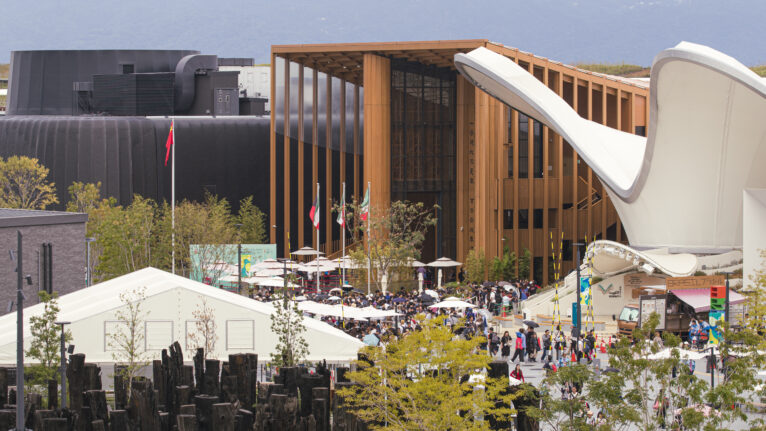
China Pavilion

US Pavilion
Indeed, circulation and circularity were recurrent themes across the Expo—as was fluidity, which took literal form in the large water plaza by the sea and the hydrological features of several pavilions. Naturally, it was at the Japan Pavilion where these themes were explored most earnestly. The pavilion, whose circular planked structure made it somewhat of a synecdoche of Fujimoto’s design, was powered by an on-site fermentation plant, where microorganisms fed on food waste from the Expo site to generate electricity. Inside the pavilion, exhibits illustrated the process in detail as well as its different applications. For one, carbon dioxide produced through decomposition can be used to feed hydrogen-oxidizing bacteria, which in turn produces new compounds for making fully biodegradable plastic. Even the water remaining after the process was not wasted: once purified, it was collected in a basin at the pavilion’s center. In line with this philosophy, the entire pavilion was designed to be easily disassembled to be reused after the Expo concluded.

Expo site in the afternoon
Circularity was also present in the informational loops of several new media-focused pavilions. At the Korea Pavilion, visitors recorded their voices at the entrance for an AI model to transform them into a musical track experienced inside together with psychedelic lighting. Likewise, at the Singapore pavilion—a massive red sphere covered by recycled aluminum discs which enclosed what its designers call a “dream-like cloudscape”—audiences were invited to illustrate their dreams on a digital device to be projected onto the immersive ceiling projection where they coalesced into a collective vision for the future. Yet, in both instances, as I struggled in vain to seek out my own voice amidst the sea of audience-generated data, what I felt was neither autonomy nor collectivity, but a dreadful sense that the McLuhanite dream of new media uniting humanity in “a single constricted space resonant with tribal drums” had instead created semantically hollow echo chambers.

Construction cranes at work behind the Grand Ring
If the Dome was the architectural emblem of the age of the World Interior—when one could still fantasize about gathering all humanity under a single universal geometric order—the Cloud of today speaks instead to a time marked at once by endless circulation and hyper-containment, where matter becomes flow and semiosis becomes computation, allowing us, or rather our data, to be broken down and transmitted through global circuits of technocapital, only to be ensnared within different algorithmic loops of control. Indeed, Fujimoto’s design brief already gestured to this reality when he spoke of “a world marked by division,” thus necessitating his architectural intervention as a means to “hold it all together” in a kind of forced cuddle.

Tower of the Sun at the 1970 Osaka Expo Commemorative Park
However, to understand the full implications of this seismic shift in the spatio-political imagination, it is not the Dome but another architectural symbol against which we need to consider the emergence of the Cloud. About 20km north in Suita stands the Tower of the Sun, the outlandish and somewhat haunting totem to Japan’s postwar technoutopianism designed by Tarō Okamoto for the 1970 Osaka Expo. Featuring three distinct faces representing the past, present and future, the tower’s intimidating, almost trippy, verticality—drawn from the lineage of Paris’s Eiffel Tower and Brussels’s Atomium—embodied a zeitgeist in which historical progression was imagined as a ceaseless upwards climb. Since a few years ago, the interior of the tower has again been made open to the public, allowing me to recently make the ascent past the enormous sculptural installation inside spanning the tower’s height, which depicted the evolution of life from microorganism to homo sapiens. I couldn’t help but wonder: at what point did such quests for verticality appear so hopelessly quaint?

Visitors gathering at the roof of the Grand Ring at dusk

Expo site at night
Tellingly, it was the US pavilion at this summer’s Osaka Expo where this ascent to the cosmos appeared to have been renewed most unabashedly. Organized around the theme of space exploration, the pavilion took visitors on a tour beginning with a video showing Donald Trump proclaiming America’s “golden age” and ending with a simulated rocket launch. Outlandish? Or just good old nostalgia in a time when upward mobility appears a remote possibility for many laboring under the Cloud’s new informational regimes? After all, lest not forget, the Cloud here is also a vertical structure. Climbing to the top of the Grand Ring, one could take in not only a commanding view of the Expo as World, but also a sobering glimpse of the construction cranes at work in the distance. As I was told, once the last ecologically conscious pavilion has flat-packed its building and left, the site will be transformed into a major casino-resort. From the ruins of the Cloud rises a new totem to Capital.
Ho Rui An is an artist and writer working in the intersections of contemporary art, cinema, performance and theory. Through lectures, essays and films, his research examines the relations between labor, technology and capital across different systems of governance in a global age.