From Mutiny to Diplomacy: Colonial and Post-Colonial Foodways in the Indo-Pacific
| April 3, 2026
Text by Lou Mo
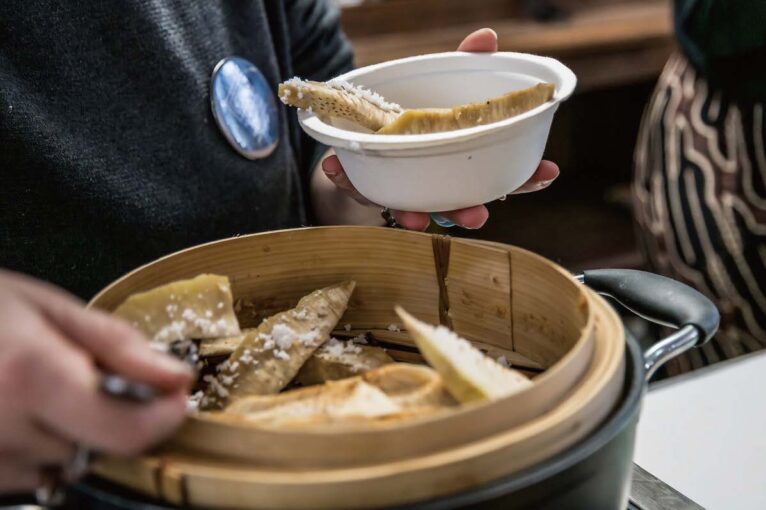
The artist Nathalie Muchamad’s nourishing workshop “du pain et du lait, une technologie tropicale,” December 6, 2025, as part of the program centre d’art nourricier 2024–2025–2026: Cycle 4, En des lieux sans merci, Centre d’art contemporain de Malakoff.
Photo: Séverine Fernandes
Courtesy the City of Malakoff
It was early winter in France, and the wind was already brisk. Nathalie Muchamad and I were talking and rubbing our hands. Her group exhibition “En des lieux sans merci (In Merciless Places)” had just opened that day at the Maison des arts de Malakoff in close Parisian suburbs and we were talking in front of the exhibition space. The topic turned to daily matters and administrative hassles without our noticing.
I said fretfully that I had to wait for some papers to come through before I could travel and complained about French administrative inefficiency. She said that she still had to clarify some issues that arose with the digitization of overseas department civil status documents when she asked for a new passport last time and will need to officially redeclare her name and surname at a civil court.
Nathalie is Indonesian French, and her ancestors were brought in as indentured laborers by the Dutch to the French. She was born in the Pacific, in French New Caledonia, a department now seeking independence. She studied and worked in metropolitan France for several years before moving to Mayotte, a French territory in the Indian Ocean, to teach and practice art. When she was born in New Caledonia, the clerk who registered her birth did not understand what her father’s name and surname was, and that is causing administrative difficulties today.
“Good thing the official back then didn’t know we Javanese people don’t even have surnames! He’d have been completely stumped!” she said with a playful smile.
Nathalie wore an Indonesian batik dress, with her Asian look and bronzed complexion, she falls far from a stereotypical image of a “French” woman. Her unique family background and experiences working and living in various French overseas departments formed the vein of her research and practice. In France, Nathalie is French but unlike the other French, and the France she cares about also far exceeds metropolitan France. She continues to observe this modern nation that can still be called an empire on which the sun never sets, but chooses to focus on the history and peoples of its peripheries.
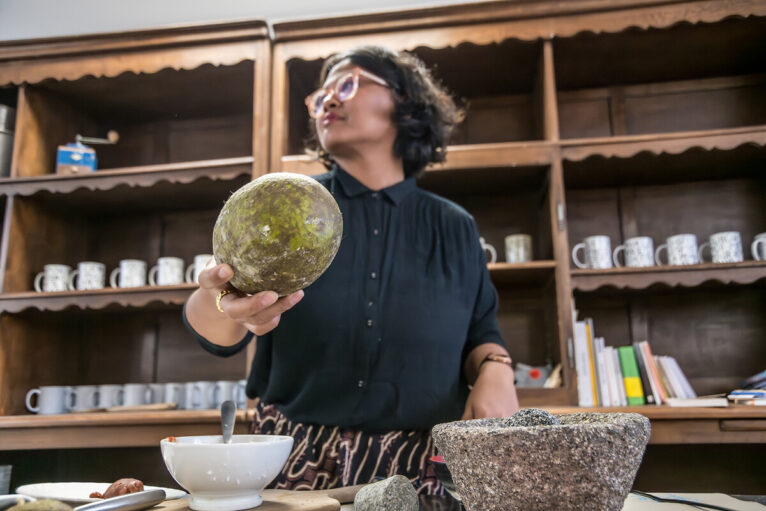
The artist Nathalie Muchamad’s nourishing workshop “du pain et du lait, une technologie tropicale,” December 6, 2025, as part of the program centre d’art nourricier 2024–2025–2026: Cycle 4, En des lieux sans merci, Centre d’art contemporain de Malakoff.
Photo: Séverine Fernandes
Courtesy the City of Malakoff
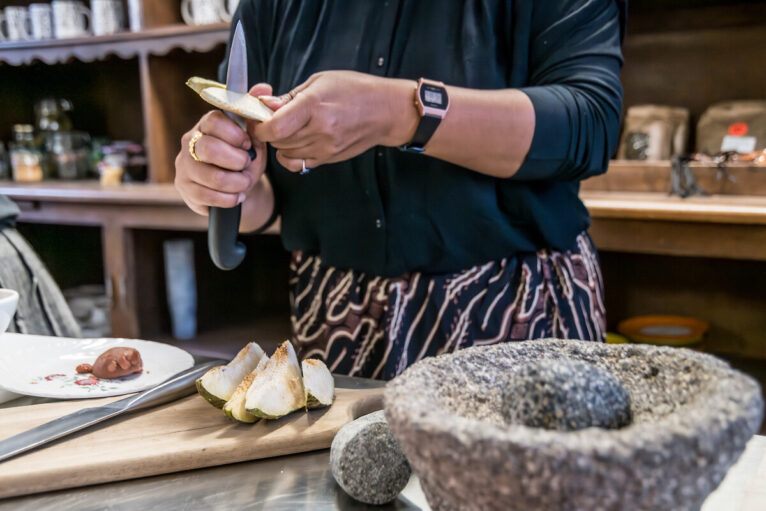
At the group exhibition in Malakoff, she tells us such a story through breadfruit. In recent years, we can frequently see artworks in international contemporary art exhibitions about colonial administration and plantation history. More often than not, these works try to elucidate the entanglements between colonies and empire through representative colonial cash crops such as cacao, sugarcane or coffee. However, what the breadfruit tries to tell us is a hidden story of how to feed the labor force working on plantations.
In 2024, at the invitation of Paris-based Turkish curator Asli Seven, Nathalie presented the first installation in the breadfruit series entitled Breadfruit, Mutiny, Planetarity. She narrates the story of breadfruit through a Hollywoodian lens.
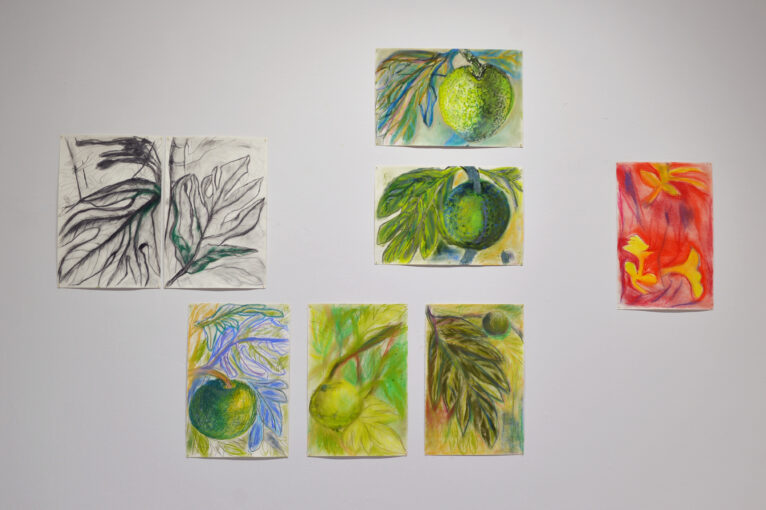
Nathalie Muchamad, Breadfruit, Mutiny and Planetarity, 2024, installation view at Asian Art Biennial, Taichung
© Nathalie Muchamad / ADAGP
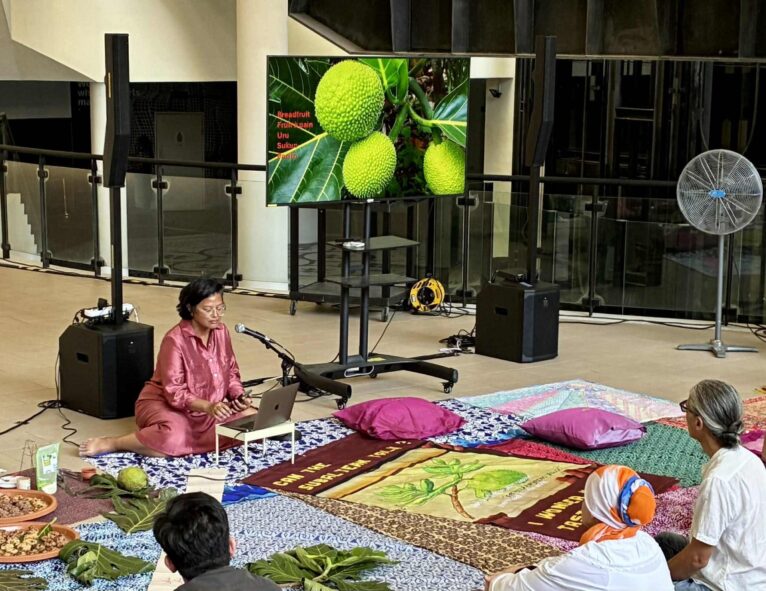
“Tasting Justice,” organized by Francis Maravillas and featuring Nathalie Muchamad, Singapore, 2025.
Courtney the artist
From 1780 to 1790, British Royal Navy vessel HMS Bounty undertook a mission in Polynesia under Captain Bligh. He was tasked with finding appropriate kinds of breadfruit fit for transplantation from Polynesia to the Caribbean in order to feed the slave population working in plantations cheaply. The Bounty sailors could not get enough of Tahiti and Polynesian beauties and had no heart for an arduous mission. Instead, they planned a mutiny.
The Bounty tale has graced Hollywood screens multiple times, with the 1962 version of Mutiny on the Bounty being the most famous. Handsome Marlon Brando played First Lieutenant Fletcher Christian who led the crew against an authoritarian Captain Bligh. It is a blockbuster about romance and exoticism, but what truly lured the British to Tahiti – the breadfruit saplings – became a harmless footnote.
Breadfruit, a crop that long traveled the Indian and Pacific oceanic region with Indigenous Austronesian communities, became a part of the plantation economic chain in the Age of Discovery. It reminds us not only that the Indian Ocean and Pacific Ocean are a continuous body of water, but also the fact that people have always migrated in it for whatever reason with their food and eating habits. These experiences are read in different lights of yore and of now.
Highly nutritious and high in carbohydrate content, breadfruit was looked down upon and ignored due to its connotation as a staple food of slaves. Now, breadfruit has become a superfood in the eyes of researchers precisely because it is nutritious, adaptable to climate change, good at sequestering carbon and is a perennial crop that requires minimal water and fertilizer to grow. For a long time post-Plantationocene, scholars and artists have focused on representative crops, not the nameless bite that fed the nameless slaves.
In a lot of former colonies, breadfruit trees, associated with slavery, withered because of this painful past and the rise of the Green Revolution. In France, the colonies who did not become independent became overseas departments or territories in the 1940s. In Réunion Island, located in the Indian Ocean, local inhabitant Mr. Pascal Aho tells me that the breadfruit is something he would eat as a child, but it has become less and less common now. Nobody is eating it means that nobody is planting new trees. If young people don’t know about breadfruit and don’t know how to plant it, its taste will gradually be forgotten.
Located east of Madagascar and west of Mauritius, Réunion Island was once a plantation island under French rule, and produced coffee, sugarcane, and vanilla. It went through slavery and indentured labor systems, and the ancestors of its current occupants came from all over the world, including white Europeans, Africans, Malagasy, Indians, Chinese, and more. All of them brought their own food. I was pleasantly surprised by Reunionese Creole restaurants discovering that a typical Creole meal can include a plat of sautéed bok choy like greens and a chayote cheese gratin.
Pascal’s mother was Chinese and his father Indian. Though he looked more Indian than Chinese, his heart belongs to Chinese culture and gastronomy. Pascal’s vegetable garden is a snapshot of this Creole world. The plants he tends to meticulously everyday included not only food brought by migrants, because home is also where the stomach feels at peace, but also storied ones such as the Bourbon vanilla that encapsulates in every pod the love and loathing of the colonies.
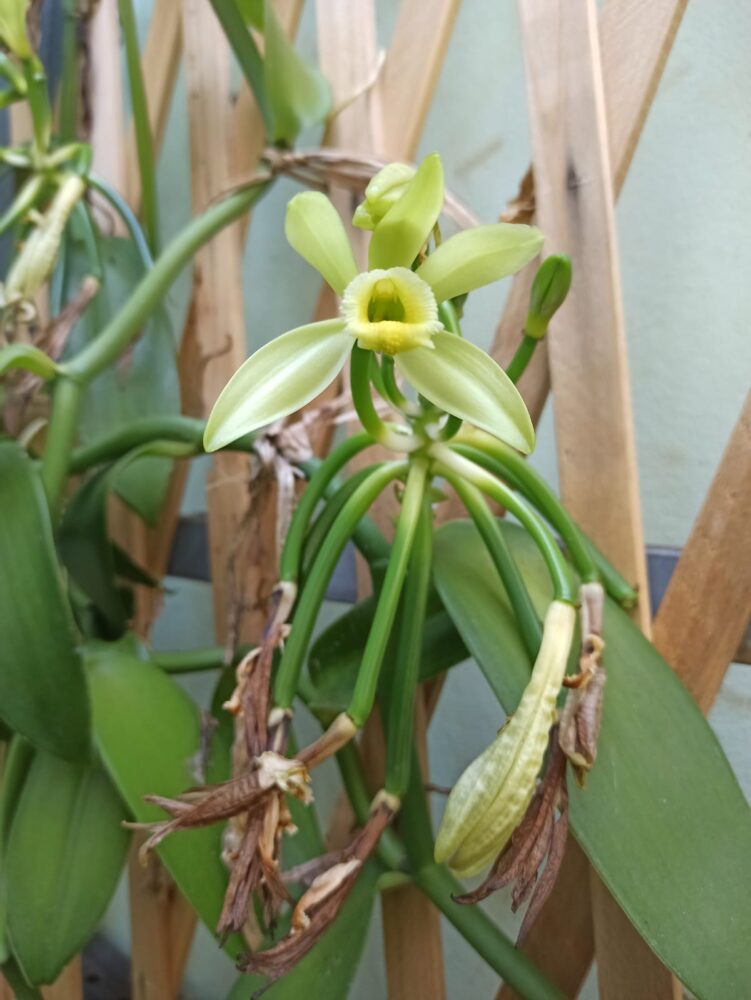
Bourbon vanilla
Courtesy Pascal Aho
When the New World plant vanilla was introduced to French colonies, its production encountered a bottleneck due to pollination difficulties until a 12-year-old enslaved boy Edmond Albius invented a way for artificial pollination. Réunion Island’s vanilla production bloomed, creating important wealth for the colonial empire. Dark-skinned Edmond left his name in the history books but died young in poverty. Today, the vanilla growing in Pascal’s garden is no commercial secret, but a result of his ingenious green fingers.
In Réunion Island today, the main staple is white rice. Speaking of which, we should circle back to the mid 20th century Green Revolution. This revolution brought forward new seeds, new varieties of crops, and changed the production methods and quantities in agriculture along with what’s in people’s plates. Crops like rice are far from endogenous plants for the island, and only substituted maize, breadfruit and cassava in recent years to become the irrefutable staple starch. White rice imported from South Asia’s large monoculture paddies is now the most commonly seen staple food.
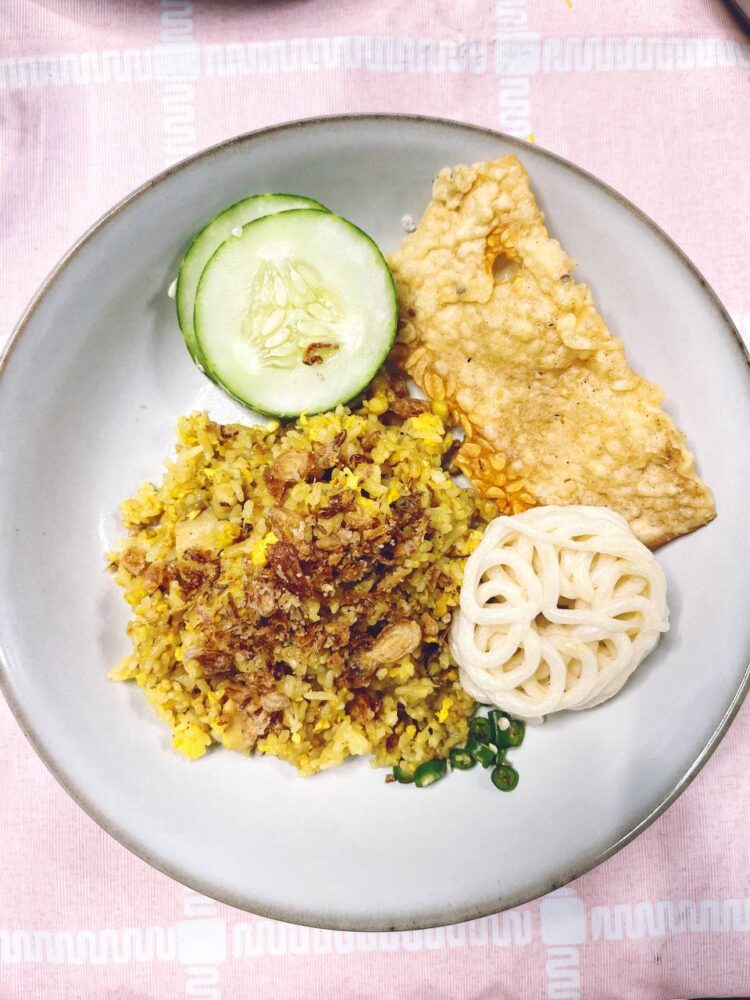
Nasi Goreng Suna Cekuh, a fried rice specialty in Bali
Photo & courtesy the artist and Practice Tuckshop
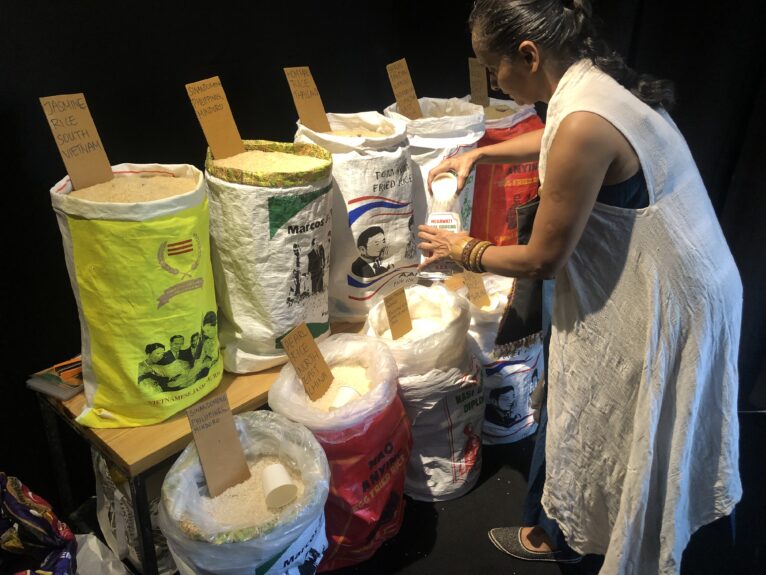
Chu Hao Pei, Nasi Goreng Diplomacy #1, installation view at the Serendipity Arts Festival 2023, Goa
Courtesy the artist
Singaporean artist Chu Hao Pei’s Nasi Goreng Diplomacy (2023—) is a work about the cultural and political meaning of fried rice. Former Indonesian president Megawati Sukarnoputri often used fried rice as a bottom-up grassroot diplomatic method to unite different communities and ease tense relations. Even though you and I fried rice in different ways, we should have enough of a common base to communicate and negotiate. White rice can always become fried rice, and there is nothing friendlier than sharing a meal. The universal meaning of fried rice enters the museum space through the artist’s work, and pursues this game of common base with added novelties. At a first glance, this would seem like what we define as food exchange and traditions.
Nevertheless, white rice is often criticized because it is not the most nutritious staple, nor the best for our bodies. Many Southeast Asian art collectives have spent years researching and paying attention to food, ever since before the Covid pandemic. Food, art, and the ecosystem are not only intimately connected to each other but also closely linked to the development of modern capitalist nation-states. Yogyakarta-based Bakudapan Food Study Group uses food-based activities and conversations to give the younger generation raised in cities opportunities to engage with issues like food policy, agricultural reform, and their implications in their daily lives. Concepts such as food security and food sovereignty thus emerge.
Incidentally, people’s memories are short. What the Reunionese and Indonesians recognize today is the homogenous and apparently clean white rice. Is this not a kind of gastrocolonialism? The fact we make the unconscious choice in supermarkets to easily acquire globalized, monocultural, and standard food products is a part of capitalist expansion. Our taste buds are also to be conquered, and history on the other hand, should be forgotten. Fortunately, unruly tastes still do exist.
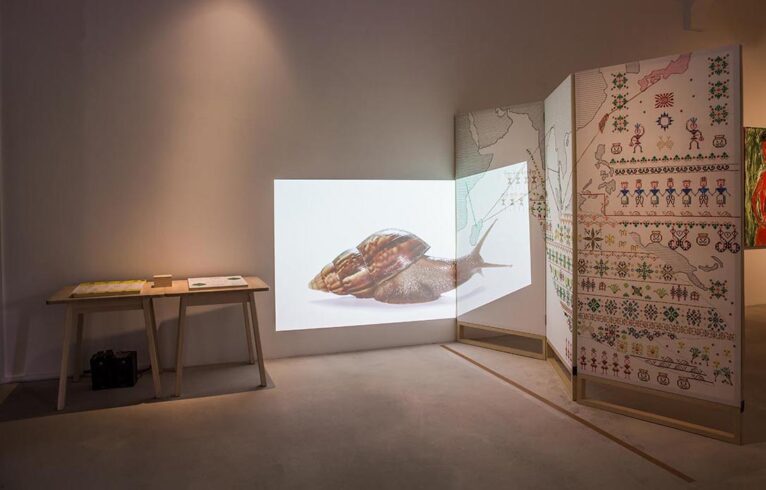
Chang En-Man, Snail Paradise, 2019
Embroidered screen, recipe, video, 300 × 200 cm
Installation view at Singapore Biennale, 2019
Courtesy the artist
In her series of work about the African snail (Achatina fulica), Taiwanese Paiwan artist Chang En-Man tells a story full of community boundaries and tensions about sea voyage and food hygiene through the snail’s drifting. Chang En-Man’s mother is from the Paiwan tribe and has the habit of collecting snails after rain and making a dish with them for her children. Chang’s memories of the snail are connected to her maternal family and Indigenous culture.
The African snail ventured out of Africa in the 1930s on cargo ships, and advanced like a checkers pieced through the Indian Ocean, from one British colony to another, and was introduced as a food species in Taiwan by Japanese colonial officers. Even though it had become a troublesome invasive species in many other places, the African snail became a delicacy in the dishes of many Taiwanese Indigenous communities and part of maintaining social relations on special occasions.
Snail mucus is poisonous and needs to be thoroughly cleansed before consumption. The snail that followed historical colonial migration became a part of Indigenous heritage in the swirls of history. However, the Han Chinese do not eat snails and think it is unclean. Different and new community boundaries are born. Chang En-Man combines cooking, sharing food and recipes with other artists and visitors with embroidery, singing, installations and video to engage a varied way to tell how this encounter happening in a slit ignites whole new understandings about knowledge and comfort. Colonial contacts are not all random or uncontrollable, sometimes they also grow new antennae.
From Columbus’s arrival to the New World at the tail end of the 15th century, Europeans expended all their nerve cells on knowing and appropriating knowledge of its agricultural and medicinal plants and transforming it into financial return. Ironically, the greater and more urgent the scale of imperial religious and colonial expansion, civilizing and evangelizing peoples of the New World all the while diligently surveying information on Indigenous life through questionnaires, the more knowledge becomes elusive and ruptured under the spread of Old World diseases and frequent forced displacements. In the words of French historian Samir Boumedienne, the colonization of knowledge is the ultimate goal of colonial expansion.[1]
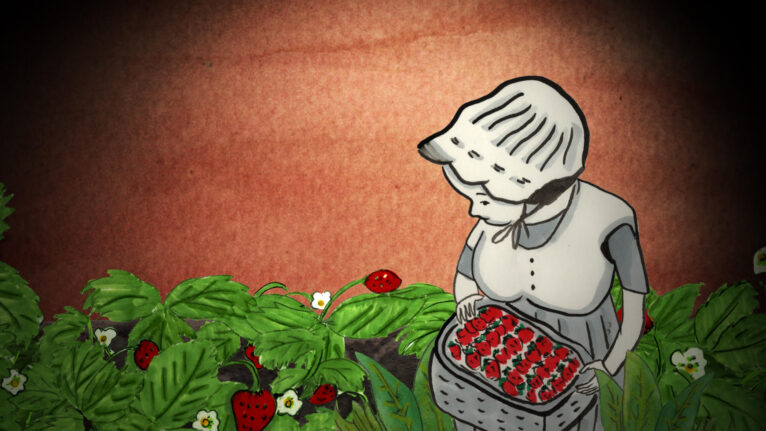
Cindy Mochizuki, Autumn Strawberry (still), 2021
Installation view, Surrey Art Gallery, Canada
Photo: Dennis Ha
Courtesy the artist
The expansion of frontiers always seems to be connected with claiming and plowing land. Only the land we can control with our own two hands seems real and reliable. This story continues until the latter part of the 20th century. Japanese Canadian artist Cindy Mochizuki dedicated a series of multimedia installations to tell the stories of Japanese farmers who have crossed the Pacific to cultivate land in Canada, and the unfair treatment they received during and after WWII. The memories and stories of Fraser Valley strawberry farmers became the main narrative of the hand illustrated feature animation film Autumn Strawberry (2021). What happens with crops and farmers in Canada, this vast and seemingly new federation stretching from sea to sea and disconnected from the old world, is always entangled with diasporic experiences and racial conflict.
Very often, even though the taste of home follows us, it is not necessarily home, and can also come from distant shores.
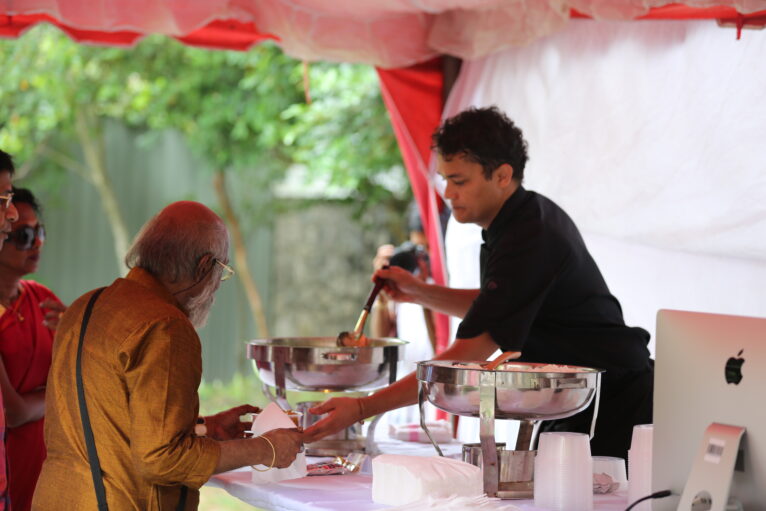
Jean-François Boclé, Colombo IN, 2016, participatory culinary performance-conference, at Conceiving Space, 4th Colombo Art Biennale
Photo: Sooriya © Jean-François Boclé / ADAGP
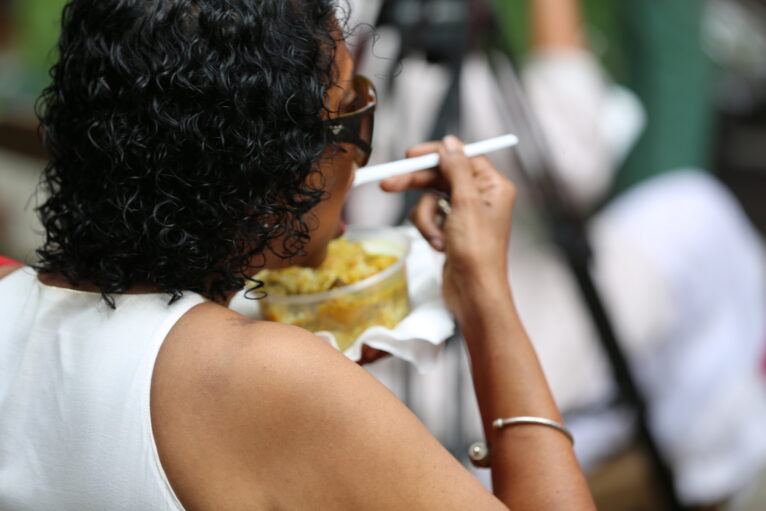
The colombo stew is a typical Creole dish from Martinique, a French overseas department in the Caribbean, and one of Martinique-born French artist Jean-François Boclé’s signature dishes. When he was invited to participate in the 4thColombo Art Biennale in Sri Lanka in 2016, he made this dish a part of his lecture performance. While he cooked colombo for more than two hundred attendees, Boclé told the story of how Asian indentured labor crossed the oceans in the last century. They learned how to use different spices in their new home, such as the Jamaican pepper, and used these to make the taste of a new home infused with memories of an old home.
Artist Richard Fung was born in Trinidad in the Caribbean but now based in Toronto, Canada. When he is homesick, he always goes to eat a dal puri, and that makes the harsh northern winter more bearable. He thought that the dal puri is an Indian dish who has crossed the waters, but it was only after filming Dal Puri Diaspora (2012) that Fung realized that there is no such thing as the dal puri he knows in India, just like there are no fortune cookies in China. Even though Richard found the dal puri in his travels on a stop in the Indian Ocean, in Mauritius to be precise, he did not find the dal puri he imagined at what was supposed to be the final destination in his investigation in Bihar, India. Finally, Richard Fung, who is not a gourmet chef, started making his own dal puri.
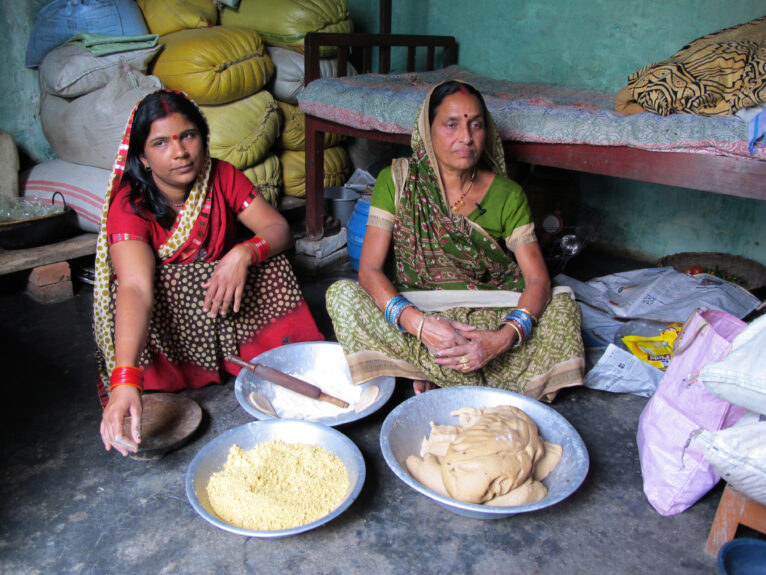
Preparing dal puri, Bihar
Courtesy Richard Fung
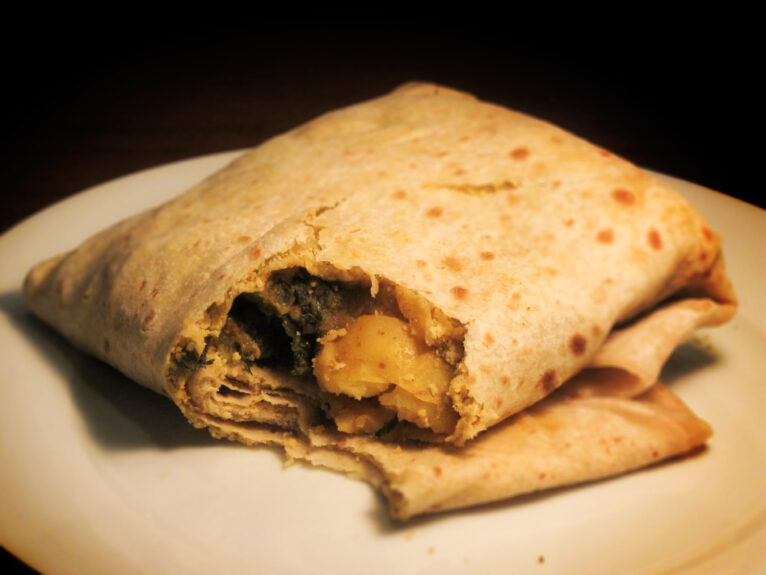
Trinidad-style dal puri, Toronto.
Courtesy Richard Fung
In the vast expanse of the Indian and Pacific oceans, willingly or unwillingly, people often embarked on journeys with no return. This helpless destiny seems to easewhen we can hold a cooking spatula, and life gains a bit more breathing room when we hold some autonomy in our hands. In the continuation of Nathalie Muchamad’s works, the Austronesian breadfruit is no longer a monotonous existence, and it has regained many names from its own past. She collects its many names, many pasts, many recipes, and many meanings in different communities, making it live again. In Indonesian, breadfruit is called sukun, which also means peace and tranquility in Arabic. There is also always a breadfruit tree in front of an Indonesian family home, feeding this family. In the newly opened Yogyakarta Biennale where Nathalie exhibited Sukun, let’s mutiny (2025), the breadfruit breaks away from the Bounty narrative. Besides cooking and sharing activities, the visitors can now rest and take a nap on pillows embroidered with the word “sukun,” claiming immobility as a defense against the everchanging world.
[1] See Samir Boumediene, La colonisation du savoir. Une histoire des plantes médicinales du « Nouveau Monde » (1492-1750), Vaulx-en-Velin, Éditions des Mondes à faire, 2016, 477 p.
Lou Mo is an artist and curator based in France. Her research is focused on modern and contemporary Afro-Asian connections and Third World artists’ creative practices. She is also interested in issues of diaspora, identity, and perception in relation to post-colonial history and the center-periphery model.