From Divine Maiden to Heavenly Empress: The Historical Formation of Mazu Belief and the Maritime Imaginary
| June 1, 2026
Text by Zixi
Translated by Gao Chang

A pilgrimage ritual at the Meizhou Island Mazu Ancestral Temple in October 2025. Worshipers wear vests printed with the slogan “One Family United under Mazu,” symbolizing the role of contemporary Mazu culture as a unifying social bond.
Photo: Zhang Taotao
Fujian’s terrain appears to be composed half of mountains and half of sea, yet in fact it is commonly described as “eight parts mountains, one part water, and one part farmland.” Mountainous and hilly landscapes account for more than eighty percent of the province’s total area; arable land is scarce, the soil is poor, and the population is dense. Under such conditions, turning toward the vast ocean in search of space for survival and development became an inevitable choice for the people of Fujian. With a coastline extending nearly four thousand kilometers, winding and indented, Fujian is endowed with numerous natural harbors. The sea provided Fujianese communities with food, wealth, and avenues of livelihood. Yet making a living from the sea was never easy. Fujian’s coast directly faces the Taiwan Strait, where typhoons are frequent and maritime conditions are complex and highly variable. Under the constraints of limited navigational technology in pre-modern times, every voyage to sea concealed risks and uncertainties, often amounting to a test of life and death.
Marine practices and cultural formation in Fujian’s coastal regions unfolded through a long historical process. As early as the Classic of Mountains and Seas (Shanhai jing), the phrase “Min lies within the sea” (Min zai haizhong) already appears. Archaeological discoveries at the Keqiutou site in Pingtan and the Tanshishan site in Minhou indicate that the ancestors of Fujian had begun engaging in nearshore fishing and shellfish gathering as early as the Neolithic period. At this stage, however, Fujian was located on the periphery of the Huaxia cultural sphere and maintained relatively limited interaction with the Central Plains civilization; its development was comparatively independent. The description “Min lies within the sea” thus functioned more as a characterization of geographical location than as a marker of maritime orientation.
By the Han dynasty, the Book of the Later Han (Hou Hanshu), in the “Biography of Zheng Hong,” records that “the tribute and transport from the former seven commanderies of Jiaozhi all arrived by sailing from Dongye across the sea,” indicating that Fuzhou (Dongye) had already become an important node in maritime transport networks. It was not until the Tang and Song periods, however, when regimes based in the Central Plains began to actively administer the southeastern coast, that Fujian’s maritime practices entered a golden age. During the Tang dynasty, the traditional overland Silk Road was frequently disrupted by warfare in the Western Regions, prompting renewed exploration of the possibilities of a Maritime Silk Road. The Song dynasty marked the period when Fujian’s inhabitants truly began to venture overseas on a large scale. The prolonged conflicts in the Central Plains highlighted Fujian’s geopolitical advantage as a relatively sheltered region, distant from the main theaters of warfare. Aristocratic families from the Central Plains gradually migrated to Fujian, bringing with them Confucian learning and the civil service examination system, which interacted with indigenous Min-Yue cultural traditions.
The large influx of population led to food shortages, and increasing numbers of Fujianese were compelled to leave their native places in search of livelihoods elsewhere. At the same time, driven by fiscal needs, the Song court actively promoted overseas trade, establishing maritime trade offices (shibosi) in Quanzhou and other ports.

The interior of the Xinghua Prefecture City God Temple, originally constructed in the third year of the Hongwu reign of the Ming dynasty (1370). The temple remains in active use today, serving as a site for popular devotional practices, with incense offerings and ritual goods visible.
Photo: Zixi

The interior of the Xinghua Prefecture City God Temple
Photo: Zixi
It was precisely during the Song dynasty (960 CE) that Mazu, Lin Mo Niang, was born on Meizhou Island in Putian. Her emergence was by no means accidental; rather, it constituted a cultural manifestation of the increasing density of Fujian’s maritime practices during the Tang-Song period. Legends of her ability to foresee weather conditions and rescue people at sea, as well as accounts of her miraculous powers, directly resonated with the most fundamental concerns of the vast population engaged in seafaring. As these maritime communities traveled overseas, belief in Mazu spread with their voyages beyond regional boundaries. With the efforts of the Putian gentry and the maritime merchant class, both of which grew increasingly powerful during the Song dynasty, Mazu belief was elevated in status and incorporated into more orthodox frameworks. After the Song period, through the Ming and Qing dynasties, Mazu’s image and artistic representations were continually reshaped and enriched in response to changing historical contexts, eventually extending into the modern era. Mazu belief employed theatrical and ritual practices as mediating forms; through successive processes of embodiment across different periods, it was gradually woven into a coherent narrative and visual system.
I. The Divine Maiden
Prior to Mazu becoming Mazu, Fujian people had already accumulated experiences of engagement with the sea, from which early imaginaries of maritime departure emerged. In antiquity, Fujian was known as “Min.” The Shuowen jiezi glosses Min as “the southeastern Yue, a serpent lineage,” a definition that has given rise to the conjecture that the ancient Min-Yue people regarded the serpent as their totem and considered themselves descendants of serpents. Traces of this belief are deeply inscribed in religious sites across Fujian, such as serpent-king temples in Zhanghu and Nanping. Serpents are adept at swimming, and their bodily form bears visual resemblance to ocean waves. In the imagination of ancient people, serpents may have been envisioned as capable of transforming into jiaolong—mythical creatures endowed with divine power over waters, able to command winds and stir waves. This form of primordial serpent worship was perhaps later absorbed and transformed through the sinicization of local cultures, becoming incorporated into Dragon King belief.
However, belief in the Dragon King does not yet constitute a maritime deity lineage in the strict sense. Rather, it derives from ritual traditions of agrarian societies along the Yellow River, Huai River, and Yangtze River basins. Mazu scholar Xu Xiaowang notes in A Study of the History of Mazu Belief (2007) that:
“The Chinese nation originated inland and was relatively unfamiliar with the sea. During the Zhou dynasty, sacrifices were offered to the gods of the Five Sacred Peaks and the Four Watercourses. The Four Watercourses referred to water deities, namely, the gods of the Yellow River, the Yangtze River, the Huai River, and the Ji River, among which no sea deity was included. This mode of thought was distinctive to the Huaxia peoples residing in the Central Plains.” [1]
The maturation of a maritime deity lineage thus proceeded in step with the historical development of seafaring practices. Scholar Wang Rongguo, in Oceanic Deities: Chinese Sea-God Beliefs and Local Economies (2003), traces the historical evolution of sea-god worship as follows: in remote antiquity, there already existed a generalized and abstract veneration of marine waters; during the Western Zhou period, totemic representations of the “Gods of the Four Seas” emerged; it was not until the Tang dynasty that anthropomorphized sea deities appeared in popular belief, such as the female sea deity Guanyin. By the Song-Yuan period, “the female sea deity Lin Mo Niang of Meizhou Island in Putian, Fujian, received official investiture from the imperial court, thereby laying the foundation for her emergence as a national sea deity. During the Ming and Qing dynasties, the divine status of Lin Mo Niang, namely, Mazu, continued to rise; she was successively conferred the titles of ‘Heavenly Empress’ and ‘Heavenly Holy Mother,’ ultimately becoming the supreme sea deity.” [2]
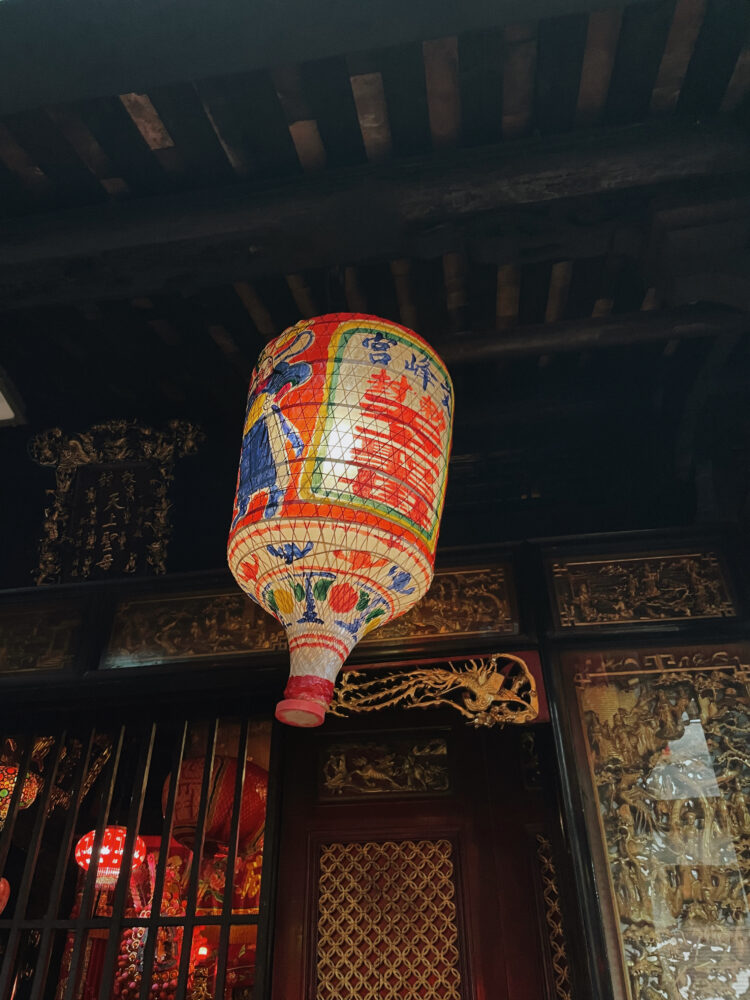
Multiple oil-paper lanterns hang within the Mazu Temple of Wenfeng Palace. In the foreground, one lantern bears the inscription “Imperially Enfeoffed Heavenly Holy Mother” (Chifeng Tianshang Shengmu).
Photo: Zixi
Prior to her official investiture, Mazu, or Lin Mo Niang, was more commonly referred to by local communities as the “Divine Maiden of Meizhou.” At this stage, the Divine Maiden had not yet become a nationwide protector of maritime navigation, nor was the safeguarding of seafaring her original function. Rather, this role emerged gradually in response to changes in maritime modes of production and social relations. The Min region had long been afflicted by miasma and endemic diseases, with epidemics occurring frequently. Indigenous populations in Fujian traditionally revered shamanic practices and the spirit world, seeking relief from suffering through the ritual interventions of shamans (wu) and incantatory healing rites. The Divine Maiden herself was originally a rural woman from Putian. Known from an early age for her intelligence, she was said to have mastered ritual techniques, possessed medical knowledge for treating illness, and was capable of drawing talismans and expelling malevolent forces. She was thus recognized in popular belief as a female shaman endowed with supernatural powers. Praying for clear skies or rainfall, averting calamities, and dispelling epidemics constituted the principal sphere of the Divine Maiden’s functions within the local community.
In Record of the State Conferred Heavenly Empress (Chifeng Tianhou zhi, 1778), compiled by Lin Qingbiao, a descendant of the Lin lineage during the Qianlong reign of the Qing dynasty, it is possible to trace the earliest account of the Divine Maiden of Meizhou receiving imperial bestowal. According to this text, vessels dispatched by the Northern Song court on a long-distance maritime mission to Goryeo encountered severe winds and waves. The ships were rescued after encountering a female sea deity, and subsequently completed their voyage safely. As the specific identity of the deity was unknown, the court conferred titles upon a group of coastal protective deities, among whom was the Divine Maiden of Meizhou in Fujian, who received the title Shunji (“Smooth Passage”). The suppression of maritime banditry may represent the first clearly articulated function of the Divine Maiden in relation to seafaring affairs.
By the Southern Song period, piracy had become prevalent along the Fujian coast, prompting the court to strengthen its naval forces. The Fujian navy frequently offered prayers to the Divine Maiden of Meizhou both before and after military engagements. During the Jiading reign (1208–1224), large bands of pirates invaded the Quanzhou region. At that time, the prominent Neo-Confucian scholar Zhen Dexiu served as Prefect of Quanzhou; in his efforts to pacify the pirates, he repeatedly prayed to the Divine Maiden of Meizhou [3]. In the later Southern Song, in recognition of her efficacious manifestations in rescuing vessels and providing powerful protection, the Divine Maiden of Meizhou was conferred the title “Holy Consort” (Shengfei). The earliest extant textual source concerning the Divine Maiden is Record of the Reconstruction of the Shunji Temple at the Ancestral Sanctuary of Shengdu (1150), authored by Liao Pengfei, a tezouming Palace Graduate ( “jinshi”) of the Southern Song. This text indicates that the legends surrounding the Divine Maiden had begun to undergo a process of textualization.

The interior of the Xinghua Prefecture City God Temple
Photo: Zixi
Textualization came to symbolize the further incorporation of belief in the divine maiden into both official and popular imaginaries concerning maritime departure and overseas travel. The Ming-dynasty printed novel Tianfei Lin Niangniang zhuan (The Biography of Heavenly Consort Lady Lin) elaborates upon the goddess’s life origins, stating that she was “of Daoist divine origin, and, upon receiving the command of Guanyin, was reborn in the household of Elder Lin in Putian County, Xinghua Prefecture, Fujian. From childhood she recited scriptures and invoked the Buddha, practiced bugang tadou (meaning pacing the guideline and treading on the stars of the Dipper) as a means of cultivation. Thereafter she resolved to attain the Dao, selected an auspicious day to establish a grand ritual altar at her home, and finally bade farewell to her parents. By the banks of the Xianliang River, she “removed one embroidered shoe from beneath her feet and cast it into the river; the maiden then drifted away, riding the current toward Meizhou.” [4] Through such narration, the goddess is connected with more universal and orthodox systems of values, thereby increasing the sense of her exalted and sacred status.
Records of the Manifest Efficacy of the Heavenly Consort (Tianfei Xiansheng lu, also known as The Records of the Manifested Holiness of the Heavenly Princess) likewise records multiple legends concerning the Divine Maiden. It relates that Caizi Islet was barren and unproductive, whereupon the Divine Maiden scattered seeds upon it, causing vegetables to grow so that the island’s inhabitants would have produce to eat. On another occasion, a merchant vessel encountered heavy seas and was on the verge of sinking; the Divine Maiden took several blades of grass at hand and transformed them into a row of large fir logs, which attached themselves to the ship and prevented it from foundering.
Seafaring was arduous, and these stories all reveal the local populace’s simple aspiration for the Divine Maiden to manifest her power in order to alleviate the hardships of everyday life. Such spontaneity is particularly evident in the artistic form of popular folk theater. In Putian, a Mazu opera entitled Tianfei Xianglong Zhuan (The Complete Script of the Heavenly Consort Subduing the Dragon) [5] circulates among the people; it tells of sea monsters wreaking havoc and oppressing fishermen, and of Mazu subduing the Dragon King of the Eastern Sea, thereby restoring order and pacifying the spirits. In eastern Fujian, the siping puppet theater, a more archaic theatrical form, also preserves plays that record the deeds of the Divine Maiden. Works such as Water Realm Cavern, Offering to the Jellyfish Mother, and Subduing the Wooden Fish Spirit all center on the Divine Maiden’s use of ritual power to overcome malevolent beings that cause disturbances at sea.
II. Going to Sea
Belief, however, has never been merely the veneration of miraculous manifestations, nor simply the expression of people’s modest hopes for a smoother life. It also functions as a conduit through which power operates in subtle and concealed ways. The American sinologist Edward Hetzel Schafer observes in The Empire of Min: A South China Kingdom of the Tenth Century (1980) that such omens appeared in a monotonous and regular pattern, closely linked to the most important political designs of the time—designs intended to shape popular opinion as well as to influence the perceptions of the emperor. [6]
The elevation of the Divine Maiden of Meizhou from a local deity to the supreme protector of maritime navigation and the subsequent spread of her belief across the Chinese realm and into the maritime zones of Southeast Asia were likewise not achieved in a single step. Rather, this transformation was accomplished through increasingly close interactions with central political authority, within which her status was progressively upgraded.
The central dynasties, which strengthened their rule through top-down moral instruction, and local belief systems represented by Mazu originally constituted two distinct narrative systems. Yet the gradual officialization of the Mazu narrative precisely reflects the former’s sustained efforts to appropriate and integrate the latter —— a process that has left crucial traces in both oral history and visual history. For example, during the Yuan dynasty, the Divine Maiden continued to receive reverence and additional titles due to her perceived capacity to protect maritime transport and the grain tribute system. In the eighteenth year of the Zhiyuan reign (1281), under Kublai Khan, she was formally enfeoffed as the “Heavenly Consort of Illustrious Manifest Efficacy Who Protects the State” (Huguo Mingzhu Tianfei). From that point onward, Tianfei (“Heavenly Consort”) became the most standardized and exalted official title.
The timing of grain-transport voyages closely coincided with the ritual calendar of Heavenly Consort worship: in spring on the twenty-third day of the third lunar month, and in autumn on the ninth day of the ninth lunar month. Offering sacrifices to Mazu prior to departure and praying for safe passage thus became a sacred rite of navigation. In the early Ming period, the Ming military was ill-prepared for naval warfare; raids by wokou pirates were frequent, and Western colonial forces were advancing eastward. Under these circumstances, maritime prohibition (haijin) became a defining policy of the Ming state. Against this backdrop, Mazu’s protection of Zheng He during his voyages to the Western Seas constituted a pivotal event in the further elevation of her divine status in the Ming dynasty. From this point onward, Mazu was not only officially recognized as a maritime protector of navigation; her function expanded from safeguarding voyages to protecting the state itself. The belief system associated with her also achieved overseas dissemination.
This episode is recorded in the stone murals of the Ancestral Mazu Temple on Meizhou Island. It is likewise documented in the Xinghua Prefecture Gazetteer of the Wanli reign, which states:
“In the fifth year of the Hongwu reign of the present dynasty, she was enfeoffed as the Filially Devoted and Pure, Efficacious and Responsive Holy Consort. In the early years of the Yongle reign, when the imperial eunuch Zheng He and others sailed to the Western Seas, they relied upon the deity at sea; in moments of peril, wondrous lights were repeatedly observed. Upon their return, a memorial was submitted requesting that the garrison officials of Fujian be ordered to rebuild her temple.”

Along the pilgrimage route to Mazu on the southern axis of the Meizhou Island Mazu Ancestral Temple, a monumental stone sculpture of Mazu emerges at a turning point along the path, partially concealed amid the surrounding landscape.
Photo: Bai Mao
The historian You Jianxi argues that “the most significant period influencing the formation of Mazu worship should be the Yongle reign of the Ming dynasty. This was because Zheng He’s seven voyages to the Western Seas expanded China’s overseas influence and commercial routes, and Mazu worship likewise extended to the countries of the Western Seas.” [7] From his analysis in Zheng He’s Voyages to the Western Seas and the Overseas Transmission of Mazu Worship, it can be seen that the “various foreign polities” (zhufan) visited during Zheng He’s seven voyages included the Kingdom of Ceylon and the Kingdom of Sumatra, as well as Java, Calicut, Cochin, and Siam——covering large parts of what are today Sri Lanka, Indonesia, Thailand, and other regions of Southeast Asia.
Both Luodong ji and Changle ji record Zheng He’s construction of temples and shrines in overseas regions. As stated in the Changle ji: “This spring we again journeyed to the various foreign lands……and furthermore, out of compassion, distributed funds to erect a Hall of the Three Pure Ones.” You Jianxi notes that the Hall of the Three Pure Ones enshrines the Daoist Three Pure Ones, and that Mazu may also have been worshiped therein, since the primary purpose of building such halls and offering sacrifices to deities was to express gratitude for Mazu’s protective grace.[8] As Mazu belief accompanied Zheng He’s fleets overseas, it projected the authority and splendor of the Ming dynasty outward, dispersing across foreign lands much like the ritual “division of spiritual power” (fenling). Although distant devotees would not have regarded themselves as thereby submitting to imperial rule, whenever they sought to venerate the Heavenly Consort, the direction of their prostration was necessarily oriented toward her place of origin: Meizhou in Putian, an imperial territory of the Ming realm.

The statue of Mazu enshrined in the Tianhou Hall of the southern-axis complex at the Meizhou Island Mazu Ancestral Temple, together with offerings of ritual items, incense, and flowers. Behind the altar, a newly constructed monumental clay sculpture of Mazu gazes down with a compassionate expression.
Photo: Bai Mao
During the Ming-Qing transition, the Zheng regime loyal to the Ming established Taiwan as its base and waged anti-Qing, pro-Ming resistance along the southeastern coast for as long as forty years, posing a serious threat to the Qing state. In the twentieth year of the Kangxi reign (1681), the Qing-defecting general Shi Lang led troops across the sea, advanced on Taiwan, defeated the Zheng regime, and formally incorporated Taiwan into Qing territory. In this process, Mazu, who had been honored as a sea deity under the Ming, was again granted imperial titles by the Qing, owing to the legend that she “caused springs to gush forth to aid the army” (yongquan ji shi) in support of Shi Lang’s campaign. Mazu belief thus appears to have become a particularly expedient instrument for dynastic rulers: a form of worship whose identity had originally been conferred through official enfeoffment was, in turn, transformed into a representative of official authority, mobilized to legitimize acts of conquest. Following Shi Lang’s reconquest of Taiwan, the Qing court, acting upon his petitions, conferred upon Mazu the title “Heavenly Empress” (Tianhou) in 1684, one of the highest honorific titles granted to a deity under imperial rule.
At the Ancestral Mazu Temple on Meizhou Island, murals depicting Zheng He’s voyages to the Western Seas are juxtaposed with murals showing Shi Lang requesting imperial recognition of Mazu following his military expedition. Within the sculptural ensemble of maritime generals on Meizhou Island, only Shi Lang, a Qing general, is enshrined; Zheng Chenggong (Koxinga), a leading figure of the Zheng regime, is notably absent. This selective commemoration bears clear traces of Qing official ideology embedded in the sacred landscape of Meizhou Island. The contest over the authority to shape sites of Mazu worship thus became a crucial arena of political negotiation between the Ming and Qing. By this point, the progression of titles—from Shunji, to Chongfu Furen, to Tianfei, and finally to Tianhou—reveals that the relationship between Mazu belief and imaginaries of seafaring functioned as a series of footnotes to the shifting claims of central political authority across different historical periods.
III. The Theater Stage
On the stone wall of the mountain gate of the City God Temple in Xinghua Prefecture, Putian, the title of a Puxian xi opera tune, Caidinggui, is carved in seal script. Caidinggui is a typical Confucian didactic narrative. During the Jiajing reign of the Ming dynasty, wokou pirates ran rampant and violated the maritime frontier. The emperor dispatched the grand commander Qi Jiguang to campaign across the seas and suppress the maritime disturbances. After many years of warfare, Qi returned to court and received imperial rewards. Among his valiant officers, Yang Xian distinguished himself through military merit. However, during the anti-piracy campaigns he became separated from his wife and two sons, their fate unknown. As a reward for his service, he petitioned the emperor to assist in reuniting his family. After a series of conflicts and reversals, the family was finally reunited, harmony between mother-in-law and daughter-in-law was restored, and the didactic purpose of moral instruction was fulfilled.

The theatre stage of the Xinghua Prefecture City God Temple, situated between the mountain gate and the main hall. The couplet inscribed on the pillars reads, “Entering with loyalty, departing with filial piety to uphold orthodox moral teachings; songs before and dances behind depict Great Peace,” reflecting the dominant moral values of the period.
Photo: Zixi
In earlier Mazu legends, the dangers of the sea arose from the context of arduous subsistence, grounded in awe and mystery inspired by the natural world. In elevated, didactic theatrical narratives such as Caidinggui, by contrast, maritime danger is framed as a threat to state development itself, and therefore calls more urgently for value systems such as the dictum sung in the lyric “Among all virtues in worldly affairs, filial piety comes first; the mother is the earth, the father the heaven,” to stabilize popular sentiment. For the anti-piracy general Yang Xiancai, the most essential hope is precisely that maritime affairs remain calm and that the family be reunited. At this point, Confucian moral instruction and the sea-goddess belief centered on Meizhou Island—systems that had once existed in relative independence and represented the divide between official and popular spheres, center and periphery, land and sea—gradually converged in the modern period, woven into a unified ideological formation.

A distant view from Meizhou Island toward the urban area of Putian. In the foreground, Mazu-related signage and guesthouse buildings intersect with an industrial zone visible in the distance, highlighting the juxtaposition of devotional imagery, tourism infrastructure, and industrial landscape.
Photo: Bai Mao

The harbor of Meizhou Island, one of the most important ports in Fujian Province. Enclosed by mountains on three sides, the bay forms a natural deep-water harbor well suited to the transport of bulk cargo. These favorable geographical conditions give rise to an unresolved question: whether Mazu’s protection and miraculous efficacy preceded the emergence of the good harbor, or whether the formation of the harbor itself came first.
Photo: Bai Mao
Today, upon arriving on Meizhou Island, along the road leading to the Mazu Ancestral Temple, one encounters classical red-brick dwellings, swallowtail roofs, small polychrome figurines of maritime generals set among roof tiles, and oil-paper lanterns suspended from gateways. Together, these elements evoke the auspicious wish associated with Mazu’s guidance at sea and the lighting of lamps to “illuminate the way home,” quietly recalling earlier imaginaries and memories tied to maritime departure. At the same time, contemporary manifestations of Mazu belief are visible throughout the island. A prominent example is the expansive Tianhou Square, a large plaza funded through donations from Chinese communities worldwide. It has become the central venue for cultural tourism festivals and large-scale collective rituals, capable of accommodating tens of thousands of participants. Within the Shunji Hall stands a pure-gold statue of Mazu, weighing 323 kilograms and measuring 3.23 meters in height. Initiated by the board of the Mazu Ancestral Temple and cast through collaboration between experts from both sides of the Taiwan Strait, the statue functions as an invisible yet powerful contemporary bond, drawing together devotees from diverse backgrounds.
Opposite the deity statue, Tianhou Square also features a newly constructed, architecturally modern theatrical structure: the Tianhou Grand Theater, modeled after the spatial layout of the ancestral temple. In addition to hosting large-scale events, the theater serves as a venue for newly created performances themed around Mazu folk traditions, as well as digital theatrical productions connected to Meizhou Island’s cultural tourism initiatives. Currently staged at the Tianhou Grand Theater is First Encounter with Mazu, a laser light spectacle in digital theatrical form. Elsewhere on the island, at the Ruyi Theater, the immersive production Impression · Mazu is performed, incorporating cutting-edge technologies such as extended reality (XR).
In 2017, the Fujian Puxian Theater produced a newly adapted legendary opera entitled The Sea Goddess Mazu. Like most folk narratives concerning Mazu, the production takes as its principal plotline episodes from the life of Lin Mo, including “burning the house to guide ships” “subduing the mechanism to save her kin,” and “combing her hair to vow her resolve” [10]. At the same time, it places the central dramatic conflict in the emotional entanglement of the mother, who is anxious and unsettled by Lin Mo’s unresolved “marital affairs.” When the mother grows angry, Lin Mo responds with childlike coaxing, while her father interjects with comic relief, attempting to interpret Lin Mo’s growth through modes of family relations familiar in contemporary life. In this way, the production draws Mazu down from a sacred and distant celestial realm into the sphere of secular imagination.
The opera further introduces an episode in which a Persian merchant vessel is rescued under Mazu’s protection. Through the promotional slogan “the Guardian Deity of the Maritime Silk Road,” the Divine Maiden is incorporated into a present-day strategic discourse. The production subsequently participated in the Maritime Silk Road International Theater Festival, touring Southeast Asian countries such as Singapore and Malaysia. The recurring fate of Mazu, being continually appropriated by official institutions and mobilized as cultural capital “going overseas,” thus continues to unfold in the contemporary era.
Contemporary imaginaries of the ocean differ markedly from ancient narratives in which the sea was often depicted as perilous, ominous, mysterious, and aggressive. For younger generations, belief in Mazu has increasingly taken the form of a leisure-oriented pursuit of mental and spiritual well-being. Matters both large and small in everyday life may be addressed through ritual acts, casting divination blocks when faced with uncertainty, seeking Mazu’s guidance in decisions, and praying for prosperity in business, wealth, and romantic relationships. From a broader political perspective, the cultural logic with which Mazu belief now aligns no longer centers primarily on production and security, as it did in pre-modern contexts. Instead, it functions as a cultural strategy for forging affective connections with Chinese communities and neighboring regions. The appeal of the ocean, together with the imaginaries of going to sea that accompany it, has never been neutral: it is always an intention, a narrative formation produced through ongoing negotiation and entanglement between center and periphery, official authority and popular practice. Belief constitutes the gathering of this intention; art, in turn, serves as its reflection.
Notes
[1] Xu, Xiaowang. A Study of the History of Mazu Belief (Mazu xinyang shi yanjiu). Haifeng Publishing House, 2007, p. 55.
[2] Wang, Rongguo. Oceanic Deities: Chinese Sea-God Beliefs and Local Economies (Haiyang shenling: Zhongguo haishen xinyang yu difang jingji). Jiangxi University Press, 2003, p. 12.
[3] Xu, Xiaowang. A Study of the History of Mazu Belief (Mazu xinyang shi yanjiu). Haifeng Publishing House, 2007, p. 40.
[4] Ye, Mingsheng. A Study of the Cultural Ecology of Puxian Theater (Puxian xiju wenhua shengtai yanjiu). Xiamen University Press, 2007, p. 425.
[5] Meizhou Daily (Overseas Edition), 17 November 1999.
[6] Schafer, Edward H. The Empire of Min: A South China Kingdom of the Tenth Century. Translated by Cheng Zhangcan and Hou Chengxiang, Shanghai Culture Publishing House, 2019, p. 171.
[7] You, Jianxi. “Zheng He’s Voyages to the Western Seas and the Overseas Transmission of Mazu Worship.” China Taoism (Zhongguo Daojiao), no. 4, 2007, pp. 41, 43.
[8] Ibid.
[9] “Puxian” refers to the combined geographical designation of Putian and Xianyou in Fujian Province. Puxian opera traces its lineage to the Southern Drama (nanxi) of the Song dynasty and is regarded as one of the oldest surviving forms of classical Chinese theater.
[10] “Burning the House to Guide Ships” refers to the legend in which Lin Mo sets fire to her ancestral home, producing light in the darkness to guide vessels that have lost their bearings during storms at sea. “Subduing the Loom to Save Her Kin” recounts the story in which Lin Mo, while weaving at a loom, senses that her father and brothers are in distress at sea and, through spiritual projection, goes to rescue them. “Combing Her Hair to Declare Her Resolve” denotes Lin Mo’s act of combing her hair to signify her lifelong vow of celibacy, renunciation of worldly ties, and dedication to the salvation of sentient beings.
Zixi is a PhD candidate in Drama and Theater Studies at the China National Academy of Arts. Her research focuses on theater history and theory, with particular attention to the dramatic adaptation of literary works and visual culture. Her scholarly articles have been published in Sichuan Drama, Oriental Art, and Studies of Nuo Theatre, among others.