Where the Tongue Catches on Stress: Sounds in Diaspora, Narrative at Its Limits
| May 15, 2026
Text: Arden Yang Xian

Theresa Hak Kyung Cha, Mouth to Mouth, 1975
© Theresa Hak Kyung Cha/Electronic Arts IntermixCourtesy M+, Hong Kong
i. daɪ–AS–pə–rə
I first came to understand the word diaspora at a talk given by Ruth Wilson Gilmore during her visit to Yale. Gilmore, the geographer-activist who has made prison abolition a kind of ethical weather system around her, stood at the lectern already preceded by her reputation: radical, tireless, stitched into a long lineage of resistance. To me, then, that reputation carried a faint air of excess. Some friends who came with me had spent the previous night plotting ways to “push back” during the QA, as if Gilmore weren’t a scholar but the force of Critical Resistance to be reckoned with.[1]
The room was packed, a kind of intellectual claustrophobia, with Gilmore smiling, cutting through the reverence by announcing: “Let’s skip the talk and get to questions—so you can get your yelling over with.” She then began to speak about prisons. Her argument takes shape at a point of misrecognition: the prison, habitually described as a “margin,” is better understood as a misreading of vision. The margin is not elsewhere but in the middle—an “invisible” interface, quietly operating between spaces that are otherwise nonadjacent. She questioned, too, the overidentification of the American carceral system with racial narratives in the public imagination, only to widen the scope[2]: What are the production factors—land, finance capital, labor—being reorganized into when we build prisons? How does this arrangement come to seem natural? Why not put those resources into housing, roads, or ports? Much of the talk has since blurred into static. But one single phonetic fragment returns to me:
daɪ–AS–pə–rə.[3]
Gilmore kept repeating it throughout her talk, punching the syllables with an odd stress that felt like a bruise on the rhythm. An iambic metron usually moves like a reliable line of hooves—da DUM da DUM da DUM—but the syllables of “diaspora” break the gait. Its stress drifts, and unstressed syllables descend. Even if you forced it into metrical compliance, it retains an audible foreignness, stubborn and unassimilable. The sound itself enacts the meaning: belonging breaks down here.
After the talk, drunk on Gilmore’s geographical logic, I reconsidered my own migration. Flying from one edge of the Pacific to the other—but along what path? Did it cross waters soaked in centuries of misery? The fact is more disorienting: my flight path curved over the goddamn Arctic, a line drawn by fuel efficiency and science. This misalignment unsettles me; I began to suspect whether I had merely borrowed a word weighted with other people’s histories. Diaspora, I realized, is not an identity one simply claims. It belongs to a class of words that are frequently invoked yet remain unfamiliar—terms that can hold one in place. It was in this talk, ostensibly about marginal experience and carceral geography, that diaspora crossed out of theory and entered me quietly, with precision. Somewhere between semantics and rhythm, I drifted off. It was a tiny but sharp dérive—a postcolonial experience delivered straight to the eardrum, like a rogue tide streaming across inside me.
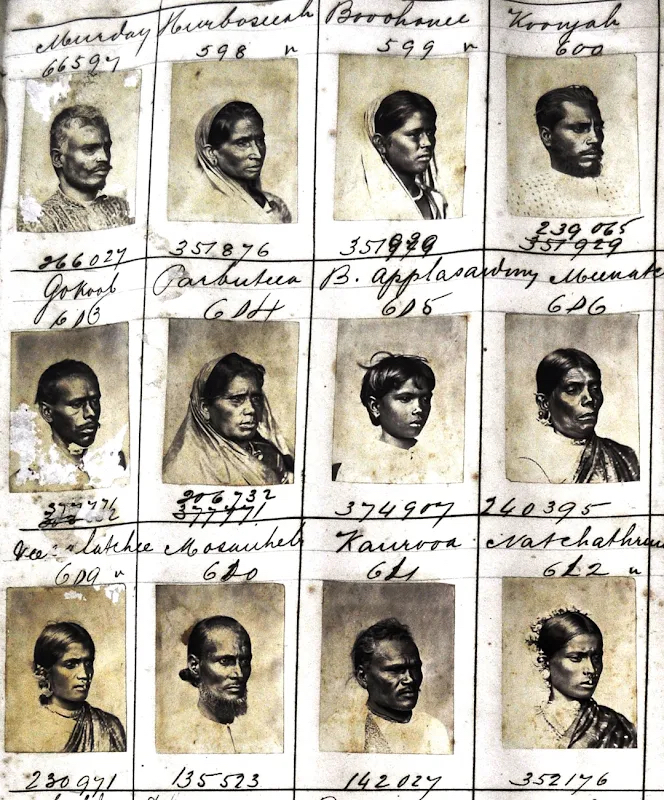
Records of Indentured Immigration
In 1834, the British Government selected the island of Mauritius to be the first site for what is hailed as the “Great Experiment,” which aimed to determine the viability of a new system of “free” labor to replace slavery. Close to half a million people from India, China, Madagascar, Southeast Asia and other parts of Africa were moved to the colony as indentured laborers.
The records document the establishment and management of Aapravasi Ghat, the first immigration depot outside India for the processing of immigrants. It sheds light on the role of women in African history, featuring their lives and labor in the Mauritian Records of Indentured Immigration.
© Mahatma Gandhi Institute
Courtesy the Mahatma Gandhi Institute
Later, in a seminar on nationalism, I began to notice colonial residues embedded in the English canon. In Mansfield Park, Mrs. Bertram casually asks her son William, bound for the East Indies, to bring her back an Indian shawl.[4] In The Tempest, Caliban, under Prospero’s rule, comes to understand that he has been fully absorbed into language’s system of naming, while remaining barred from the subject position that language promises. Empire hides in the margins of the text; political and “non-political” speech do not appear as opposites here, nor do secular and religious registers, which intertwine with each other in a narrative structure marked by continuous, tsunami-like disturbance. And in that low, anticipatory rumble of this disturbance, I come to recognize the grammar of domination—one that makes diaspora narratable while also exposing its limits. When language cannot fully contain a voice, identity ceases to be a fixed outcome and instead becomes something provisional—open to renegotiation, spoken under stress.
ii. Onde a terra acaba e o mar começa[5]
1492 is conventionally cited as the beginning of discovery; a more accurate account would call it the moment the world began to share breath—to trade air, disease, and myth. The Columbian Exchange was not merely ecological; it recalibrated Europe’s political imagination of world order. In its wake, the empire learned to justify itself through racial differentiation, increasingly grounding its legitimacy in racial differentiation rather than religious authority or pseudo-scientific explanation, assembling across the Atlantic a governing framework that divided the world into bodies rendered governable and rights made to appear natural. Power here was neither singular nor transparent, but a composite of administrative flexibility and hardened hierarchy. As colonial expansion advanced, the oceans became a vital infrastructure. By the late sixteenth century, the Manila galleons stitched Western Europe, the Americas, and East Asia into a fragile but decisive circuit. The triangular trade followed, binding Europe, Africa, and the Americas into a single economic chain, its middle passage carrying the dark pulse of Atlantic slavery and shaping the plantation logic of the New World. For centuries, the ocean functioned as the empire’s true territory: the Atlantic echoing Europe back to itself, the Indian Ocean reflecting Asia under colonial pressure, the Pacific held its distance, which served as the fearless adventurer’s exotic elsewhere—until distance itself was absorbed by capital.

Title page border and woodcut illustration by Hans Holbein the Younger from the 1518 edition of Thomas More’s Utopia, printed by Johann Froben
© The Trustees of the British Museum
Imperial ambition did not stop at maps; it seeped into writing. Although the empire was not the cause of the Renaissance, its practices furnished the background conditions of early modern knowledge: maps, travel narratives, and colonial reports. English literature of the period rarely staged the “exotic” directly; instead, it absorbed the world-scale of expansion as an unspoken premise. This non-representational logic can already be glimpsed in Thomas More’s Utopia. The ideal society positioned on the so-called New World presents itself as a satire of European reality, yet it quietly depends on imperial expansion as its a priori condition. Only after conquest and possession have been secured can order be imagined as reasonable, balanced, even humane. Critique, here, does not reach the structure itself; it is merely permitted to occur once the empire has finished its work. Montaigne, in “Of Cannibals,” appears to take a more contrary stance. By praising those people, whom he describes as living “in the sweet freedom of nature’s first laws,” he exposes the hypocrisy and violence of Western civilizational systems (Montaigne 2). Yet this posture never truly leaves the European position of looking. The Other remains fixed before a mirror polished by the West—understood, compared, and measured according to its surface. Its nakedness is not the absence of power but a condition conferred upon it: a rhetorical state, a temporarily suspended figure of humanity designed to complete the labor of critique. In other words, the Other does not step outside relations of power; it is repositioned within them, placed where it can be more easily moralized and consumed.
For centuries, literary engagements with the empire were largely affirmative. After the Second World War, decolonization and postmodern criticism allowed marginalized voices to enter the foreground, only to be rapidly reclassified—Third World, immigrant, or diaspora literature. Political discipline did not retreat; it changed its cartography. Vast regions were blackened and labeled as “hic sunt dracones.” Within it, writers who crossed borders were compelled to use imperial languages to articulate experiences of non-belonging. And when diaspora ceased to be merely the remnants of empire and became an active participant in global circulation, representation narrowed to a central tension: between being heard as Other and speaking at all.
iii. Outside the Whale[6]
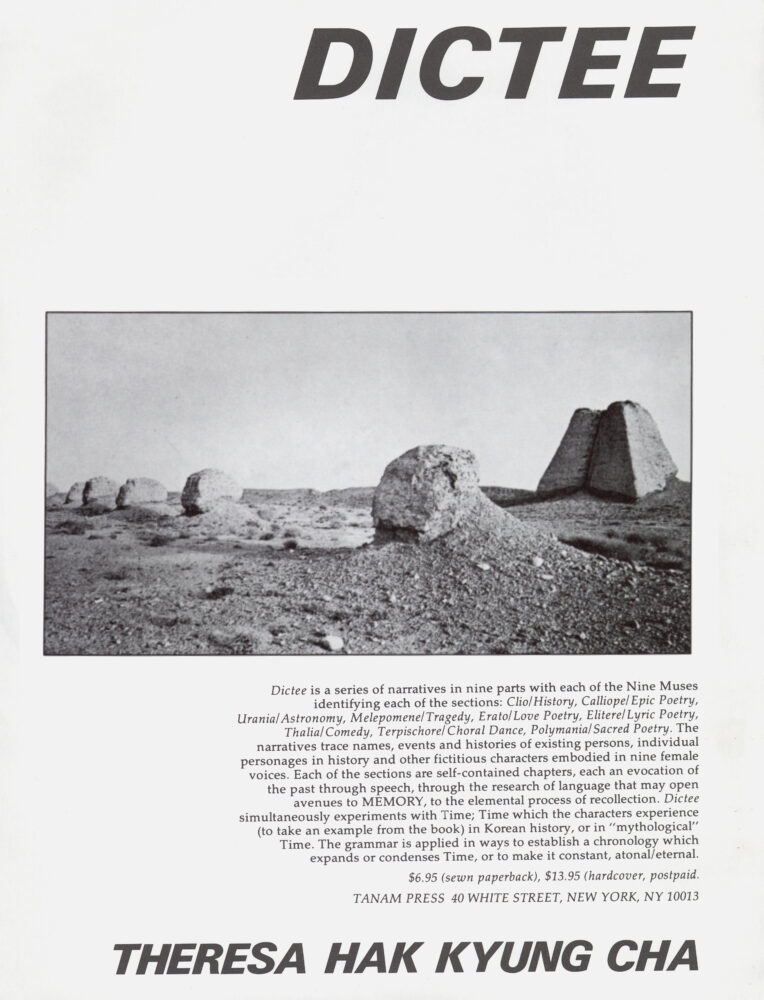
A 1981 broadside announcing the first publication of Dictee by Theresa Hak Kyung Cha from Tanam Press.
Courtesy the University of California, Berkeley Art Museum and Pacific Film Archive
My first encounter with what could genuinely be termed a diaspora text was Dictee, by the Korean American artist Theresa Hak Kyung Cha—a book that reads like an oracle written out of a wound. Its pain is restrained, almost mute, and precisely for that reason, difficult for academic discourse to approach. For more than a decade after its publication, Dictee remained largely peripheral to the core conversations of Asian American studies, as if its silence resisted institutional handling. Cha’s life—only thirty-one years long—forms a compressed chronicle of overlapping colonial regimes. Born in 1951 on the Korean peninsula fractured by war, she left at twelve with her family, fleeing the violence of the South Korean authoritarian state, first to Hawaii and later to San Francisco. Her parents had already been compelled under Japanese colonial rule to learn and work in the colonizer’s language for survival.[7] Migration to the United States did not end this linguistic disciplining but reconfigured it. At a Catholic high school, Cha was retrained within another system: French and English, grammar, prayer, and silence. As she entered a new institutional order, the previous one continued to sound, attenuated but persistent, in her parents’ accents. Language change here does not replace; it scars. It repeats itself across generations, marking the intersection of colonial history and migratory experience. Dictee opens precisely at this intersection,
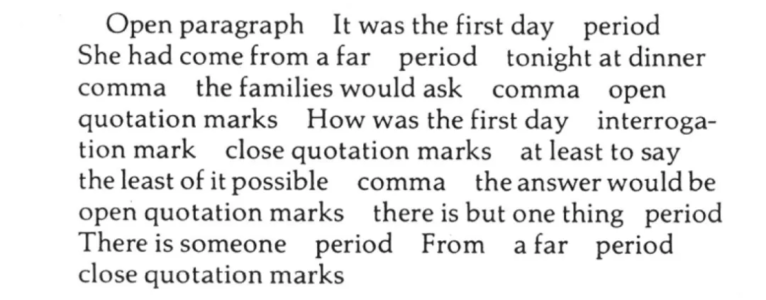
(Cha 1)
The narrator recites a passage in English and French, word by word, stripped of intonation, almost emptied of breath. Language is rendered mechanical, affectless, as if vocality itself had been evacuated. At first glance, this resembles pathological mimicry. Yet Cha deliberately amplifies obedience until it collapses into absurdity, and in doing so, drains it of its authority. In Dictee, when the mother tongue is compressed into silence, reading can no longer proceed as a linear reception. It becomes an act of searching, verifying, reassembling. Meaning flickers in the gaps between image and text, where “fact” appears not as origin but as provisional possibility. Within this highly symbolic imperial context, the text does not recover beginnings; it exposes the reader’s own desire to know how one is made. Muses, saints, and historical documents reveal their fictional status through misrecognition and error. Fragments cease to function as guarantees of identity. Instead, they mark the points at which collective memory fails. The text’s self-generation—its awareness, while writing, of its own instability—does not negate meaning; it collapses a narrow but operative space of resistance for private imagination.
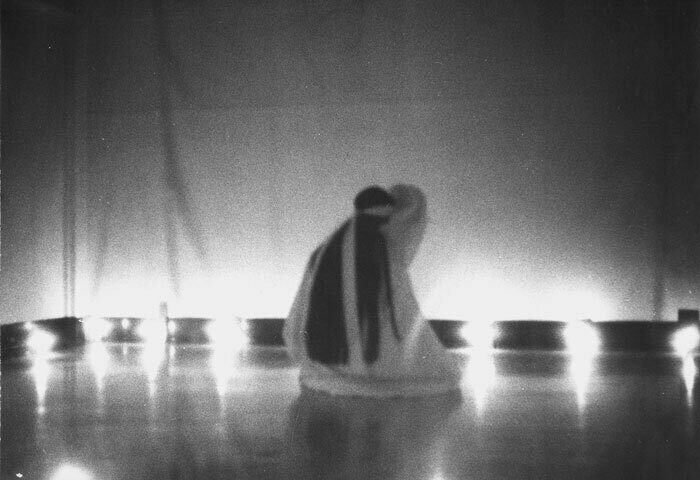
While Cha was a student at Berkeley, she worked in many mediums, including video and performance. The photograph documents A Ble Wail from 1975, performed at Worth Ryder Gallery. Cha constructed a space with mirrors, candles, and curtains made of cheesecloth, through which she moved wearing a white robe and over twenty meters of black and red cloth. In the accompanying text, she wrote, “In this piece, I want to be the dream of the audience.”
Photo: Trip Callaghan
Courtesy the University of California, Berkeley Art Museum and Pacific Film Archive
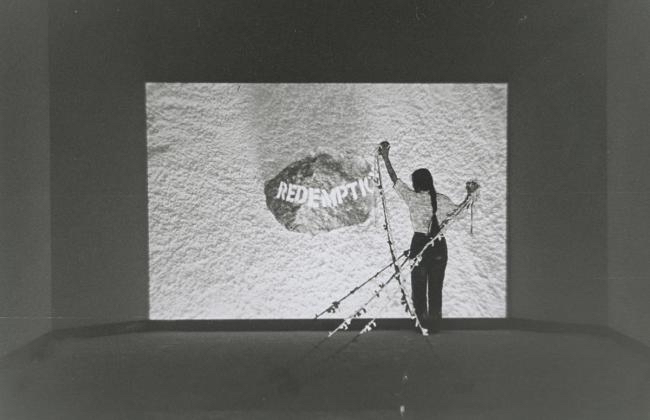
Theresa Hak Kyung Cha, Other Things Seen, Other Things Heard, 1978
Courtesy the University of California, Berkeley Art Museum and Pacific Film Archive
Gift of Theresa Hak Kyung Cha Memorial Foundation
If Dictee clarified for me how diaspora writing often resists genre, it was V. S. Naipaul who revealed the internal tension of diaspora literature itself. Editors who worked with Naipaul often remarked on his sharp temperament—hardly surprising to anyone familiar with his interviews. John Maxwell Coetzee and George Orwell carried similar reputations, and it is precisely writers of this stripe who have shaped me most deeply. Naipaul rejected Foucault as much as Barthes, genealogy as much as post-structuralism. He insisted on continuity over rupture, on identities formed through specific environments rather than the drift and indeterminacy of diaspora. For this, Edward Said famously condemned him as a “colonial renegade, a native informant for the Other” (Said 41). Yet the irony is unavoidable: the more fiercely Naipaul clung to certainty, the more sharply his work exposed the fractures borne by diasporic subjects.
Naipaul’s family history itself is composed of continuous displacement—from India to Chaguanas in Trinidad, from Port of Spain to England—identity fails at the moment of crossing water. As his brother Shiva Naipaul wrote, to cross the Kala Pani (Black Water) was to lose the Brahmin caste, requiring purification rituals for any imagined return (Naipaul 7-23)[8]. This repeated uprooting aligns Naipaul, unexpectedly, with Cha. Neither is ultimately concerned with diaspora as an identity; what they examine instead is the condition in which identity cannot fully take hold. Cha, in her semi-conscious, ritualized writing, constructs fleeting linguistic sanctuaries for the fallen of her nation. Naipaul, by contrast, summons the ghosts of history back into the text, laying bare the delicate, exposed interior of the colonized subject. This is most concentrated in A House for Mr Biswas, a novel modeled closely on the family’s indentured labor background.[9] The novel ceaselessly establishes the house as the prerequisite for existence itself. Without land, life resembles an unplaced birth and death, stripped of meaning (Naipaul 13-14). When ancestral houses vanish without a trace, Mr. Biswas turns obsessively toward building permanence (Naipaul 41). Yet this effort collapses time; the repressed past repeatedly intrudes upon the present. “Home,” commonly imagined as a stable site of belonging, is revealed instead as structurally disordered. Diaspora here is not only distance but contradiction, far enough to register loss, close enough to keep arrival endlessly deferred.
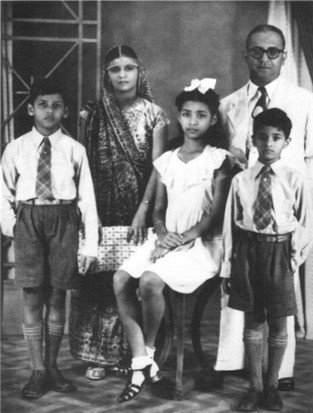
Simbhoonath Capildeo, uncle of V. S. Naipaul, and his family
© The Lion House Company Limited 2002
Courtesy the Lion House
And in Miguel Street, that dissonance—so intimate, so quietly wrenching—spills outward, folding into the lives of the street’s residents, each a finely etched figure in Naipaul’s sprawling, claustrophobic portrait of colonial intimacy and exposure,
A stranger could drive through Miguel Street and just say ‘Slum!’ because he could see no more. But we, who lived there, saw our street as a world where everybody was quite different from everybody else. Man-man was mad; George was stupid; Big Foot was a bully; Hat was an adventure; Popo was a philosopher; and Morgan was our comedian (Naipaul 407).
A House for Mr Biswas’s contradiction expands outward in Miguel Street. Here, homelessness is absorbed into daily life and normalized as a social condition. Naipaul calls the residents “romancers,” not in praise but as a diagnosis: figures immobilized within a colonial structure, their actions looping in Sisyphean, fruitless repetitive labor, for which fantasy becomes the only viable reality. Popo the carpenter boasts of “making the thing without a name”; Bogart obsesses over becoming a real man among men; The self-proclaimed “new Messiah,” Man-man, stages his public crucifixion, only to be confined under the guise of madness; B. Wordsworth constructs the illusory fame of being a poet, and then vanishes into silence; Uncle Bhakcu drowns in mechanical perfection, living within a self-imposed technical hallucination. Naipaul layers his cold satire atop relentless realism; they fight, they drink, they abuse, and yet dreams persist—cinemas, calypso—but departure rarely succeeds. Those who leave return burdened, disappear, or die. Only the unnamed boy-narrator escapes, watching his shadow before him, “a dancing dwarf on the tarmac,” he realizes not only his own smallness, but the projected nature of the world he leaves behind (Naipaul 502). Port of Spain, Miguel Street—these were never the center, only an image cast by the empire.
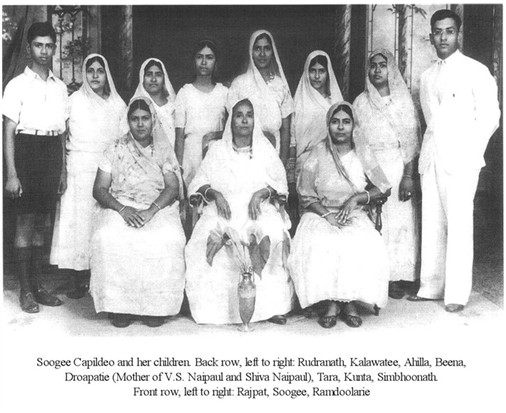
Soogee Capildeo, maternal grandmother of V. S. Naipaul, with her children (Dhan not shown).
© The Lion House Company Limited 2002
Courtesy the Lion House
When Naipaul later said in an interview, “I am not English, not Indian, not Trinidadian. I am my own person” (Naipaul 3), the statement is not made in haste, nor an attempt to correct others’ expectations of his identity. It is more like the marking of a boundary: when history has already been assigned its positions by empire, what remains for the individual is a form of possession reduced to its barest minimum. He returned, repeatedly, to the lands called his “homeland,” yet what he encountered was the unbridgeable gap between the emptiness of the homeland and the solidity of empire. It is in this context that the declaration, “I wanted to live outside history,” acquires its necessity (Coetzee 151). What the statement proposes is not erasure but cessation: a refusal to continue bearing history’s accumulated weight, to inhabit the assigned contours of identity, or to narrate the self in rhythms already prescribed.
Note:
[1] The organization’s philosophy stems from the 19th-century abolitionist movement and advocates the abolition of the prison-industrial complex.
[2] In terms of racial demographics, while Black Americans constitute 15.2% of the U.S. population, they represent approximately 38.2% of the prison population, making them the group most disproportionately impacted by mass incarceration. However, according to 2025 data from the Federal Bureau of Prisons, White inmates account for about 57.1%, and Hispanic inmates for approximately 30.7%. If one argues that the humanitarian concern for “incarceration” lies in categorizing it first, the underlying intention might have a slave-oriented tendency. Data source: https://www.bop.gov/about/statistics/statistics_inmate_race.jsp.
[3] The metre of “diaspora” is x / x x, four syllables, unstressed on the second.
[4] Although Jane Austen expressed admiration for the works of abolitionist Thomas Clarkson in her private correspondence, she often adopted an evasive stance toward “colonial” themes in her own writing.
[5] In the Portuguese national epic poem Os Lusíadas, it refers to Cape Roca, the westernmost point of the European continent. As the headland bordering the Atlantic Ocean for Portugal, it symbolizes the kingdom’s frontier in the poem, from which exploration and conquest set sail.
[6] In 1984, Salman Rushdie published his seminal essay “Outside the Whale” in Granta, arguing that contemporary writers could not remain inside the whale—isolated from history and politics, detached from realities. He wrote: “The modern world lacks not only hiding places, but certainties.”
[7] In 1943, during Japan’s colonial rule of the Korean Peninsula, the “4th Joseon Education Ordinance” was enacted. This ordinance abolished Korean-language education, prohibited the use of the Korean language, and promoted Japanese as the national language.
[8] Brahmin heritage is rooted in the late Vedic period of ancient India, evolving from Indo-European settlers in northern India. It is intrinsically linked to the Purusha Sukta and regarded as the “mouth of society,” symbolizing spiritual knowledge. As a prominent elite class within the Hindu caste system, Brahmins were regarded as the highest social stratum. Historically, they held exclusive rights to perform religious rituals and serve as priests, thereby establishing their pivotal role in both spiritual and political spheres.
[9] Following the abolition of slavery, Western colonies widely relied on indentured labor to sustain the plantation economy. Between 1837 and 1917, approximately 500,000 indentured laborers were transported to the Caribbean region until the system was formally abolished in 1917.
Work Cited:
Cha, Theresa Hak Kyung. Dictee, Minneapolis: Tanam, 1982.
Coetzee, J. M. Waiting for the Barbarians. New York: Penguin, 1980.
Montaigne, Michel de. Essais. Edited by Maurice Rat, vol. 1, Garnier,
1962. The Complete Essays of Montaigne. Translated by Donald M. Frame, Redwood: Stanford University Press, 1958.
Naipaul, Shiva, North of South, Budapest: André Deutsch, 1976.
Naipaul, V.S. A House for Mr. Biswas. Harmondsworth, Middlesex:
Penguin,1969.
Naipaul, V.S. Interview with Rahul Singh. “I’m not English, Indian, Trinidadian. I’m my own man: V.S. Naipaul.” The Times of India. 18 Feb. 2002, New Delhi ed:3.
Naipaul, V.S. Three Novels: The Mystic Masseur, The Suffrage of
Elvira, Miguel Street. New York: Knopf, 1982.
Said, Edward W. “Intellectuals in the Post-Colonial World.” Salmagundi 70-71 (1986): 41-46.
Arden Yang Xian is a writer and a New York State investigator. She has recently been engaged with the Pingyao Crouching Tiger Hidden Dragon International Film Festival and now works on projects at NEON, a New York-based independent film production and distribution company.