In the ink wash paintings of the American immigrant Yun-Fei Ji, the equivalent of nostalgia appears as the reflection and examination that follows the rejection of modernity, not as an aesthetic decision based on questions of cultural identity. His works bear the marks of his generation, as well as a critique of reality. Together, the…
Read More
If the title “Interweaving” is intended to convey a state of intermingling, then that is approximately the feeling that Li Qing’s solo exhibition ultimately gives the viewer: an encounter with intricate and gentle obscurities. At the very least, I am not able to use clear or precise words to summarize my sensations and feelings. To…
Read More
New York is one of those places that are meant for the birth of legendary art moments. “Taiping Tianguo” exhibits the artistic creations— all produced in New York in the 1980s— of four Chinese artists of different backgrounds. The show takes its name from the title of one of artist Martin Wong’s paintings (itself based…
Read More
Luxury Logico was formed in early 2010 by two artist collectives: Chang Keng-hau and Chang Geng-hwa’s Luxury and Ken Chen and Llunc Lin’s Logico. These four men, all barely in their 30s, together created the group’s foundation, utilizing their own respective specialties in terms of concepts and execution, ultimately orchestrating high-tech machine-software interactions to produce…
Read More
“Unclaimed Objects” features just that: a random assortment of bric-a-brac the young Fujianese artist Yang Jian found on the street, and then brought into the gallery to form this solo exhibition at Where Where Art Space. The modest collection of items in the show was collected between 2005 and the present. They range from the…
Read More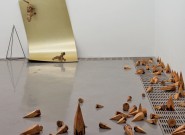
In line with the sculptor and installation artist Yang Xinguang’s predilection for referencing classical Chinese, the title of his third solo exhibition at Boers-Li originates in an excerpt from Journey to the West: “As the saying goes, the warrior avoids unnecessary combat; but once I start there’ll be no mercy.” Indeed, the works scattered throughout…
Read More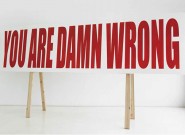
Liu Xinyi’s work is instantly recognizable from within the art environment of China today: an adeptness and integrity of the expression of form, subjects with a high degree of political sensitivity, and a (so far) clear continuity of a personal logic, with touches of obvious yet tempered slyness and dry humor. Liu’s first solo exhibition…
Read More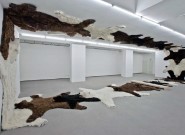
“Share, But It’s Not Fair” is Paola Pivi’s first solo exhibition in China. Her works focus on the power of images themselves, often emphasizing factors like number and size. Because of this, some media coverage employed terms such as “gimmicky” and “wasteful.” Though such skepticism may be simplistic and crude, it also reflects how contemporary…
Read More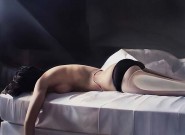
From 2008 onward, Song Kun began building a new internal reality, related to life but existing through images. This “realism” is alive in the world of her works. In contrast to real life, she weeds out the underbrush and preserves only what is real and essential, allowing the images to emerge transcendent and clear. Her…
Read More
The most eye-catching spectacle of Zhang Ding’s “Buddha Jumps over the Wall” can be found atop two monumental metal columns; a lean man, holding a knife and a gun, on a ritualistic platform such that to see him we have no choice but to look up. The subjects of video-looped “sacrifice” must either directly face…
Read More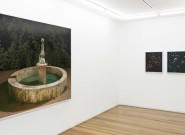
The word “more” is a word full of hunger. It is also a word many Chinese people associate with the American cigarette brand “More”— or “Mó’ěr,” its transliteration in Chinese. In the 1980s and 90s, these slim cigarettes were all the rage in China. A large contingent of teenage boys became fond of collecting the…
Read More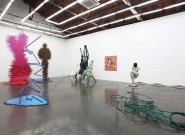
Zhao Yao’s latest solo exhibition, “You Can’t See Me, You Can’t See Me,” is an almost total replication of last year’s “I Am Your Night.” It would be easy to take this exhibition as one-time-only event, a disposable strategy; such an opinion would not be baseless. “You Can’t See Me” is a direct attack on…
Read More
The title of this year’s Manifesta, “The Deep of the Modern,” has three meanings. The first is related to the setting of the exhibition: the André Dumont coal mining complex in Waterschei, Genk, Belgi…
Read More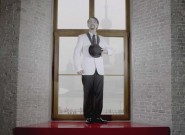
THE PERFORMANCE ARTIST Hu Xiangqian (b. 1983) is quick to point out that he does not agree with that classification. More appropriate, he claims, would be “performer” or “actor.” For one, his work is rarely prepared for a live audience, and furthermore, although he readily admits to have never studied, say, Jacques Lecoq or Jerzy…
Read More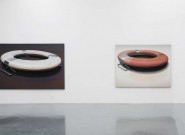
Seen at the studio or displayed inside a gallery, Zhang Hui’s works always possess the quality of connectivity; each artwork is a branch rooted in and growing from others. A section from one painting becomes the central image for another canvas; one square of color could determine the palette for the next work. These root-and-branch…
Read More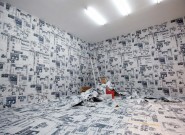
First, let us reproduce a scene from the eve of this exhibition, fleshed out, perhaps, with a bit of imagination. It is around midnight and you, an anonymous observer, have just checked into your hotel room, but are too impatient to wait until tomorrow to see the exhibition. So you decide to grant yourself a…
Read More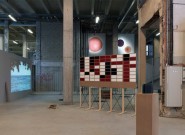
Once known as La Force de l’Art, the Paris Triennale was founded in 2006 by the Ministry of Culture as a showcase for French contemporary art. The previous two editions paraded a dependably bland selection of local wares through the center of the Grand Palais, but the anticipated international acclaim never materialized and La Force…
Read More
In 2011, Hans Ulrich Obrist, Shumon Basar, and Joseph Grima together proclaimed the establishment of “Posthastism.” In June 2012, their movement arrived to The Pavilion in Beiing in the form of a one-day exhibition titled “Beijing Posthastism.” Alongside film screenings and live performance, the three curators laid out the terms of “The Posthastist Manifesto,” calling…
Read More
IT WAS WHEN we found ourselves tone-deaf and with two left feet that we fell in love with noise. Since his performance at The WALL in June 2011, “Blackwolf Nagashi” has made converts of music fans of all stripes in Taipei. With the release of his debut album Blackwolf Nagashi in Bedroom in May 2012,…
Read More
In Taiwan, noise is a surplus of culture. It began with a generation of well-to-do youth, and ended with that same generation. The discussion of the history of noise in Taiwan likely dates back to sometime around 1994, to the experimentation, rebellion, political collision, media-ization, intimate gatherings, and festivals with which that period was saturated….
Read More