In China, the development of sound art stretches back 15 years (from another perspective, we could perhaps adjust this figure to 12 years; see below). This, in spite of the fact that sound art still occupies a misunderstood and marginalized position (in this respect, media art isn’t much different). However, there are already enough people,…
Read More
In the 1980s, of course, no one talked about art spaces. Sure, artists intervened in the public realm, looking to bend it to their purposes. And of course there were always institutions, and the logic of coopting them for newer, bolder purposes was a motivation that then, as now, loomed large. (Look no further than…
Read MoreA particular and much remarked upon characteristic of the Chinese art scene is the hyper-commercialized, gallery-based system. By and large an import from the West, the Chinese gallery system over the last ten years has swiftly matured, serving as an important point of connection between Chinese artists and the outside art worlds. For better or…
Read More
[portfolio_slideshow timeout=7000 exclude=”5167,5171,5503″] A BRIEF HISTORY OF SPACE Art spaces in China have evolved the hard way, through a long process of selection and replacement. We look at some of the places and people who have made this happen. BACK IN THE DAY: ALTERNATIVE SPACES IN THE EARLY YEARS LEAP chats with some of the…
Read More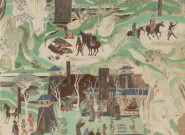
The Chinese name for the material consists of the characters for “cliff” and “color.” The Japanese call this material iwae and the Taiwanese call it jiaocai. By any name, its is a compelling story of an ancient skill, its transmission out of and back to China, and its somewhat awkward attempt to find a place in art today.
Read More
Chen Xiaoyun’s enigmatic videos have defied critical interpretation for the better part of a decade, and inspired a younger generation of artists to veer experimental. A recent solo show at the Beijing branch of ShanghART Gallery showed him to be refining his concerns even further, externalizing an internal hysteria that runs just below the surface of Chinese society.
Read More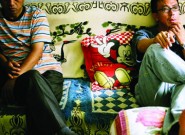
The little town of Jincheng is built around a paper mill. The mill, erected in 1939, has survived many periods—from the Japanese occupation to the civil war to the Cultural Revolution. It was first called Jinzhou’s “Barbu” Co. Ltd. and then went through a string of names as a state-run Jinzhou paper mill, before finally ending on its current name:…
Read More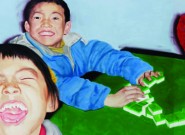
Inside the Chinese art world, people tend to think of the Sichuan artists (which we should define as those coming from the southwestern area of China centered on Chongqing and Chengdu) as belonging to a tight, perfectly ordered community. This impression might initially come from their easily recognizable accents and common love of hot pot—a shared sensorium based on a rich,…
Read More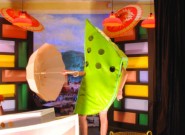
Characterized by a reflective architecture of glass and steel and culturally dominated by a visually rich cinematic tradition that merges seamlessly with tourism marketing, Hong Kong does not lack for specular images of its urban core. In the now-classic films of Wong Kar-Wai and John Woo, the surface of the city emerges primarily through textural definition: the sweaty glint of neon…
Read MoreZhang Ding produces intriguing art, which he then dismisses with a gentle smile as “having no meaning.” He does acknowledge that his work should induce a “strong feeling,” but never lets on exactly what sort. In China as elsewhere, artists often avoid explaining their works, affecting a simple nature in order to protect their ideas. Yet even against this background of…
Read MoreThe first thing Zhou Bin did after he had ended his sojourn in the Beijing artists’ villages of Yuanmingyuan and Songzhuang and settled in Chengdu in 1998 was stage a performance. For this work, titled Historical Watermark, he used river water to wash a human form (or perhaps that of the Buddha) onto a stretch of old city wall slated…
Read More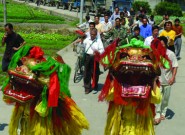
1 Almost every Fujianese family has a child who has left home to find work. In New York, only the Fujianese mafia competes with the Sicilian. In Europe, Fujianese farmers exploit Westerners’ worship of organic produce, substituting Oolong tea for red wine and selling shoes made in Jinjiang, Putian, and Fuzhou in the process. In the world of art, Fujianese…
Read More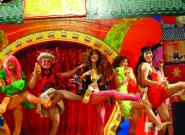
The contemporary art world’s concept of the “Guangdong artist”—emerging from the haze of the growing Pearl River Delta cities of the mid-1990s, flourishing through the first years of the new century, and fading as the entire ecology of the art world grew, enticing many of those with whom the designation was initially associated to move north toward the end of the…
Read More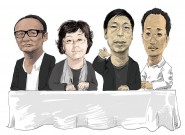
Symposium on “The Borders of Art” DATE: 2010.5.30 / LOCATION: CENTRAL ACADEMY OF FINE ARTS MUSEUM, VIP LOUNGE Held in conjunction with “Pan Gongkai Conceptual Art Exhibition” FROM LEFT PAN GONGKAI Art theorist and educator; President, China Central Academy of Fine Arts (CAFA) ZHU QINGSHENG Professor of Art, Peking University AN YUANYUAN Director, Art and…
Read More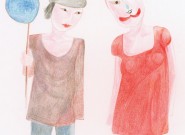
Simon Kirby had just called in a food delivery. Kirby, director of the gallery Chambers Fine Art Beijing, was sitting in the Ai Weiwei-designed gallery courtyard out in Caochangdi on a summer afternoon, plotting an exhibition with his visitors. He asked Yangzi about the origins of their group, the Wangjing Painting Society (WPS). Then Dong…
Read More[portfolio_slideshow timeout=7000] History has abandoned time, we have lost our souls. Magicians This world lacks a clear concept of time; we live in emptiness. Right and wrong are confounded! There are no laws, no rules. Lies dominate! Here there are only the cheaters and the cheated. I am a formerly great prognosticator. These days, I practice as a magician, wearing a…
Read MoreQIU XIAOFEI & HU XIAOYUAN Qiu Xiaofei and Hu Xiaoyuan have been living together for fifteen years now. Best not to think about how long it’s been, Hu says. “It gets scary.” They grew up with no access to computers, and didn’t find out about the Internet until after university. Today, Qiu has little faith in digital images. The aversion…
Read More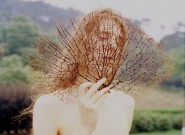
[nggallery id=3]
Read MoreA China Youthology x LEAP Special Report For over two years, China Youthology conducted an ongoing study of China’s young people. They are a generation affected by the Internet, a rapidly developing economy, a transforming social structure, the onset of globalization, and the arrival of consumer culture. There are a lot of changes going on. That’s true for China’s youth. What…
Read MoreWhenever the topic of “art youth” comes up, many are eager to throw cold water on it. Some keep quiet, reflecting on the now seemingly unfounded optimism and heedless idealism of earlier generations, while others, reacting more to a current situation, fear that the young can only become pawns in someone else’s chess match. This…
Read More